
How Gulf Coast Salt Air Destroys AC Units in Panama City Beach (And How to Stop It)
Short answer: Salt air destroys air conditioners through galvanic corrosion — airborne chloride forms a salt electrolyte that accelerates a reaction between the copper tubing and aluminum fins of the outdoor condenser coil. The result is aluminum fin degradation: pitting, powdery white oxidation, and collapsed fins that choke airflow and leak refrigerant. In Panama City Beach, an unprotected coil can fail in 6–10 years versus 15+ inland. A factory E-coated (coastal-rated) coil plus regular rinsing is the fix.
| Outdoor coil setup (coastal home) | Typical lifespan* | Primary failure mode |
|---|---|---|
| Standard bare aluminum-fin coil | 6–10 yrs | Galvanic corrosion → aluminum fin degradation → refrigerant leak |
| Standard coil + monthly coil rinsing | 8–11 yrs | Slows chloride attack, does not stop it |
| Factory E-coated / "blue-fin" coil | 12–15 yrs | Coating outlasts bare fin; cabinet & fasteners corrode next |
| E-coated coil + stainless hardware + annual maintenance | 15+ yrs | Approaches inland lifespan |
*Representative ranges for a Panama City Beach / 30A coastal home with regular maintenance, consistent with Quincy's field data below.
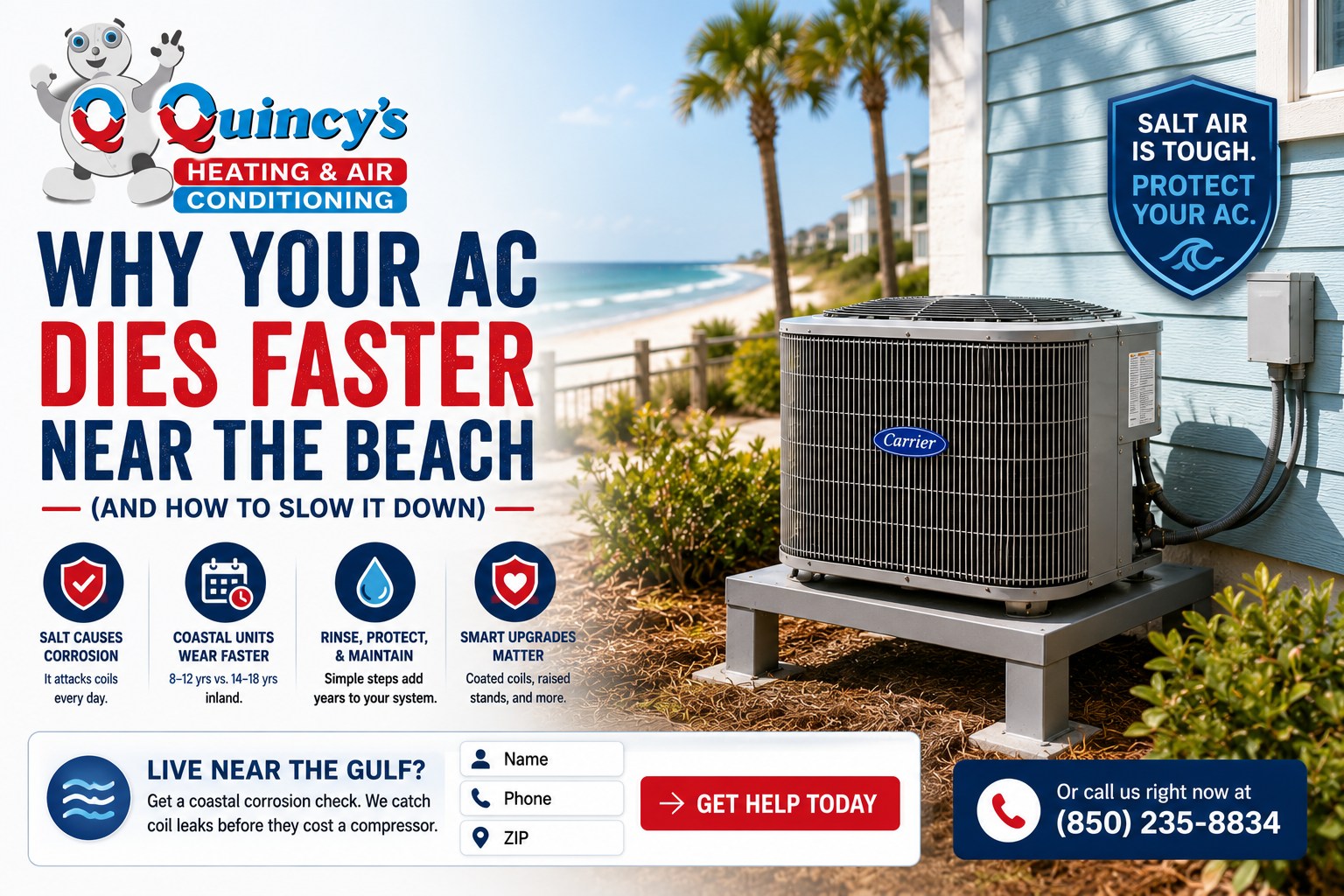
If you live in Panama City Beach, Inlet Beach, Carillon, or anywhere along 30A within a couple miles of the Gulf, here is something you probably already feel: things wear out faster here. Patio furniture rusts. Door hinges seize. Outdoor electronics fail. And your AC dies a few years sooner than it would in Chipley or Tallahassee.
The reason is salt. Salt is in the air, in the dew, in the breeze. It settles on metal. It accelerates corrosion. And the most exposed metal you own is probably the outdoor coil of your AC.
| Protection | Cost | Years added | Worth it? |
|---|---|---|---|
| Factory coated (e-coat / blue fin) outdoor coil | +$300 to $700 on install | +3 to 5 years | Yes, every time |
| Raised stand mount (above slab) | +$150 to $300 on install | +1 to 2 years | Yes, on coast |
| Twice-yearly maintenance (Quincy's plan) | $292 / year | +3 to 4 years | Yes, always |
| Owner does coil rinse monthly | Free | +1 to 2 years | Yes, easy |
| Year-round unit cover | $50 to $150 | Negative | No, traps moisture |
| Aftermarket coil coating spray | $200 to $500 | +1 year | Marginal |
Live within a couple miles of the Gulf?
Get a coastal corrosion check. We catch coil leaks before they cost a compressor.
What Salt Air Actually Does to Your AC (Galvanic Corrosion Explained)
Your outdoor unit has a coil made of copper tubes wrapped in aluminum fins. That coil dumps the heat your AC pulled from inside the house. The copper carries the refrigerant. The aluminum fins help heat transfer.
Salt does two things to this:
- Galvanic corrosion. Aluminum and copper touching each other in the presence of salt water creates a tiny battery. The aluminum corrodes much faster than it would on its own. Pinholes form in the fins. The contact between fin and tube weakens. Heat transfer drops.
- Direct corrosion. Salt accelerates oxidation of bare copper. Copper coils develop pinhole leaks at weak points, often where the tube curves or where vibration concentrates.
Why the fins go first. Galvanic corrosion is electrochemical: when two dissimilar metals — copper and aluminum — sit in contact and a conductive electrolyte (salt plus humidity) bridges them, the more reactive metal corrodes preferentially. On a coil, that is the aluminum fin. This means the fins, not the copper, dissolve first. The white, chalky buildup you see on a coastal condenser is aluminum fin degradation, and once the fins crumble the coil cannot shed heat — the system runs longer, hotter, and eventually leaks.
Galvanic vs. formicary corrosion — what is actually happening
Two different processes get blamed on "salt." Galvanic corrosion is the dissimilar-metal reaction above and is the dominant coastal problem on the outdoor coil. Formicary corrosion ("ant-nest" corrosion) is different — it is driven by organic acids rather than chloride and tends to pit copper tubing from the inside, often on the indoor evaporator coil. For Gulf-front homes in Panama City Beach, galvanic corrosion and direct chloride attack on the outdoor unit are what shorten system life the most.
The result: a system installed in PCB on a regular contractor coil might leak refrigerant in 7 to 10 years. The same system in Tallahassee can run 14 to 16 years on the same parts.
How much faster do coastal units fail?
Here is roughly what we see in the field, all else being equal:
- Inland Florida (more than 5 miles from saltwater): 14 to 18 year system life with regular maintenance
- Bay area, near salt water but sheltered: 12 to 14 years
- Coastal Panama City Beach, 30A, Gulf-front homes: 8 to 12 years
- Beachfront with no protection: as low as 6 to 8 years on a coil that was not coated
This is one reason we hate when an out-of-area contractor sells someone in PCB the same system they would sell in Atlanta. It will not last as long, and the customer feels burned when it fails early.
What Is an E-Coated (Coastal-Rated) Coil — and Is It Worth It?
An E-coated coil (also sold as "epoxy-dipped," "blue-fin," or a "seacoast" package) is a condenser coil dipped in a flexible epoxy polymer that seals the aluminum fins and copper tubing from the salt electrolyte. The coating is what stands between the metal and the chloride, so the galvanic reaction slows dramatically. Manufacturers rate these coatings with the ASTM B117 salt-spray test — quality coatings survive thousands of hours of accelerated salt exposure.
Is it worth it on the coast? For a Panama City Beach home within a couple miles of the Gulf, almost always yes. A factory E-coat typically adds $300 to $700 to an install and buys several years of coil life — far cheaper than the compressor or full system it protects. Unlike a year-round equipment cover, which traps moisture and makes corrosion worse, an E-coated coil protects the metal without holding salt against it. We quote a coastal-rated coil by default on coastal AC installation in Panama City Beach.
How to Stop Salt-Air Corrosion (What Actually Works)
You cannot eliminate the salt. You live where you live. But these things make a real difference:
- Wash the outdoor coil regularly. A garden hose, gentle stream, from outside in. Salt stays on the fins until you wash it off. Once a month in summer is not crazy if you are within a quarter mile of the water. Always cut the breaker first.
- Get coated coils on your next install. Most major manufacturers offer factory coil coatings (sometimes called "blue fin," "e-coat," or similar) that significantly slow corrosion. We always recommend these for coastal homes.
- Elevate the unit. Set the condenser on a stand instead of the slab. Higher up means less salt spray reaches the coil during high winds and surf. Also helps with hurricane flooding.
- Twice-a-year maintenance. Yes, again. Our techs catch corrosion early, often before it leaks, following the same core maintenance checklist the DOE recommends, just more frequently. $292 a year for a single system.
- Cover with a hurricane cover, not a year-round cover. Year-round covers trap moisture against the unit and accelerate corrosion. Only cover during a storm.
Things to ask for on a new install
If you are getting quotes for a new system on the coast, ask every contractor about these:
- Coated outdoor coil (factory or aftermarket)
- Raised stand instead of pad-direct
- Stainless or coated outdoor screws in the cabinet (a small detail that adds up)
- Drain line layout that handles peak humidity without backups
- Float safety switch on every drain pan
These are not exotic upgrades. They are what should be standard on a coastal install. We include them on ours. More on how we install.
Live near the water?
If your system is over 7 years old and on the Gulf coast, ask us to do a corrosion check. We catch most coil leaks before they cost you a compressor.
📞 Call (850) 235-8834Frequently asked questions
What is galvanic corrosion in an AC unit?
Galvanic corrosion is an electrochemical reaction between two dissimilar metals — the copper tubing and aluminum fins of your outdoor coil — in the presence of a salt electrolyte. The aluminum fin corrodes first, producing the white, powdery buildup (aluminum fin degradation) seen on coastal condensers. It is the main reason AC coils fail faster in Panama City Beach than inland.
How long does an AC last in coastal Florida?
8 to 12 years on the Panama City Beach / 30A coast with maintenance. Inland Florida systems often last 14 to 18 years on the same maintenance. Beachfront homes without coil coatings can fail as early as 6 to 8 years.
What does salt air do to an AC unit?
Salt accelerates corrosion. Aluminum fins develop pinholes. Copper coil tubes get pinhole leaks. Refrigerant escapes. The system loses cooling, freezes the coil, and eventually kills the compressor.
Should I cover my outdoor AC unit?
Only during a hurricane. A year-round cover traps moisture against the unit and causes MORE corrosion than the salt air would. Take it off as soon as the storm passes.
How often should I rinse my AC outdoor coil?
Once a month in peak summer if you are within a quarter mile of the Gulf. Once every couple months otherwise. Use a garden hose, gentle stream, from outside in. Turn the breaker off first.
Are coated coils worth it on a new AC install?
On the coast, absolutely yes. A factory e-coat or blue fin coil adds 3 to 5 years of life for $300 to $700. That math is in your favor every single time.
What brand of AC lasts longest in coastal Florida?
Brand matters less than the install and the coating. We have seen Carrier, Trane, Lennox, Rheem and Goodman all run great with proper coastal install practices, and we have seen all of them fail early without them.
How can I tell if my outdoor coil is corroding?
Look for white powder or dark green oxidation on the aluminum fins. Bent, crushed or missing fins. Oily residue (a sign of refrigerant leaking through corroded copper). We check this on every spring maintenance visit.
Is salt air bad for HVAC equipment?
Yes. Coastal salt air is one of the harshest environments for HVAC anywhere in the country. The combination of salt, humidity, and year-round run time chews through outdoor units faster than almost anywhere else in the US.
Who installs salt-rated AC systems in Panama City Beach?
We do. Quincy's has been installing systems on the Emerald Coast since 1979. We always quote coastal-rated coils and elevated mounts. Call (850) 235-8834.