
How to Choose an HVAC Contractor in Panama City Beach: A Homeowner's Checklist
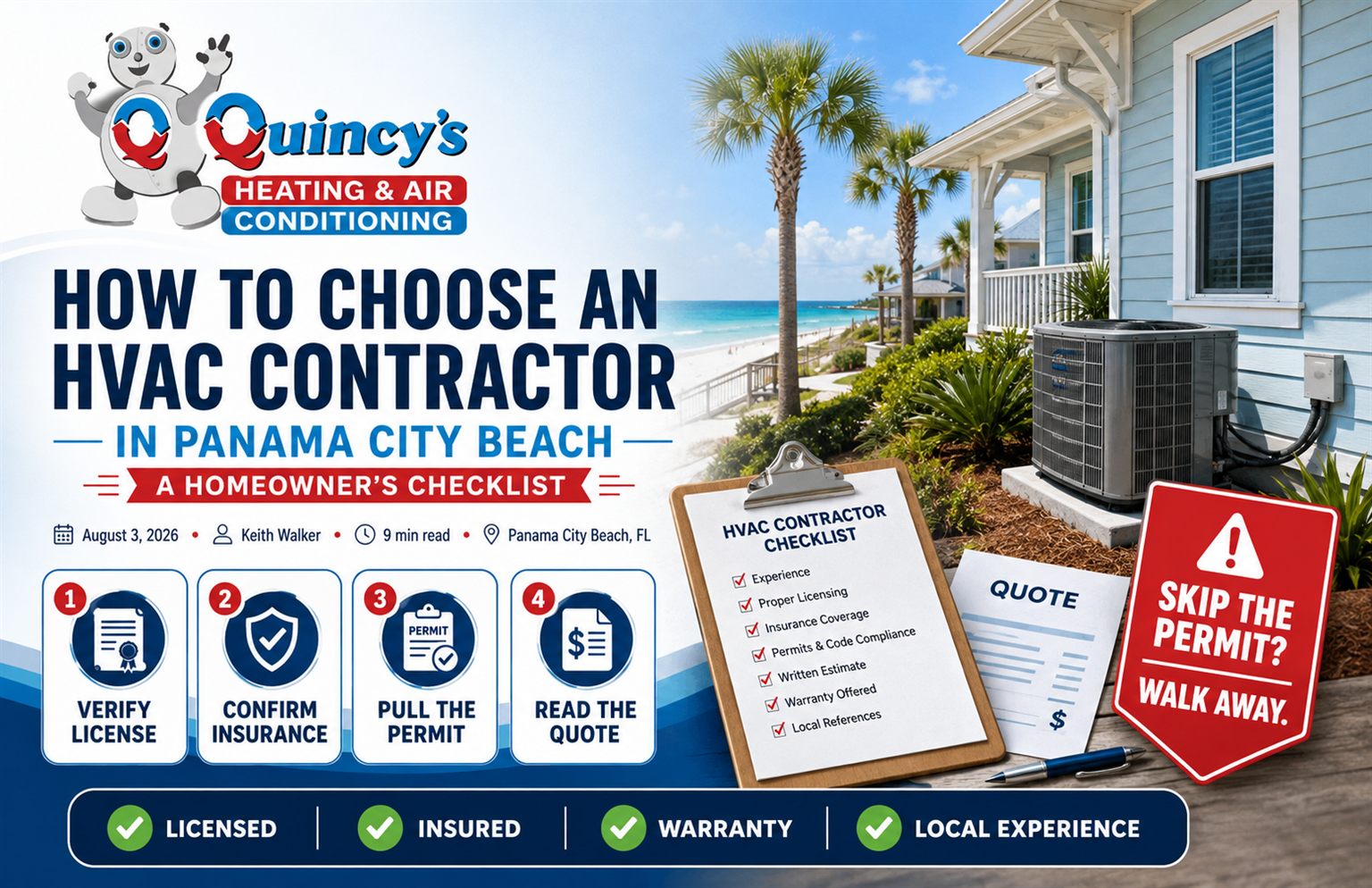
To choose an HVAC contractor in Panama City Beach, verify the Florida license on the state DBPR site, confirm general liability and workers compensation insurance, insist on a permit for any system changeout, and read the quote line by line. Anyone who resists those four steps is telling you something useful.
This guide is written to be useful even if you hire somebody else.
- Verify the license yourself. The Florida DBPR search is free and takes two minutes.
- Workers compensation protects you. An uninsured injury on your property can become your problem.
- A changeout needs a permit. Anyone offering to skip it is dodging the inspection.
- Ask who registers the manufacturer warranty, then get confirmation.
- The lowest bid is usually the shortest scope. Compare line items, not totals.
How do you verify an HVAC contractor license in Florida?
Florida licenses air conditioning contractors at the state level through the Department of Business and Professional Regulation. Look any company up for free at the DBPR license search, by name or by the number on the truck.
Three things matter on the results page. The status should read current and active. The license type should cover air conditioning. The name on the license should match the company billing you.
That last one catches the most problems. Unlicensed operators sometimes work under a license held by somebody who left years ago. If a name nobody mentioned comes back, ask why.
What the CAC license prefix means
CAC is a Class A air conditioning contractor, covering HVAC work with no capacity limit. CMC is a mechanical contractor, a broader license that includes the same work. Either is legitimate for a house.
The digit matters too. CAC1 is state certified and valid anywhere in Florida. CAC0 is registered, valid only where it was issued. Registered is not a red flag by itself, but a license registered three counties away is worth a question.
Anyone opening a sealed refrigerant system also needs an EPA Section 608 certification, a federal technician credential separate from the company license.
Why do liability insurance and workers compensation matter to you?
Homeowners treat insurance as the contractor's paperwork problem. It is yours the moment something goes wrong.
General liability covers damage the contractor causes: a punctured water line, a foot through the ceiling, a condensate line routed into a wall cavity. Without it, your options are their bank account or a lawsuit.
Workers compensation quietly matters more. Florida requires construction employers to carry it from the first employee. If an uninsured worker falls out of your attic, the medical claim can end up aimed at your homeowners policy, and many policies exclude injuries to uninsured workers hired for construction at the property.
Ask for a certificate of insurance sent directly from the insurance agent, with your name as certificate holder. A PDF forwarded by the contractor is easy to edit. One that arrives from the agency is not.
License and insurance verification checklist
| What to verify | Where to check it | What good looks like | Walk away if |
|---|---|---|---|
| State license | DBPR, myfloridalicense.com | Current and active, CAC or CMC | No record, or expired |
| Name on license | Same search result | Matches the company on your estimate | An unrelated business |
| General liability | Certificate from the agent | Current dates, you as holder | They will not provide one |
| Workers compensation | Same certificate, or exemption | Active coverage for the crew | "They are subs, not my problem" |
| EPA 608 certification | Ask the technician | Held by whoever touches refrigerant | Nobody on the truck has one |
| Physical local address | Invoice, website, Google profile | A street address you can drive to | PO box only, or none |
| Permit history | Bay County building department | The company pulls permits routinely | They offer to skip the permit |
Want a second opinion on a quote you already have?
Drop your number. We'll call back within minutes during business hours.
Do you need a permit to replace an AC in Panama City Beach?
Yes. A full system changeout is permitted mechanical work here, and the contractor pulls the permit under their own license. You are not the one filing paperwork.
What the permit buys you is an independent set of eyes. The electrical, the disconnect, the equipment tie-down and the condensate routing all get inspected. On the coast the tie-down is not a formality. It is why your condenser stays on its pad in a storm.
So when someone offers to skip the permit and knock a couple of hundred off, understand the trade. They are avoiding an inspection of their own work and handing you an unpermitted system that surfaces at resale, a storm damage claim that is harder to argue, and no record that the install met code.
A contractor who pulls permits unprompted is showing you their work survives inspection.
Who registers the manufacturer warranty on a new system?
The contractor should, and you should confirm they did.
Most equipment ships with a base parts warranty of around five years. Register the serial numbers inside the manufacturer's window, commonly 60 to 90 days from installation, and that typically extends to ten years on parts. Miss it and you keep the shorter term, which homeowners discover in year seven when a coil fails.
Nail down three things before the truck leaves: who files the registration, when you will see confirmation, and whether the labor warranty is separate. Ten years on parts with one year of labor still means paying a technician in year four.
Get the model and serial numbers in writing. If the company disappears, those numbers let anyone else file your claim.
What are the HVAC red flags worth walking away from?
Most contractors here are honest. The ones who are not run the same few plays, hardest in August when the house is 85 degrees and you want it over with.
Pressure to decide immediately is the big one. A price that is only good today is a sales tactic. Equipment pricing does not change between Tuesday and Thursday.
A replacement recommendation without a diagnosis is the other. If someone reads the data plate and leads with a new system before putting a meter on anything, they diagnosed your age bracket, not your air conditioner.
Refusing to show you the failed part tells you plenty. A bulging capacitor or a pitted contactor is visible, and any technician should be glad to hand it over.
Cash only pricing means no invoice and no warranty trail. No physical local address means nobody to find in eighteen months. A quote far below everyone else is a shorter scope, not a better deal. And vague scope wording is the one people miss: if the paperwork says "system replacement" and stops, you have not agreed on what you are buying.
| Situation | Green flag | Red flag |
|---|---|---|
| Timing | "Get another bid, take a few days" | "This price is only good today" |
| Diagnosis | Names the failed part, shows readings | Recommends replacement before testing |
| The old part | Hands it over, explains the failure | Already in the truck, not shown |
| Payment | Card, check or financing, with an invoice | Cash only, large deposit up front |
| Business presence | Street address, local number | Magnetic door sign, out of area |
| Pricing | Within a normal spread, itemized | Thousands below everyone, one line item |
| Scope wording | Models, tonnage, SEER2, what is included | "Install new AC system" and nothing else |
| Permits | Pulls it without being asked | Offers to skip it to save you money |
What should a proper HVAC quote itemize?
You cannot compare two quotes that describe the work differently. That is why the cheapest number so often wins and so often disappoints. It is not a better price for the same job, it is a different job.
A quote does not have to be a legal document. Ours can be verbal and approved on the spot when a system is down. Either way, you should be able to repeat back what is in it.
| Item | A complete quote says | A vague quote says |
|---|---|---|
| Equipment | Brand, model number, tonnage, SEER2 | "New high efficiency system" |
| Indoor unit | Matched air handler or coil, model listed | Silent on the indoor half |
| Sizing basis | Load calculation performed when necessary | "Same size as the old one" |
| Line set | New, or flushed and reused, stated | Not mentioned |
| Electrical and pad | New disconnect, whip, pad, hurricane tie-down | Not mentioned |
| Condensate | New drain, safety switch, secondary | Not mentioned |
| Permit | Permit and inspection included in the price | Not mentioned, or "not needed" |
| Old equipment | Removal and disposal included | Left for you to deal with |
| Warranties | Parts term, labor term, who registers it | "Fully warrantied" |
| Total | One number, taxes and fees stated | A number that grows on invoice day |
Ask for a safety switch on the condensate line specifically. We put one on every install. It shuts the system down before a clogged drain finds your ceiling.
Still deciding between fixing and replacing? Our guides to what AC repair actually costs in Panama City Beach and when to replace your AC versus repair it give you numbers to hold a quote against.
What questions should you ask an HVAC contractor?
Keep these on your phone. Ten minutes of questions beats any review.
- What is your Florida license number? Look it up while they are standing there.
- Is it certified or registered? And is the holder still with the company?
- Can your agent send me a certificate of insurance? Liability and workers compensation both.
- Are the technicians employees or subcontractors? Subs need their own coverage.
- Will you pull the permit? If not, ask why not.
- What exactly failed, and can I see it? On a repair, that is the conversation.
- Is the part still under manufacturer warranty? You may only owe labor.
- How did you arrive at the size? Like for like is a start, not an answer.
- What is included and what is extra? Line set, pad, disconnect, drain, permit, disposal.
- Who registers the warranty, and what is the labor term?
- How long have you worked on this coast? Salt air experience is not interchangeable with inland experience.
None of these are trick questions. A good contractor answers every one without getting defensive.
Why local matters when you choose an HVAC contractor in Panama City Beach
Local is not sentiment here. It changes the equipment recommendation.
Salt in the air attacks the aluminum fins and copper tubing on an outdoor coil, and it works on the electrical contacts inside the disconnect and contactor. A condenser a few blocks from the Gulf ages faster than the identical unit in Chipley, and the closer to the water, the sharper the difference.
A contractor who works this coast every day accounts for that. Coastal coils are standard options within the selections we offer, and choosing one on a beachfront home is a different call than on a house ten miles inland. So is pad height on a low lot.
Someone driving over from two counties inland quotes the same box everywhere. Our page on AC service in Panama City Beach covers that, and what to look for in a recommended AC repair company goes deeper on repair work.
Where we stand on our own checklist
Fair is fair, so run us through it. Quincy's has been family owned since 1979, which is 47 years on the same stretch of coast. We are licensed and insured, and the license number sits in the footer of every page here, so you can check it without asking us. We hold 4.8 stars across 173 Google reviews, and we do not do hard sales.
Our AC repair service page explains how we work, and you can get in touch here. If you hire someone else, use the checklist anyway.
Want a straight second opinion?
Send us the quote you have. We will tell you what is missing from it, even if you go with them. No hard sales.
📞 Call (850) 235-8834Frequently asked questions
How do I verify an HVAC contractor's license in Florida?
Search the company name or license number on the Florida DBPR site at myfloridalicense.com. You want a status of current and active, a license type covering air conditioning, and a business name matching the company on your quote. The search is free and takes two minutes.
What does the CAC prefix on a Florida HVAC license mean?
CAC is a Class A air conditioning contractor license, covering HVAC work with no capacity limit. CMC is a mechanical contractor license, a broader category including the same work. A number starting CAC1 is state certified and valid statewide. CAC0 is registered and valid only where issued.
Why does workers compensation insurance matter to me as the homeowner?
If an uninsured worker is hurt in your attic or on your roof, the medical claim can end up pointed at your homeowners policy, and many policies exclude it. Florida requires construction employers to carry coverage from the first employee. Ask the agent to send the certificate directly.
Do I need a permit to replace an air conditioner in Panama City Beach?
Yes. A full system changeout is permitted mechanical work in Bay County and Panama City Beach, and the contractor pulls it under their own license. The permit brings an independent inspection of the electrical, the tie-down and the condensate work. Anyone who skips it is avoiding that inspection.
What are the biggest red flags when hiring an HVAC contractor?
Pressure to sign today, a replacement recommendation made before any diagnosis, refusing to show you the failed part, cash only pricing, no physical local address, and a price far below every other bid. Vague scope wording is the quiet one: if the paperwork says system replacement and stops, you do not know what you are buying.
Should I always take the cheapest HVAC quote?
No. A bid thousands below the others is usually missing something rather than being generous. Common omissions are the permit, a new line set or flush, a matched indoor coil, a new pad and disconnect, and haul away of the old unit. Compare line items before totals.