
AC Repair Cost in Panama City Beach: What You Should Actually Pay
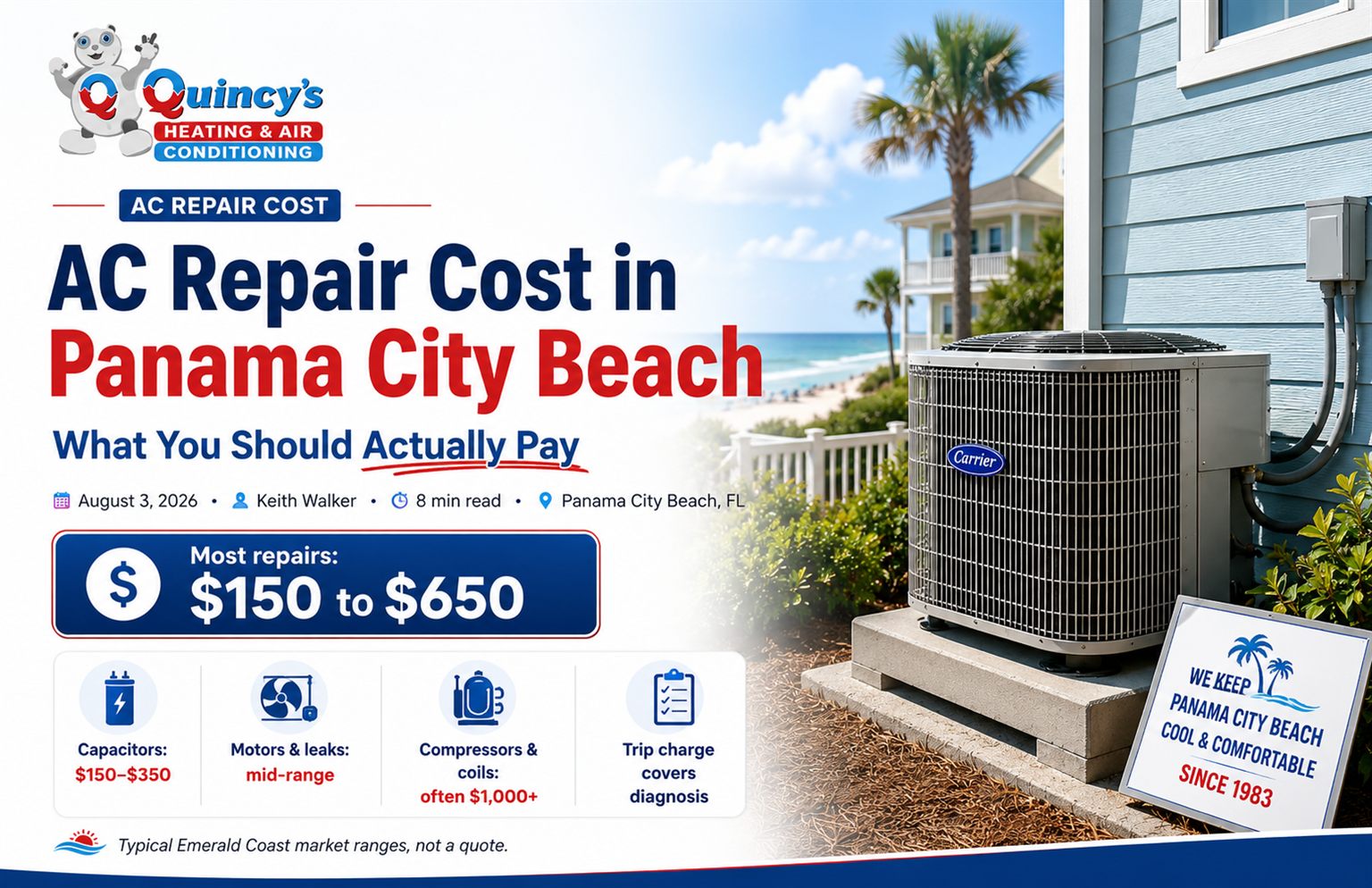
Most AC repairs in Panama City Beach cost between $150 and $650 once you include parts and labor. Small electrical failures like a capacitor or contactor sit at the bottom of that range. Motors and refrigerant leaks sit in the middle. Compressors and evaporator coils run past $1,000, which is usually the moment to stop and ask whether the system is worth saving at all.
That is the honest answer, and nobody likes giving it because the real number depends on what broke. Below is what each of the common repairs actually costs on the Emerald Coast, what you are paying for before anyone touches a wrench, and the point where spending more money stops being sensible.
- A trip charge pays for diagnosis, not the repair. It is normal and it is not a scam.
- Capacitors are the most common failure and one of the cheapest fixes, typically $150 to $350.
- Salt air makes coastal repairs more frequent, especially electrical contacts and outdoor coils.
- If a repair costs more than half the price of a new system, replacement usually wins.
- Any quote should name the specific failed part. "It needs a lot of work" is not a diagnosis.
What you pay before anything gets fixed
Every reputable company charges something to come out. We call it a trip charge. It covers a licensed technician driving to your house, putting meters and gauges on the system, and telling you what is actually wrong.
People sometimes push back on paying for diagnosis. The reason it exists is simple: finding the fault is the skilled part. Anyone can swap a part. Knowing which part failed, and why it failed, is what stops you replacing a compressor when the real problem was a $200 capacitor starving it.
Two things worth knowing. First, many companies apply the trip charge toward the repair if you approve the work. Second, a quote should always come before the work starts. Ours can be verbal and approved on the spot if you want it done while we are there, because in August nobody wants to wait a day for paperwork.
What common AC repairs cost in 2026
These are typical market ranges on the Emerald Coast, not Quincy's quotes. Your actual price depends on the part, the brand, whether the component is still under manufacturer warranty, and how much labor the job takes. Use this to sanity-check a quote, not to hold anyone to a number.
| Repair | Typical range | Time on site | How urgent |
|---|---|---|---|
| Run or dual-run capacitor | $150 to $350 | Under 1 hour | High, system is usually down |
| Contactor | $150 to $350 | Under 1 hour | High |
| Clogged condensate drain line | $100 to $300 | 1 hour | High if water is leaking |
| Condensate pump | $250 to $500 | 1 to 2 hours | High |
| Thermostat replacement | $150 to $500 | 1 hour | Medium |
| Condenser fan motor | $400 to $850 | 1 to 2 hours | High |
| Blower motor | $450 to $1,100 | 2 to 3 hours | High |
| Refrigerant leak, find and repair | $400 to $1,600 | 2 to 4 hours | Medium to high |
| Evaporator coil replacement | $1,200 to $2,800 | Half a day | Consider replacement |
| Compressor replacement | $1,500 to $3,500 | Half to full day | Consider replacement |
Ranges reflect typical parts-and-labor pricing across the Panama City Beach area in 2026 and are provided for orientation only. They are not a quote from Quincy's.
The pattern is worth noticing. The bottom half of that table is electrical, and electrical parts are cheap and fast. The moment a repair involves the sealed refrigerant system, the compressor or a coil, the price jumps by a factor of five. That is the real dividing line in AC repair, not any particular dollar figure.
Not sure what your AC needs?
Drop your number. We'll call back within minutes during business hours.
Why coastal homes see more repairs than inland ones
An air conditioner in Santa Rosa Beach and an identical one in Chipley do not age the same way. Salt in the air corrodes the aluminium fins and copper tubing on the outdoor coil, and it works on electrical contacts inside the disconnect and the contactor.
The practical result is that coastal homeowners see more of the cheap repairs, more often. A contactor with pitted, corroded contacts fails earlier. A capacitor working against a struggling, salt-fouled coil runs hotter and dies sooner. None of these are expensive individually, but three service calls in five years adds up, and the outdoor unit reaches the end of its life earlier than the brochure suggested.
We have written about the mechanism in detail in our guide to how salt air destroys AC units on the Gulf Coast. The short version is that distance from the water matters a great deal, and the closer you are, the more regular rinsing and maintenance pay for themselves.
| What you are seeing | Usually means | Likely cost band |
|---|---|---|
| Outdoor unit hums but the fan will not spin | Failed capacitor | Low |
| Nothing happens at all, breaker is fine | Contactor or control fault | Low |
| Water on the floor near the air handler | Clogged drain line or pump | Low |
| Air is blowing but it is warm | Several possible causes | Low to high |
| Ice on the copper line or indoor coil | Airflow problem or low refrigerant | Medium to high |
| Loud grinding or screeching | Motor bearings or compressor | Medium to high |
| System runs constantly, never satisfies | Refrigerant loss or failing compressor | High |
If you want to narrow it down before you call, two of our guides cover the most common complaints in detail: AC not cooling but running and what each strange AC noise means.
Telling a cheap fix from an expensive one
Here is a rule of thumb that holds up well. If the problem is electrical or drainage, it is almost always in the low hundreds. If the problem is inside the sealed refrigerant system, it is almost always over a thousand.
That is because opening the sealed system means recovering refrigerant, brazing, pulling a vacuum and recharging, and the refrigerant itself is expensive and getting more so. Manufacture of new R-410A ducted equipment ended on 1 January 2026 as part of the phase-down, and every year that goes by, recharging an older R-410A system costs more than the last.
Which is why a leaking system is a different conversation from a failed part. A capacitor is a repair. A leak on a fifteen-year-old unit is a decision.
When repair stops making sense
The guide most of the industry uses is the 50% rule: if a single repair costs more than half of what a new system would, replace instead. It is not a law, but it is a decent filter.
Age deserves at least as much weight. Here on the coast, outdoor units simply do not last as long as they do inland, and pouring money into a corroded twelve-year-old condenser rarely ends well.
| Your situation | Lean toward | Why |
|---|---|---|
| Under 8 years, one electrical part failed | Repair | Plenty of life left, cheap fix |
| 8 to 12 years, repair under $500 | Repair | Still economical |
| 8 to 12 years, repair over $1,200 | Get both numbers | Close to the 50% line |
| Over 12 years, compressor or coil failed | Replace | Money is better spent on a new system |
| Still running R-22 | Replace | Refrigerant cost makes repairs poor value |
| Third repair call in two years | Replace | The pattern will continue |
Our full breakdown of that decision, including the numbers, is in when to replace your AC versus repair it. If replacement is where you land, we cover what a new system costs and what a proper install includes on our new AC installation page, and financing through Synchrony is available subject to credit approval.
How to avoid being overcharged
Most contractors here are honest. A few are not, and the summer rush is when people get taken advantage of, because a hot house makes for a fast decision.
- Ask which part failed, by name. A real diagnosis names a component. Vague answers about the system "being tired" are a warning sign.
- Ask to see it. A bulging capacitor or a pitted contactor is visible. Any technician should be happy to show you.
- Ask whether the part is still under warranty. Many compressors and coils carry 5 or 10 year manufacturer parts warranties. You may only owe labor.
- Be wary of an instant replacement pitch. If someone leads with a new system before diagnosing the fault, get a second opinion.
- Get the second opinion on anything over $1,000. On a big number it is worth another trip charge to be sure.
The other thing that genuinely lowers what you spend over time is maintenance. Twice a year, someone checks the capacitor before it fails, clears the drain line before it backs up into your ceiling, and washes the outdoor coil with water where it is accessible. Our maintenance plan starts at $292 a year for a single-system home and includes 10% off repairs. On the coast that is not an upsell, it is just arithmetic.
If your system is down right now and you are anywhere in Panama City Beach, Bay County, South Walton or Washington County, we get to about 95% of calls the same day. Signs that it should not wait until morning are listed in our guide to what counts as an AC emergency.
Need a straight answer on a repair quote?
We will tell you what failed, what it costs, and whether it is worth fixing. No hard sales.
📞 Call (850) 235-8834Frequently asked questions
How much does AC repair cost in Panama City Beach?
Most residential AC repairs on the Emerald Coast land between $150 and $650 once parts and labor are included. Small electrical parts like a capacitor or contactor sit at the low end. Blower motors, condenser fan motors and refrigerant leak repairs sit in the middle. Compressor and evaporator coil replacement run well over $1,000 and are the point where replacing the system usually deserves a serious look.
What is a trip charge and why do I pay it?
A trip charge covers a licensed technician driving to your home, diagnosing the system and telling you what is wrong. It pays for the diagnosis, not the repair. Diagnosis is real work: it takes meters, gauges, training and time to find the actual fault instead of guessing and swapping parts. If you approve the repair, many companies apply the trip charge toward the job.
Why do AC repairs happen more often near the beach?
Salt in the air corrodes the aluminium fins and copper tubing on outdoor coils, and it attacks electrical contacts. Homes within about a mile of the Gulf can see outdoor units degrade noticeably faster than identical units inland. That means more contactor, capacitor and coil issues over the life of the system, which is why coastal homes benefit more from regular rinsing and maintenance than inland ones do.
When should I stop repairing my AC and replace it?
A common guide is the 50% rule: if a single repair costs more than half the price of a new system, replacement usually wins. Age matters too. On a unit past 10 to 12 years, especially one still running R-22 or leaking refrigerant, putting $1,500 into a compressor rarely pays off. Under 8 years with a one-off electrical failure, repair is almost always the right call.
Is emergency or after-hours AC repair more expensive?
Usually yes. Most companies charge more outside normal business hours because a technician is being called out on their own time. Quincy's runs Monday to Friday 7am to 5pm, with Saturday and Sunday 8am to 5pm for emergencies. If the situation can safely wait until the next business morning, waiting is often the cheaper choice.
Does a maintenance plan actually reduce repair costs?
It helps in two ways. Twice-yearly service catches worn contactors, weak capacitors and clogged drain lines before they fail in August, which is when a small part becomes an emergency call. Quincy's maintenance plan starts at $292 a year for a single-system home and includes 10% off any repair. On the coast, where salt shortens component life, that maintenance matters more than it does inland.