
What SEER2 Rating Do I Need in Florida? A Straight Answer for Coastal Homes
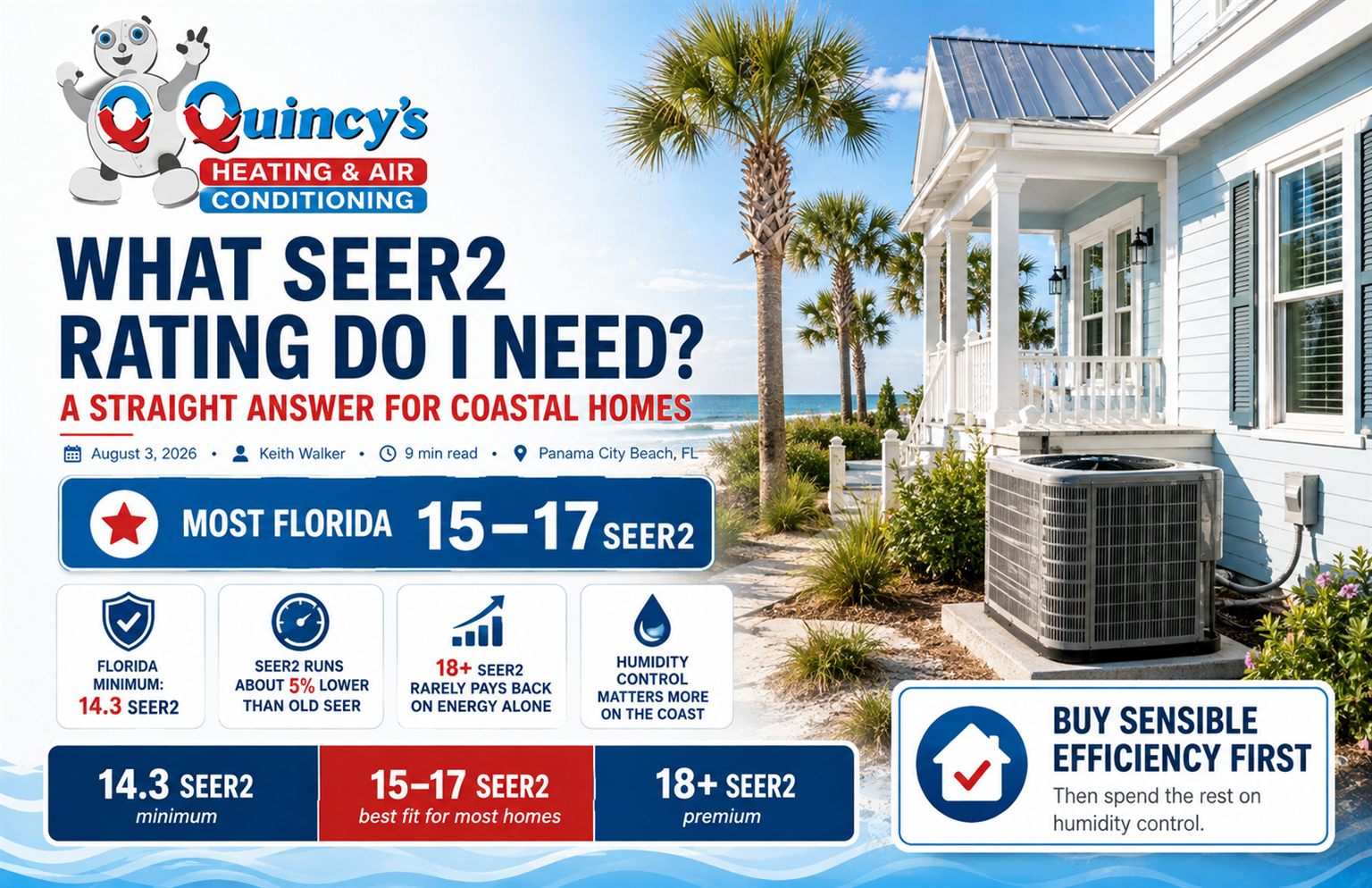
What SEER2 rating do I need in Florida? For most homes, 15 to 17 SEER2. The legal minimum in the Southeast region is 14.3 SEER2, and pushing past roughly 18 SEER2 rarely pays for itself on energy savings alone. Buy sensible efficiency first, then spend what is left on humidity control, which matters more on the coast.
- Florida's floor is 14.3 SEER2, higher than the north's 13.4 because our cooling season is long.
- SEER2 runs 4.5% to 5% lower than the old SEER number on identical equipment. The test got harder.
- The biggest saving is the first jump: a 10 SEER unit to a modern baseline cuts cooling cost by roughly a third.
- Above 18 SEER2 the payback usually runs past the life of the equipment.
- Near the Gulf, two-stage and variable-speed matter more than the SEER2 number because they pull out far more moisture.
What SEER2 actually measures
SEER2 stands for Seasonal Energy Efficiency Ratio 2. It is cooling delivered in BTU divided by the watt-hours burned delivering it, averaged across a whole season rather than one moment.
Think of it as miles per gallon for your air conditioner. Higher means the same cooling for less power, averaged across mild April mornings and flat-out July afternoons alike.
The number worth asking about alongside it is EER2, which measures efficiency at a single hot design condition rather than across a season. In Florida, where the system fights 95 degrees for months, EER2 often describes your real electric bill better than SEER2 does.
One thing SEER2 does not measure at all is moisture removal. A very efficient system that runs in short bursts can leave a Panama City Beach house cold and clammy. That is not a defect in the rating, it is a limit of what it was designed to describe.
SEER vs SEER2: why your number suddenly dropped
SEER2 replaced SEER on 1 January 2023. The old test ran equipment against 0.1 inches of water column of external static pressure, which is close to no ductwork at all. Real houses have duct runs, elbows and filters.
The new M1 test procedure raised that to 0.5 inches of water column, five times the resistance. The equipment did not change. The yardstick got honest. So the same condenser and coil that scored 16 SEER now scores about 15.2 SEER2.
So any older article, yard sign or neighbour describing a 2019 install is quoting the old scale. Here is the conversion, using the roughly 5% haircut that applies to most residential split systems.
| Old SEER rating | Approximate SEER2 | Where it stands in 2026 |
|---|---|---|
| 10 SEER | ~9.5 SEER2 | Typical 2000s unit, well past its life |
| 14 SEER | ~13.4 SEER2 | Legal in the north, not in Florida |
| 15 SEER | ~14.3 SEER2 | Florida minimum for split ACs |
| 16 SEER | ~15.2 SEER2 | Common value tier |
| 17 SEER | ~16.2 SEER2 | Usually where two-stage begins |
| 18 SEER | ~17.1 SEER2 | Solid mid to upper tier |
| 20 SEER | ~19.0 SEER2 | Variable-speed inverter territory |
| 22 SEER | ~20.9 SEER2 | Premium, long payback |
Conversions are approximate. Actual SEER2 depends on the exact coil pairing, so check the AHRI certified rating.
What is the minimum SEER2 rating in Florida?
The federal efficiency standards split the country into three regions, and Florida sits in the Southeast. Our minimums are higher than the north's on purpose.
For a split system air conditioner under 45,000 BTU, the floor is 14.3 SEER2. Split systems at 45,000 BTU and above must reach 13.8 SEER2. Split heat pumps are held to 14.3 SEER2 nationally, along with a heating number, HSPF2, of at least 7.5.
Up in the northern region a 13.4 SEER2 split system is still perfectly legal. The reason we are held higher is straightforward: a house in Minnesota might run its compressor 500 hours a year, while a house in Bay County commonly runs 2,000 to 2,800 cooling hours. When the equipment runs four or five times as long, a point of efficiency is worth four or five times as much, and the regulators priced that in.
One consequence people miss: in the Southeast the standard is enforced at installation, not just at manufacture.
Is higher SEER2 worth it in Florida?
Yes, up to a point, and the point arrives sooner than the brochures suggest. Because Florida runs roughly double the national cooling hours, every efficiency upgrade pays back about twice as fast here as a national calculator will tell you. That is the good news.
The bad news is arithmetic. Efficiency savings are a curve of diminishing returns, not a straight line. You are cutting a percentage of a shrinking number, so each tier buys less than the one before it.
The table below runs a three ton system, 2,500 cooling hours a year, at about 14.5 cents per kilowatt hour, a fair 2026 assumption for this area. Savings are measured against the 14.3 SEER2 baseline. Premiums are typical Emerald Coast market ranges for the step-up, not quotes from Quincy's.
| SEER2 tier | Typical premium over baseline | Rough annual saving | Simple payback | Who it suits |
|---|---|---|---|---|
| 14.3 to 15.2 SEER2 single-stage | Baseline | Baseline | n/a | Rentals, second homes, anyone moving within 5 years |
| 16 SEER2 single or two-stage | $700 to $1,500 | ~$95 | 8 to 15 years | Value sweet spot for most owner-occupied homes |
| 17 to 18 SEER2 two-stage | $1,800 to $3,500 | ~$190 | 10 to 18 years | Coastal homes wanting real humidity control |
| 19 to 20 SEER2 variable-speed | $3,500 to $6,000 | ~$260 | 13 to 23 years | Forever homes, comfort-first buyers |
| 21+ SEER2 premium inverter | $6,000 to $9,000 | ~$310 | 19 years or more | Rarely justified on energy cost alone |
Illustrative market estimates for a three ton Emerald Coast home. Your figures will vary with ductwork, insulation, shade and utility rate. Not a quote from Quincy's.
Now put that next to the number nobody quotes. If your current unit is a 10 SEER system from 2005, the same maths says you are burning roughly $1,370 a year on cooling. Moving to plain 14.3 SEER2 drops that to about $910. That single step saves around $460 a year, more than every upgrade above it combined.
That is the whole story in one paragraph. Getting off an old unit captures most of the money. Everything after that is fine tuning. If you are still deciding whether it is time, our guide on when to replace your AC versus repair it walks through the age and repair-cost triggers.
Not sure which SEER2 tier fits your house?
Drop your number. We'll call back within minutes during business hours.
16 SEER2 vs 18 SEER2: where the payback stops
This is the fork in the road on almost every replacement quote in Panama City Beach.
On energy alone, 16 SEER2 wins. The step up to 18 SEER2 saves somewhere around $90 a year on a typical three ton home while adding $1,500 to $2,500 to the invoice. Even in our climate that is fifteen to twenty-five years to break even, and the equipment will not last that long on the coast.
So on the spreadsheet, stop at 16. But the spreadsheet is not the only thing in the room.
The real reason to consider 18 SEER2 near the water is that manufacturers do not build high-efficiency single-stage equipment. At 17 SEER2 and above you are almost always getting a two-stage or variable-speed compressor, and that changes how the system behaves in a humid house. You are not buying two points of efficiency, you are buying a different run pattern. Be honest with yourself about which one you actually want.
Why humidity control beats raw efficiency on the coast
An oversized single-stage air conditioner satisfies the thermostat fast, shuts off, and never runs long enough to wring water out of the air. You end up at 74 degrees and 60% relative humidity, which feels worse than 76 degrees at 48%.
On the Emerald Coast this is the whole ballgame. Long runtimes at low capacity remove moisture. Short blasts at full capacity do not.
| Compressor type | How it runs | Humidity control near the Gulf | Typical SEER2 range | Trade-off |
|---|---|---|---|---|
| Single-stage | Full blast or off, nothing between | Weakest. Short cycles leave a house cool and clammy | 14.3 to 16 SEER2 | Cheapest to buy and repair |
| Two-stage | Roughly 65% to 70% capacity, full only when needed | Good. Longer runtimes pull noticeably more moisture | 16 to 18 SEER2 | Moderate premium, more controls |
| Variable-speed inverter | Modulates continuously, often 25% to 100% | Best. Near constant low-speed running holds humidity steady | 18 to 24 SEER2 | Highest cost, electronics fail expensively |
One caution specific to us. Variable-speed equipment carries inverter boards and communicating controls, and salt air plus summer lightning is not kind to electronics. Worth buying for the right house, but it needs a surge protector, a coastal coil option and maintenance that actually happens.
If your house is already humid, fix that before buying efficiency tiers. Our guide to humidity problems in Panama City Beach homes covers the causes, and the best AC system for coastal homes goes deeper on coil coatings.
R-454B: what changed on 1 January 2026
Every new system you are quoted now uses R-454B. Manufacture of new R-410A ducted residential equipment ended on 1 January 2026 as part of the refrigerant phase-down, so the whole industry has moved.
R-454B has a much lower global warming potential and slightly better efficiency in most designs. It is classed A2L, mildly flammable, so installers need current training, leak detection in the air handler and updated tooling. Not a reason to panic, but a reason to ask who is doing your install.
Your existing R-410A system stays legal to own and to service. What changes is cost: as production winds down, recharging an older R-410A unit gets dearer every year, which quietly shifts the repair-or-replace maths on any system with a leak.
None of that means you should rush a replacement. If your system is under ten years old and working, keep it. We would rather tell you that than sell you a box.
How to pick your SEER2 number in five steps
Here is the order we would work through it at your kitchen table.
- Work out how long you are staying. Under five years, buy the 14.3 to 15.2 SEER2 baseline and keep your money. You cannot recover a premium you had no time to earn back.
- Look at your actual summer electric bill. If July costs $180, the percentages above are small dollars. If it costs $450, every tier deserves a second look.
- Fix the ductwork question first. Leaky or undersized ducts throw away efficiency faster than any rating gains it back. See our ductwork and insulation page. SEER2 is tested at realistic duct pressure for exactly this reason.
- Decide whether humidity is your real complaint. If the house feels sticky rather than hot, buy two-stage or variable-speed and treat the SEER2 number as a side effect.
- Get proper sizing, not a guess. An oversized 20 SEER2 system will underperform a right-sized 16 SEER2 one every time. We perform a Manual J load calculation when necessary.
A safety switch goes on every install we do, coastal coils are standard options within the selections we offer, and quotes can be verbal and approved on the spot. What a proper job includes is set out on our new AC installation page, and financing through Synchrony is available subject to credit approval, which is often what makes the two-stage step affordable.
Whatever tier you land on, a system only holds its rated efficiency if it is looked after. Salt-fouled coils and clogged drains cost you more than two SEER2 points ever will, which is why our maintenance plan is $292 a year for a single-system home and includes 10% off repairs. We serve Panama City Beach, Bay County, South Walton County and Washington County.
Want a straight recommendation, not a sales pitch?
We will tell you which SEER2 tier pays off in your house, and when the cheap one is the right answer. No hard sales.
📞 Call (850) 235-8834Frequently asked questions
What SEER2 rating do I need in Florida?
For most Florida homes, 15 to 17 SEER2 is the sensible range. The legal floor in the Southeast region is 14.3 SEER2 on a split system air conditioner. Below 15 SEER2 you leave easy savings behind, and above 18 SEER2 the equipment premium usually outlives the payback.
What is the minimum SEER2 rating allowed in Florida?
Florida sits in the Southeast efficiency region, where a new split system air conditioner under 45,000 BTU must be at least 14.3 SEER2. Larger split systems must hit 13.8 SEER2, and split heat pumps 14.3 SEER2 nationally. The northern region only requires 13.4 SEER2, because its cooling season is far shorter.
What is the difference between SEER and SEER2?
SEER2 measures the same thing as SEER, seasonal cooling output divided by electricity used, but it is tested against five times more external static pressure. That harder test reflects real ductwork, so identical equipment scores about 4.5 to 5 percent lower. A 16 SEER unit reads roughly 15.2 SEER2.
Is a higher SEER2 rating worth it in Florida?
Partly. Florida runs roughly twice the cooling hours of the national average, so every efficiency step pays back faster here than national numbers suggest. The catch is that the first jump captures most of the money. Replacing an old 10 SEER unit with a 14.3 SEER2 baseline can cut cooling costs by a third.
Is 16 SEER2 or 18 SEER2 better for a coastal home?
On raw energy cost, 16 SEER2 is usually the better buy. The step to 18 SEER2 saves roughly $90 a year on a typical three ton home while costing $1,500 to $2,500 more. The honest reason to buy 18 SEER2 near the Gulf is better humidity control, not the electric bill.
Do new AC systems still use R-410A refrigerant?
No. Manufacture of new R-410A ducted residential equipment ended on 1 January 2026 under the refrigerant phase-down. New systems now use R-454B, which has a much lower global warming potential. It is classed A2L, mildly flammable, so it needs trained installers. Your existing R-410A system is legal to keep and service.