
What Size AC Do I Need? Why Bigger Is Not Better in Florida
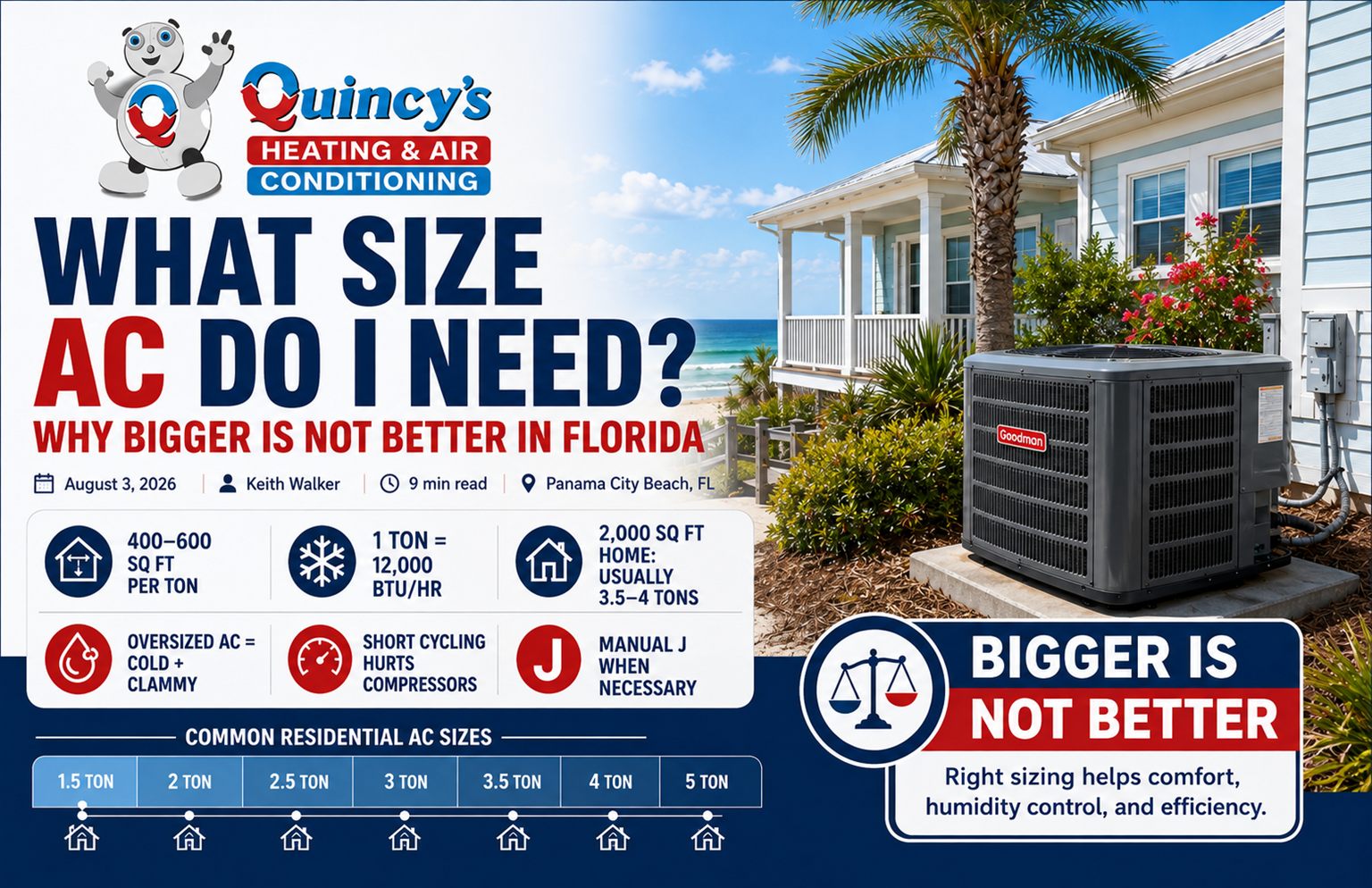
Most Panama City Beach homes need roughly one ton of air conditioning for every 400 to 600 square feet, so a 2,000 square foot house usually lands between 3.5 and 4 tons. That is only a starting point. Ceiling height, window area, insulation and duct condition move the real number in both directions.
The bigger issue is what people do with that number. Almost everyone assumes a larger system is safer. In Florida it is the opposite: an oversized air conditioner makes your house cold and clammy while it slowly destroys its own compressor.
- One ton equals 12,000 BTU per hour. Systems step from 1.5 to 5 tons.
- The 400 to 600 square feet per ton rule is a sanity check, never a final answer.
- Oversized systems cannot dehumidify. They satisfy the thermostat before the coil has run long enough to pull water.
- Short cycling is one of the fastest ways to kill a compressor.
- A Manual J load calculation settles it, and we perform one when necessary rather than automatically on every job.
What does AC tonnage actually mean?
Tonnage has nothing to do with what the equipment weighs. One ton of cooling equals 12,000 BTU per hour, roughly the heat absorbed by melting a ton of ice over 24 hours.
Residential systems come in half ton steps: 1.5, 2, 2.5, 3, 3.5, 4 and 5 tons. Most lines skip 4.5. So a 3 ton unit removes 36,000 BTU per hour and a 4 ton removes 48,000. If your house calculates out at 3.2 tons, your only choices are 3 or 3.5, and which way you round should be deliberate.
You can find your current size on the outdoor unit's data plate. Look in the model number for a block like 024, 036, 042, 048 or 060. Those are BTU in hundreds, so 036 is 3 tons.
How many tons of AC do I need per square foot?
Ask ten contractors for a rule of thumb and most land on 400 to 600 square feet per ton in Florida. Northern states use 700 or 800. We run hotter and far wetter, so our equipment works harder per square foot. Read the bracket below as a sanity check on a quote, not as an answer.
| System size | Cooling capacity | Rough square footage range | Typical local home |
|---|---|---|---|
| 1.5 ton | 18,000 BTU | 600 to 900 sq ft | Small condo |
| 2 ton | 24,000 BTU | 900 to 1,200 sq ft | Two bedroom condo |
| 2.5 ton | 30,000 BTU | 1,200 to 1,500 sq ft | Small house |
| 3 ton | 36,000 BTU | 1,500 to 1,800 sq ft | Three bedroom slab |
| 3.5 ton | 42,000 BTU | 1,800 to 2,100 sq ft | Larger single storey |
| 4 ton | 48,000 BTU | 2,100 to 2,400 sq ft | Four bedroom or two storey |
| 5 ton | 60,000 BTU | 2,400 to 3,000 sq ft | Large or zoned home |
Ranges assume 8 to 9 foot ceilings and typical coastal construction. An orientation tool, not a load calculation, and not a quote.
Notice the overlap between rows. That overlap is where the real work lives.
So how many tons of AC for 2000 sq ft? On the beach, usually 3.5 to 4 tons. A two storey home with west facing glass and duct in a 130 degree attic might justify 5. A tight, shaded, well insulated home the same size might be happy at 3.5. Square footage alone cannot tell those two houses apart.
Why is an oversized AC worse than a slightly small one in Florida?
Your air conditioner has two jobs: drop the temperature, and pull water out of the air. It only does the second while running.
Cold refrigerant chills the indoor coil below the dew point of the air passing over it. Moisture condenses onto the fins, drips into the pan and leaves through the drain line. That takes time. A system usually needs 10 to 15 minutes of continuous run before the coil removes serious moisture.
An oversized system never gets there. It dumps capacity into the house so fast that the thermostat is satisfied in six or seven minutes, then shuts off. Temperature: handled. Humidity: barely touched. Some of the water that did condense re-evaporates off the coil. Twenty minutes later it does it again.
That produces the complaint we hear every July in Panama City Beach: the house is cold and it still feels awful. Sticky floors, towels that never dry, fogged windows, mildew on sills.
Turning the thermostat down does not fix it. It makes the house colder, clammier and more expensive. Our guide to humidity problems in Panama City Beach homes covers what to check. Indoors you want 45% to 55% relative humidity.
The mechanical damage is just as real
Every startup is the hardest moment in a compressor's life: current spikes, oil is still migrating back, metal goes from still to full speed at once. A system starting six or eight times an hour instead of two or three piles up that wear several times faster. That is short cycling, one of the most reliable ways to lose a compressor years early.
An undersized system fails the other way. It runs long and hard, good for humidity, but on the hottest afternoons it cannot keep up. Between the two errors in Florida, slightly small beats slightly large.
Not sure if your system is the right size?
Drop your number. We'll call back within minutes during business hours.
What are the signs my AC is the wrong size?
You do not need instruments. Sit in the house for an hour with a cheap hygrometer and a clock. The pattern tells you most of it.
| What to look at | Oversized system | Undersized system |
|---|---|---|
| Cycle length | 5 to 10 minute bursts, several per hour | Runs 30 minutes or more, sometimes never stops |
| Reaching setpoint | Hits it quickly, all day | Falls behind on hot afternoons |
| How the house feels | Cold and clammy at once | Warm and sticky |
| Indoor humidity | Often 55% to 65% | Often 55% or higher |
| Windows and surfaces | Fogging, mildew on sills, musty smell | Generally dry, just too warm |
| Room balance | Rooms near the air handler freeze | Far rooms never catch up |
| Energy bills | High from repeated startups | High from constant running |
| Wear point | Compressor and contactor | Compressor, running past design |
| Usual cause | Contractor upsized to be safe | Addition, leaky ducts, lost capacity |
One caution: uneven rooms are not always a sizing problem. Duct leakage, crushed flex and undersized returns produce the same complaint, and new equipment fixes none of them. Read why some rooms are hotter than others before blaming the tonnage.
What actually determines the right AC size?
Floor area is one input among many, and not the strongest. Here is what genuinely moves the number on a coastal Florida home.
- Conditioned square footage. The starting figure, and the only one the rule of thumb uses.
- Ceiling height. AC cools volume, not floor area. A 10 foot ceiling is roughly 25% more air than an 8 foot ceiling over the same footprint.
- Window area, orientation and glazing. The biggest swing factor here. A wall of unshaded west windows can add half a ton of load on a Gulf afternoon, and post hurricane impact glass changes it again.
- Insulation levels. Attic R-value matters most in Florida, because most of the heat arrives through the roof.
- Air infiltration. A leaky 1980s house pulls in hot, wet outside air all day, and every cubic foot has to be cooled and dried.
- Duct condition and location. Ducts in an unconditioned attic lose capacity before the air reaches a room, and leaky returns pull humid air into the system.
- Sun exposure and shade. Mature oaks on the west side are worth real BTU. So is a light coloured roof.
- Occupancy and internal heat. A rental that sleeps ten is not a couple's second home.
- Local design conditions. Bay County design temperature and, critically, our latent load.
That last point gets missed most. A load calculation splits cooling into sensible load, the temperature, and latent load, the moisture. On the Emerald Coast the latent portion is large, and equipment is chosen partly on how it handles it.
What is a Manual J load calculation?
Manual J is the industry standard method, published by ACCA, for working out how much heat a house actually gains. It goes room by room, counting wall assemblies, every window by size and orientation, ceiling and floor construction, infiltration, duct losses, occupants and the local design temperature.
The output is a number in BTU per hour for cooling and another for heating. That is the load. Equipment is selected to match it, typically no more than about 15% over, rather than rounded up to whatever felt safe.
At Quincy's, a Manual J load calculation is performed when necessary, not automatically on every job. On a like for like changeout, where the existing system has kept the house cool and dry for a decade, the current tonnage is already real world evidence. It earns its keep on additions, new construction, upgraded windows or insulation, and any system clearly not performing.
| Factor | Manual J load calculation | Square footage rule of thumb |
|---|---|---|
| Conditioned floor area | Counted | Counted, and that is all |
| Ceiling height and volume | Counted | Ignored |
| Window area, orientation, glazing | Counted room by room | Ignored |
| Wall and attic insulation | Counted | Ignored |
| Air infiltration | Counted | Ignored |
| Duct location and leakage | Counted | Ignored |
| Shade and sun exposure | Counted | Ignored |
| Occupants and appliance heat | Counted | Ignored |
| Latent load, the moisture | Calculated separately | Ignored entirely |
| Room by room airflow | Produced | Not produced |
| What you end up with | A BTU load you can size to | A bracket you still choose inside |
Rules of thumb are not useless. They are a fast first filter. They just cannot tell apart two houses of identical size, one facing the Gulf behind single pane glass, the other shaded with R-38 above.
What to ask before you buy a new system
Five questions will tell you whether the person quoting your job has thought about it.
- Ask what size is going in, and why. A good answer references your house, not a chart.
- Ask whether anyone looked at the ductwork. A correctly sized system on leaking ducts wastes the money.
- Ask what happens to humidity. Anyone selling cooling in Florida should talk about latent capacity, blower speed and run time unprompted.
- Be suspicious of an automatic upsize. If someone moves you from 3 tons to 4 because bigger is better, they have told you what they do not know.
- Ask about two stage or variable speed. These run at partial capacity for long stretches, which is very good for humidity. They forgive a close sizing call, but they are not a licence to oversize.
Still deciding whether to replace at all? Our guide to when to replace your AC versus repair it lays out the numbers, and our new AC installation page covers what a proper job includes: a safety switch on every install, and coastal coils as standard options within the selections we offer.
One last thing. Correct sizing only stays correct if the system stays clean. A clogged filter or a fouled outdoor coil shrinks real capacity, and a right sized unit starts behaving like an undersized one. Our maintenance plan is $292 a year for a single-system home and includes 10% off repairs.
We size and install systems across Panama City Beach, Bay County, South Walton County and Washington County. If your house is cold and damp, that is worth a conversation.
Want a straight answer on what size your house needs?
We will look at the house you actually have, not just the square footage. No hard sales.
📞 Call (850) 235-8834Frequently asked questions
How many tons of AC do I need for a 2,000 square foot house?
In Panama City Beach, a 2,000 square foot home usually lands between 3.5 and 4 tons, using the rough guide of 400 to 600 square feet per ton. That is a starting point, not an answer. West facing glass, attic ducts and ceiling height can push it to 5 tons.
Is a bigger air conditioner better?
No, and in Florida it is actively worse. An oversized system cools the air so fast that it satisfies the thermostat and shuts off before it has run long enough to pull humidity out. You get a house that is cold and clammy at once. The constant starting and stopping also wears the compressor out early.
What is a Manual J load calculation?
Manual J is the ACCA standard method for calculating how much heat a house actually gains. It works room by room, counting wall and ceiling assemblies, window area and orientation, insulation, air infiltration, duct losses and local design conditions. The output is a cooling load in BTU per hour that equipment is then matched to.
Does Quincy's run a Manual J on every installation?
No. A Manual J load calculation is performed when necessary, not automatically on every job. On a like for like changeout where the existing system has kept the house cool and dry for years, the current tonnage is already real world evidence. It earns its keep on additions, new construction and systems that are clearly not performing.
What are the signs my AC is oversized?
Short run times are the giveaway. If the system runs five to ten minutes and shuts off, several times an hour, it is probably oversized. The other signs are a house that feels cold and damp at once, indoor humidity above 55%, fogged windows, musty smells and mildew on window sills.
Can an oversized AC be fixed without replacing it?
Sometimes it can be improved. Slowing the blower, sealing duct leaks, adding a dehumidifier or setting a longer minimum run time all help a system pull more moisture out. None of that changes compressor capacity. If the unit is badly oversized and near the end of its life, the fix is correct sizing next time.