Here is the counterintuitive part of heating in Lynn Haven: most of the equipment is relatively young, and that is not the protection people assume it is. A heat pump installed in 2019 has been through roughly seven winters, and in Bay County that means perhaps a few dozen hours of genuine heating operation. Its heating-side components are not worn out — they are unpracticed, which fails in its own way.
A city that re-equipped at once, heating components that almost never run, upstairs systems nobody notices, and manufacturer warranties with conditions attached.
Heating season here is a handful of cold snaps rather than a season. A 2019 heat pump has spent its whole life cooling, and its reversing valve, defrost board and sequencers have barely been asked to do anything at all.
Heat pump vs AC →Because so much of Lynn Haven re-equipped inside the same eighteen months after Hurricane Michael, that equipment reaches the same component-drift points simultaneously. Our phone reflects it — the same fault, in the same neighborhoods, on the same night.
Lynn Haven AC installation →Two-system homes are common here, and heat rises. When the upstairs unit stops heating, the downstairs system covers well enough that nobody investigates — until the bill arrives, or until August, when the upstairs suddenly matters.
Uneven room temperatures →College Point and the streets south of Highway 390 carry more overnight moisture, so outdoor coils frost more readily and the defrost cycle runs more often. A marginal defrost board fails there before it fails inland.
Heat pump not heating →Equipment from 2018 and 2019 is often still inside its parts warranty, but most manufacturers require documented annual maintenance for coverage to hold. A denied claim on a reversing valve is an unpleasant surprise.
Lynn Haven maintenance plans →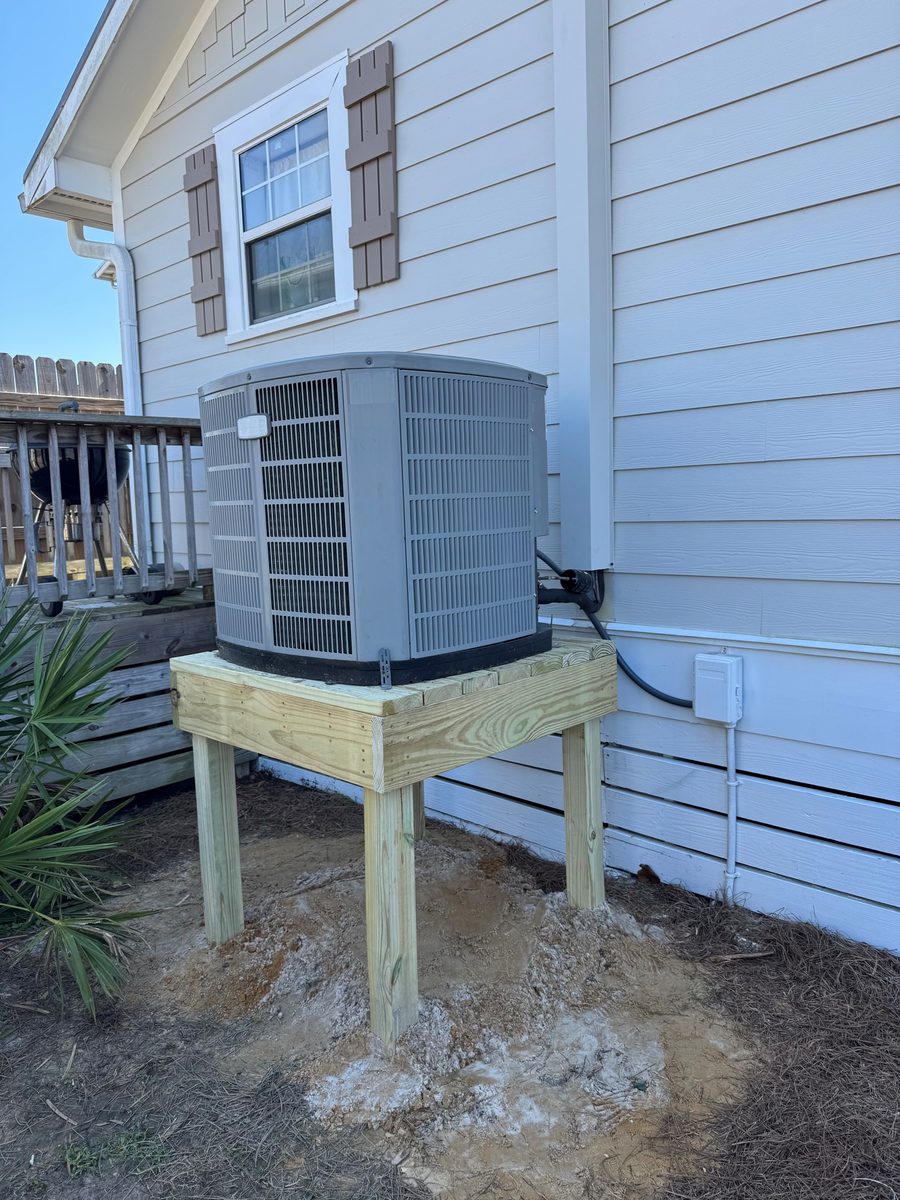
Newer equipment still fails in winter — usually for different reasons.
A cooling-season check does not find these faults.
On two-system homes we check the one you did not call about.
If the part is covered, we handle the claim paperwork.
You know the diagnostic cost before we start.
Cold snaps do not wait for business hours.
That describes most of Lynn Haven. The fall visit is when a stuck reversing valve or a dead defrost sensor turns up while it is still 70°F outside and nobody in the house is cold.
The heating problems we find in 32444 are not the problems of worn-out machinery. They are the problems of machinery that has barely been asked to do this particular job, in a city where nearly all of it was installed at once. Here is what that looks like in practice.
Mechanical components do not only fail from wear. They also fail from sitting still. A reversing valve that has held one position since February has a slide inside it that has not moved in ten months; a solenoid that has not been energized in that time; seals that have settled where they sit.
Most of the year that costs nothing. Then a cold front comes through, the thermostat calls for heat for the first time since last winter, and the valve is asked to shift. Sometimes it does not. The system keeps running, the compressor keeps working, and the house does not get warm — because the refrigerant is still flowing in the cooling direction and the backup heat strips have quietly taken over the entire job.
This is why a system that cooled perfectly well all summer can fail completely in December, and why nothing you noticed in August would have predicted it. Cooling performance tells you almost nothing about heating readiness, which is the single most useful thing to understand about heat pumps in this climate.
Lynn Haven has an HVAC history that no other part of Bay County shares. After October 2018 a very large share of this city replaced its equipment inside the same eighteen-month window. What that means for heating is unusual: not just that a lot of systems are the same age, but that they encounter the same age-related faults in the same week.
We see it clearly from the dispatch side. A cold snap arrives and the calls cluster — the same complaint, from The Hammocks and Mowat Highlands and the Belaire corridor, within a couple of days of each other. Defrost boards from a particular production period. Sequencers reaching the same duty-cycle count. Contactors pitted to the same degree.
The practical implication for a homeowner is scheduling. When that cluster hits, every HVAC company in the county is booked solid, and the difference between being seen that evening and being seen in three days is largely down to who called first or who was already on a maintenance plan. Getting the fall check done in October is not caution, it is queue position.
On a cold damp night the outdoor coil frosts over. That is normal and designed for: the system briefly reverses into cooling mode to melt the ice off the outdoor coil, then returns to heating. What is not normal is a unit that ices up and stays that way.
The parts responsible — the defrost board and the defrost sensor — are pure winter components. They have had almost no operating hours on a 2019 system, and when they do fail there is nothing gradual about it. The outdoor unit becomes a block of ice, stops being able to extract any heat from the outdoor air whatsoever, and hands the entire load to the heat strips.
Location matters here more than people expect. Homes in College Point and the streets south of Highway 390 sit close enough to North Bay to carry noticeably more overnight moisture, which means more frost, which means more defrost cycles, which means a marginal defrost board reveals itself there before it does further inland. If you have found the outdoor unit encased in ice on a cold morning, do not chip at it — switch to emergency heat to keep the house warm and call us.
Lynn Haven has a lot of larger family homes running two systems, and in winter that produces a specific blind spot. Heat rises. When the upstairs unit stops heating, the warmth coming up from the downstairs system masks it well enough that nobody treats it as urgent.
So the fault goes unreported. Meanwhile the upstairs air handler may be running its electric heat strips continuously to compensate for a heat pump that is not contributing — which is the most expensive possible way to heat a floor of a house, and it shows up on the bill long before anyone connects it to a comfort complaint.
When we come out to a two-system Lynn Haven home for a heating call, we look at both systems regardless of which one you called about. It takes very little extra time and it regularly finds the more expensive of the two problems. If one system is beyond repairing →
This is worth real money in Lynn Haven specifically. Equipment installed in 2018 and 2019 is frequently still within its manufacturer parts warranty, which on many systems runs ten years from installation and registration. A reversing valve, a defrost board or a compressor may be covered.
There is a condition attached that catches people out. Most manufacturers require documented annual maintenance by a licensed contractor for the warranty to remain in force, and a claim on an unmaintained system can be denied. That is a bad discovery to make while standing in a cold house.
So the first thing we do on a warranty-age system is establish what the equipment is, when it was installed, whether it was registered, and what the coverage actually says. If the part is covered we handle the claim paperwork and you pay only for labor. It is a straightforward thing to check and it is not always checked. Maintenance and warranty documentation →
Heating here is a specialist problem because there is so little of it. A technician who spends ten months a year on cooling can confirm a system is running and never establish whether it is actually heating. And a lot of the contractors who installed Lynn Haven's equipment in 2019 have long since left the area, which matters when a warranty claim needs filing.
The visit that finds winter faults in October, plus your warranty documentation. Lynn Haven maintenance →
When the post-Michael unit has genuinely reached the end. Lynn Haven AC installation →
Heating service across Bay County. Panama City → · Callaway →
Because heating components in Bay County barely get used. A heat pump installed in 2019 has been through about seven winters, and in this climate that is only a few dozen hours of actual heating operation. Reversing valves, defrost boards and sequencers fail from sitting idle as readily as from wear. A system that cooled flawlessly all summer tells you nothing about its heating readiness.
Quite possibly, if it was installed in 2018 or 2019 and registered — many manufacturer parts warranties run ten years from installation. The catch is that most require documented annual maintenance by a licensed contractor to stay in force. We check the equipment, the install date and the coverage before quoting any part, and if it is covered we handle the claim paperwork so you pay labor only.
Heat pump supply air is genuinely cooler than furnace air — typically in the 90s rather than 120°F and above — so it can feel weak even when everything is correct. But if the house is not actually gaining temperature, that is a fault: usually a reversing valve that has not shifted into heating, a low refrigerant charge, or an outdoor coil iced over and not clearing.
In a two-system Lynn Haven home that usually means the upstairs heat pump has stopped heating and its electric strips are covering, or the upstairs system has failed and rising warmth from downstairs is masking it. It is the most commonly unreported fault we find here, and it is also one of the most expensive to leave alone because resistance heat runs at two to three times the cost.
Light frost that clears within a defrost cycle is normal, particularly near North Bay where overnight moisture is higher. A unit encased in ice that stays that way is not — typically a failed defrost board or sensor, or a low charge. An iced coil cannot pull heat from outdoor air at all, so the strips take over everything. Do not chip at the ice; switch to emergency heat and call us.
Because a very large share of this city replaced its HVAC inside the same eighteen months after Hurricane Michael, so the equipment is unusually synchronized. When a cold snap arrives, the calls cluster from the same neighborhoods within days of each other. Practically, that means scheduling matters — the fall check in October is partly maintenance and partly queue position.
Only if the heat pump has genuinely failed. Emergency heat locks the heat pump out and runs pure electric resistance, at roughly two to three times the running cost. It is the right choice to keep a house warm overnight while you wait for a repair, and the wrong choice as a way of feeling warmer faster. Switch it back once the system is fixed.
Once a year, in the fall, before the first cold snap — and it matters more here than most places precisely because the equipment is younger and nobody expects a problem. The fall visit is when we find the stuck reversing valve and the dead defrost sensor while it is still 70°F outside. It also produces the maintenance documentation your manufacturer warranty requires.