
Thermostat Not Working in Panama City Beach? Start Here Before You Spend Money
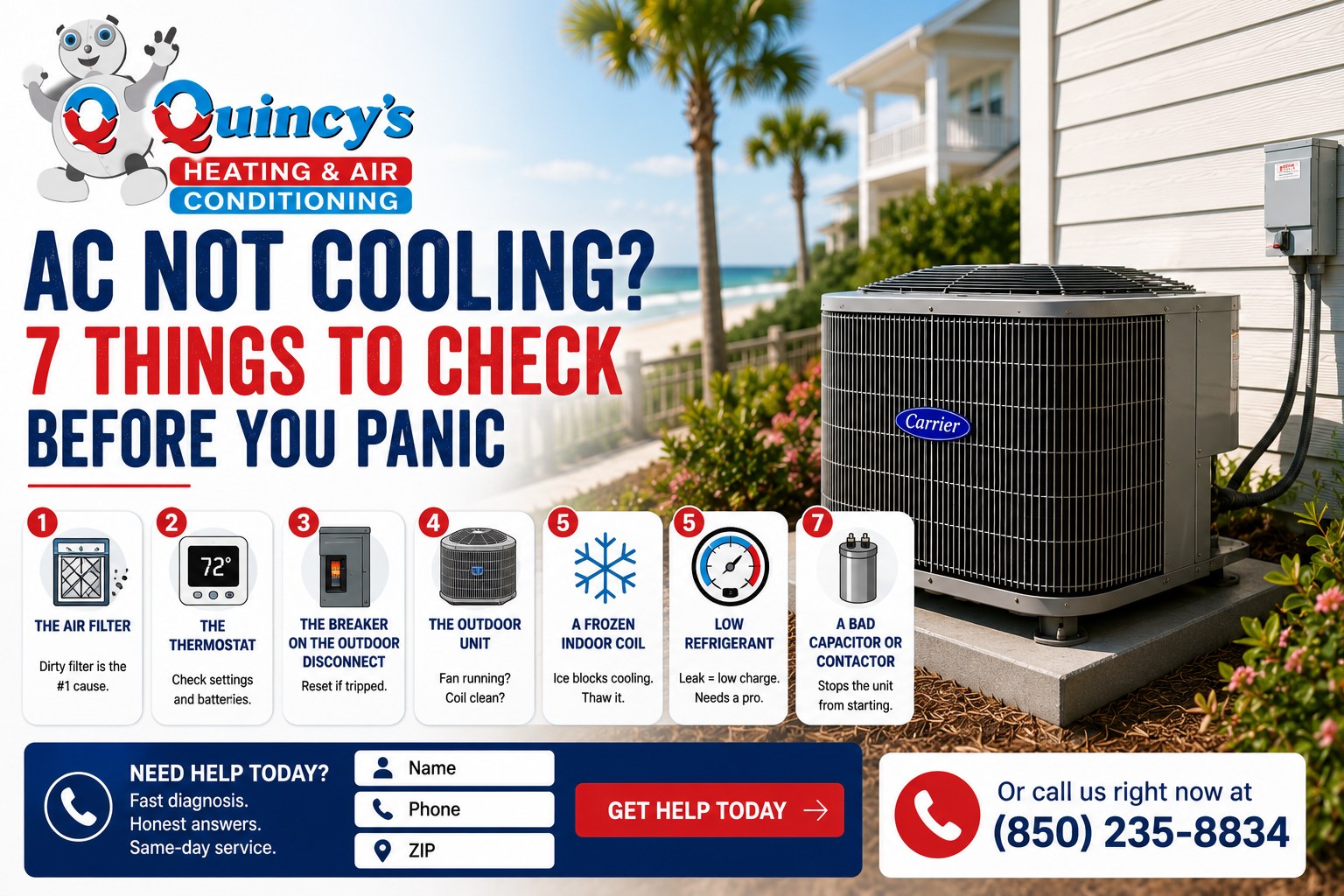
A thermostat that is not working usually is not broken. Most of the time it is dead batteries, a tripped condensate float switch cutting the 24-volt power, a blown low-voltage fuse, or a breaker. Check those four first, because three of them cost nothing to fix. On the coast, the float switch is the one nobody guesses.
We get calls every summer that start with "my thermostat died" and end with us clearing algae out of a drain line. The thermostat was fine. It was the messenger.
- A blank screen is far more often a power problem than a dead thermostat.
- In humid coastal Florida a tripped condensate float switch looks exactly like a dead thermostat.
- A system that runs but never reaches the setpoint is almost never the thermostat's fault.
- Sunlight or a supply vent nearby makes a working thermostat behave like a broken one.
- Only batteries and breakers are safe DIY. Past that you are into 24-volt wiring.
- Why is my thermostat screen blank?
- The float switch problem nobody expects
- Why does my thermostat read the wrong temperature?
- Why is my thermostat not reaching the set temperature?
- Short cycling caused by the thermostat
- Wiring, C-wire and smart thermostat issues
- Failed thermostat or system fault?
- The safe DIY checklist, in order
Why is my thermostat screen blank?
A blank screen means the thermostat lost power. There are four realistic answers for where it went.
Dead batteries. Battery models warn you for weeks and everybody ignores it. Fresh AA or AAA alkalines, correct orientation. Skip rechargeables, their lower voltage confuses some models.
A tripped condensate float switch. The big one here, and it gets its own section below.
A blown low-voltage fuse. The air handler control board carries a 3-amp or 5-amp fuse protecting the 24-volt circuit. A pinched wire blows it and the screen dies instantly. Two-dollar part, but if it blows again there is a short to find.
A tripped breaker. Most homes have two AC breakers, outdoor condenser and indoor air handler. The air handler breaker powers your thermostat, and it is the one people never check. There is often a separate service switch nearby too, easily bumped off.
| What you are seeing | Most likely cause | DIY or call? |
|---|---|---|
| Screen completely blank | Batteries, float switch, 3A fuse or air handler breaker | DIY batteries and breaker |
| Screen on, nothing responds | Broken or corroded low-voltage wire, failed thermostat | Call |
| Screen on, fan runs, no cooling | Outdoor unit, capacitor or contactor | Call |
| Reads 5 degrees off | Bad placement or a dirty sensor | DIY dust it first |
| Never hits the setpoint | Refrigerant, coil, airflow or sizing | Call |
| Cycles every few minutes | Placement, oversized system or a failing part | Call |
| Wi-Fi model reboots randomly | Missing C-wire, power stealing | Call |
| Water present, dark screen | Clogged drain line, float switch tripped | Call, never bypass it |
The float switch problem nobody expects
On a humid August day a 3-ton system drains several gallons through the condensate line, and in Bay County that line grows algae the way a boat hull grows barnacles.
When it clogs, water backs up. To stop it reaching your ceiling there is a safety float switch in the pan or the line. Water lifts the float, the float opens the 24-volt circuit, everything shuts down. Including the thermostat.
So it looks exactly like a dead thermostat. Homeowners have bought a new one, installed it, and found that blank too.
The switch did its job, because a backed-up drain is how ceilings get destroyed, which we cover in water leaking from your AC. And never bypass a float switch. Quincy's puts a safety switch on every install for this reason.
Clearing a drain line is routine and cheap, typically $100 to $300 in Emerald Coast market pricing. Compare it against other jobs in our breakdown of AC repair costs in Panama City Beach. It is standard on every maintenance visit.
Thermostat blank and the house is heating up?
Drop your number. We'll call back within minutes during business hours.
Why does my thermostat read the wrong temperature?
A thermostat measures the air touching it, nothing more. If that air is not representative of the room, the reading is wrong and the thermostat is fine.
Sunlight is the worst offender. A stripe of afternoon sun pushes a thermostat 4 to 8 degrees high. The system runs and runs, the house drops to 68, and the thermostat still reads 78. Common in west-facing beach homes.
A supply vent nearby does the opposite, satisfying the thermostat early while the rest of the house is warm. It belongs on an interior wall, 52 to 60 inches up, away from vents, lamps, TVs and exterior doors.
A dirty sensor. Dust builds on the internal sensor. Pull the cover, brush it gently, put it back. A legitimate five-minute fix.
Drafts from the wall. If the thermostat wire hole was never sealed, 130 degree attic air pours onto the sensor and reads as a permanently warm room. Caulk behind the plate fixes it.
Tape a room thermometer beside the thermostat for half an hour. If they differ by more than 3 degrees, look at placement first.
Why is my thermostat not reaching the set temperature?
This is the complaint we hear most, and the one where people replace the wrong part. If the system runs continuously and the house sits 4 or 5 degrees above the setpoint, the thermostat is telling you the truth. Something else is failing to deliver.
The usual culprits: low refrigerant from a leak, a filthy outdoor coil, a frozen indoor coil, a clogged filter, a weak capacitor letting the compressor struggle, or duct leakage dumping cold air into the attic. Sometimes the system is simply undersized for a 95 degree afternoon.
A new thermostat fixes none of those. We walk through the diagnostic order in AC not cooling but running, the right next read for this symptom. One caveat: most systems only hold about 20 degrees below outdoor temperature, so a unit running near-constantly at 3pm is not automatically faulty.
| What it looks like | What it usually is | How you can tell |
|---|---|---|
| Thermostat is dead | Tripped condensate float switch | Water in the drain pan or wet insulation |
| Thermostat is dead | Air handler breaker or service switch off | Blower will not run in fan ON either |
| Thermostat will not cool | Failed capacitor at the condenser | Outdoor unit hums, fan does not spin |
| Ignores the setpoint | Low refrigerant or a dirty coil | Runs nonstop, vents cool but not cold |
| Reads wrong | Sun, supply vent or a wall draft | Room thermometer differs by 4 degrees |
| Cycles too fast | Dirty filter or oversized equipment | Runs 5 to 8 minutes, then restarts |
| Smart model keeps rebooting | No C-wire, power stealing | Only four wires at the terminals |
| Turned itself up | An old schedule still programmed in | Happens at the same time daily |
Can a thermostat cause short cycling?
Yes, but less often than people think. A thermostat in a bad spot starts and stops the system too quickly.
Mount one beside a supply vent and it satisfies in six minutes, shuts off, warms back up in five, restarts. That is hard on the compressor and it wrecks humidity control, because short runtimes never pull enough moisture out. The house feels clammy at 74 degrees.
The other thermostat cause is a smart model without a common wire, rebooting mid-cycle. Beyond those two it is usually a dirty filter, a frozen coil, an oversized system or an electrical fault, all covered in AC short cycling causes.
Wiring, C-wire and smart thermostat problems
Thermostats run on 18 gauge low-voltage wire: R for power, Y for cooling, G for the fan, W for heat, C for the common return. The C-wire causes the trouble.
Older Panama City Beach homes were often wired with only four conductors, because a mercury thermostat never needed continuous power. A smart thermostat does. Without a C-wire it steals power through the cooling or fan circuit, producing the symptoms people blame on a defective unit: random reboots, dropped Wi-Fi, clicking on and off.
Fixes are an add-a-wire adapter, a new 5-conductor or 8-conductor cable, or a thermostat that runs on batteries. All three are normal service calls.
Corrosion is the coastal wrinkle. Salt air reaches wall cavities and works on low-voltage terminals. A green, crusty terminal screw makes an intermittent connection, so the thermostat works some days and not others.
| Type | Needs a C-wire? | Best suited to | Typical installed range |
|---|---|---|---|
| Basic non-programmable digital | No, runs on batteries | Rentals, spare bedrooms, set-it-once homes | $150 to $250 |
| Programmable 7-day | Usually no | Predictable weekly schedules | $180 to $320 |
| Wi-Fi smart thermostat | Yes, nearly always | Beach rentals and second homes | $300 to $500 |
| Smart with humidity control | Yes | Coastal homes fighting humidity | $350 to $500 |
| Communicating system thermostat | Yes, proprietary bus | Matched variable-speed systems | Varies by system |
Ranges reflect typical parts-and-labor pricing across the Panama City Beach area in 2026 and are provided for orientation only. They are not a quote from Quincy's.
On a beach rental, humidity control earns its keep. An empty unit holding 78 and 55% humidity, instead of 88 and swampy, prevents mold costing far more than the thermostat.
How do you tell a genuinely failed thermostat from a system fault?
The thermostat is a switch. Its only job is closing a circuit when the room is warmer than the setpoint. So test whether it can close one.
Set the fan from AUTO to ON. If the blower runs, the thermostat has power and completes a circuit. That rules out most thermostat failures and points you at the outdoor unit, refrigerant or airflow.
If the fan does not run and the screen is blank with new batteries, the fault is power: float switch, fuse, breaker or a broken wire. If the display is bright but nothing responds, the thermostat is suspect.
A technician confirms it in two minutes by jumping R to Y and R to G at the terminals with the thermostat removed. If the system runs without it, the thermostat is the fault. If nothing happens, it never was.
The safe DIY thermostat troubleshooting checklist
Do these in order. Stop at step 8, because everything past it involves low-voltage wiring, a live control board or a pan full of water. None of that belongs on a homeowner's list.
- Check the settings. Mode on COOL, not OFF or HEAT. Setpoint at least 3 degrees below the room. This happens more than you would think with guests in the house.
- Replace the batteries. Fresh alkalines, correct polarity. Do it even if the screen looks fine, because a weak battery causes erratic behaviour before the display dies.
- Check the schedule. An old program can override you at the same time daily. Cancel it and set the temperature manually.
- Check both breakers. Outdoor condenser and indoor air handler. Flip a tripped one fully OFF, then ON. If it trips again immediately, stop and call.
- Find the service switch. A light-switch-style disconnect near the air handler, often in a closet, attic or garage. Somebody may have knocked it off.
- Change the air filter. It causes half the airflow complaints blamed on thermostats and it is the cheapest thing here.
- Look for water. Standing water in the pan or under the air handler is your answer. Do not touch the float switch.
- Test with fan ON. If the blower runs, the thermostat has power. Write that down for whoever comes out.
Roughly half the thermostat calls we take in Panama City Beach get solved in steps 1 through 6. We would rather say that than sell you a thermostat.
If the screen is still blank or the house still warm, call. Our AC repair service covers Bay County, South Walton County and Washington County, and we reach about 95% of calls the same day, with no hard sales.
Drain clogs, weak capacitors and corroded terminals are all things a twice-yearly visit catches before August does. Our maintenance plan starts at $292 a year for a single-system home and includes 10% off repairs. On the coast that is arithmetic, not an upsell.
Blank thermostat and nobody can tell you why?
We will find the actual cause, tell you what it costs, and say so if you do not need to replace anything.
📞 Call (850) 235-8834Frequently asked questions
Why is my thermostat screen blank?
A blank screen means lost power, not a dead thermostat. Check dead batteries first. Then a tripped condensate float switch, which cuts the 24-volt supply when the drain line clogs. Then a blown low-voltage fuse on the control board, then the air handler breaker.
Can a clogged drain line make my thermostat go dead?
Yes, and in humid coastal Florida it happens constantly. A safety float switch sits in the drain pan or line. When algae blocks the line and water backs up, the float opens the 24-volt circuit powering the thermostat. The screen goes blank and the system stops.
Why is my thermostat not reaching the set temperature?
A system that runs but never reaches the setpoint is almost never a thermostat fault. The thermostat is reporting a real problem: low refrigerant, a dirty coil, a failing capacitor, blocked airflow, or an undersized system on a 95 degree afternoon. Get the equipment checked.
How do I know if my thermostat is bad or if it is the AC?
Set the fan to ON instead of AUTO. If the blower runs, the thermostat has power and can close a circuit, so the fault is elsewhere. If the screen is blank with fresh batteries, or the display works but nothing responds, the thermostat or its wiring is suspect.
Do I need a C-wire for a smart thermostat?
Most smart thermostats need a common wire, or C-wire, to run their screen and Wi-Fi continuously. Without one they steal power through the control circuit, causing random reboots, dropped Wi-Fi and short cycling. Many older Panama City Beach homes have only four wires at the thermostat.
How much does it cost to replace a thermostat?
Typical Emerald Coast market pricing for a thermostat replacement runs about $150 to $500 installed, depending on the model and whether a common wire has to be added. That is a market range, not a quote from Quincy's. Batteries and a cleared drain line cost far less.