
What Is a "Blue Fin" Coating? Coastal-Rated HVAC Upgrades Explained
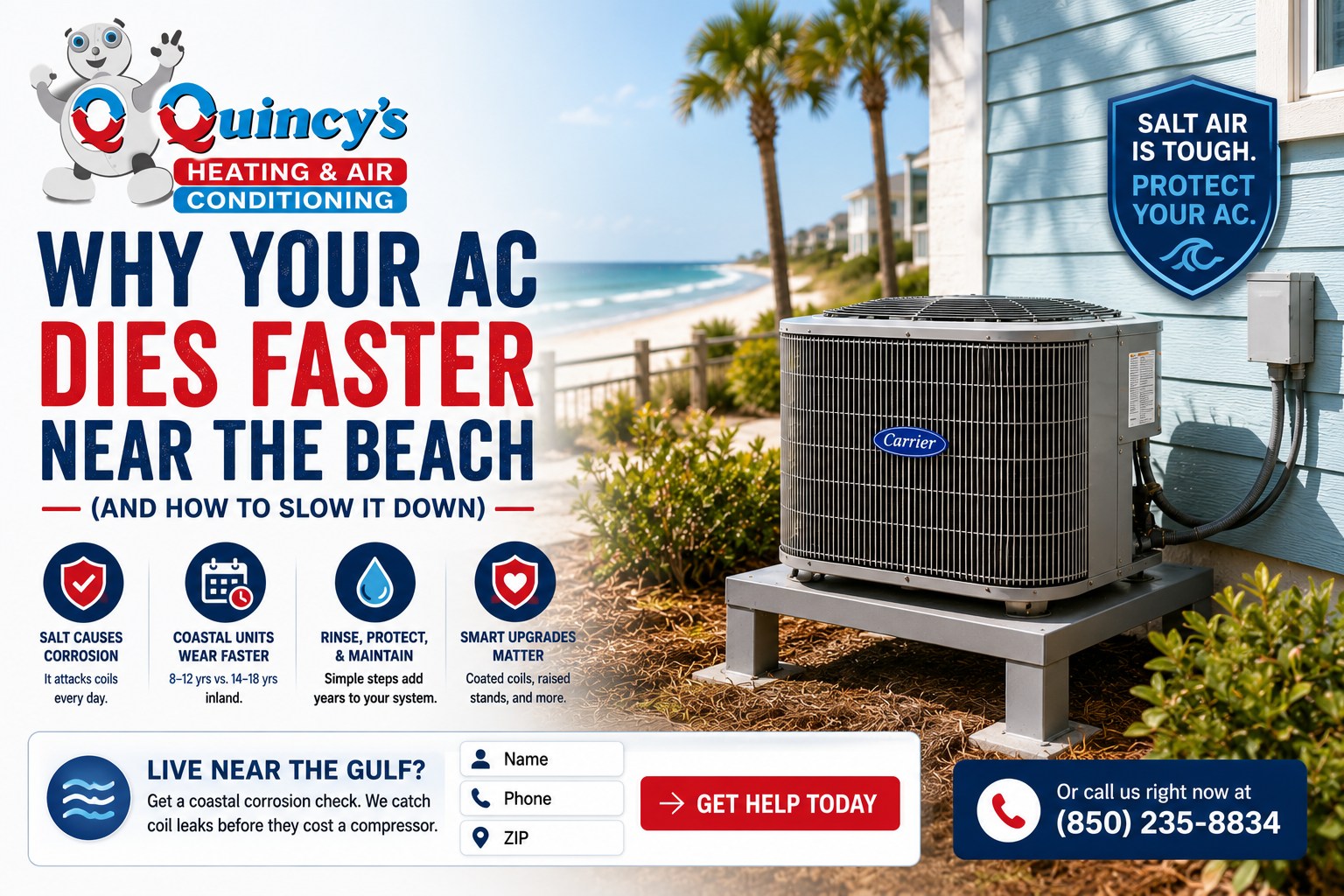
Every homeowner near the Gulf eventually hears a salesperson mention "Blue Fin coating." Most have no idea what it means or whether it's worth the premium. Here is exactly what the technology is, how it compares to the industrial alternatives, and when it actually matters.
- Blue Fin is a factory-applied polyurethane coating on AC condenser coil fins that blocks salt corrosion — the primary reason coastal AC units fail early.
- The three main coating technologies are Blue Fin (polyurethane spray), Heresite P-413 (industrial phenolic-epoxy, immersion-applied), and epoxy e-coat (electrophoretic full-penetration process).
- For homes within one mile of saltwater, a coated unit is not an optional upgrade — it is basic corrosion prevention that pays for itself in avoided compressor and coil replacements.
- Each technology protects differently. Only one is right for your distance from water.
- Blue Fin Coating
- A factory-applied polyurethane protective layer on aluminum condenser coil fins, standard on American Standard and Trane coastal-series condensers. The polyurethane encapsulates individual fins, blocking direct contact between aluminum and salt-laden air.
- Heresite P-413
- A phenolic-epoxy coating system originally engineered for oil refinery and marine industrial heat exchangers. Applied post-manufacture by specialist coating shops via immersion or spray — not at the factory. Chemically inert to salt, acids, and alkalis. Thicker and more chemically resistant than standard polyurethane.
- Epoxy E-Coat (Electrophoretic Deposition)
- An automotive-derived process in which the coil is submerged in an electrically charged epoxy bath. The electric charge drives resin uniformly into every surface, including tight internal fin geometry that spray coatings physically cannot reach. Achieves 100% surface coverage. Used by Carrier and Bryant on certain coastal-series equipment.
- Marine-Grade Components
- A collective specification for HVAC hardware engineered for saltwater proximity: stainless steel screws and fasteners (not zinc-plated), UV-stabilized polymer parts, galvanized or powder-coated steel cabinets, and corrosion-inhibited copper refrigerant line connections.
- What is Blue Fin coating? (The technical definition)
- Blue Fin vs. Heresite coating — which performs better?
- What is an epoxy e-coat and why does penetration matter?
- What does "marine-grade" actually mean?
- Do you actually need a coated unit in Panama City Beach?
- How much more does Blue Fin coating add to the price?
- Can you add coating to an existing unit?
What Is Blue Fin Coating? (The Technical Definition)
A standard AC condenser coil is made of aluminum fins crimped onto copper tubes. Both metals are workable and thermally efficient — but aluminum is highly reactive to salt. In a saltwater environment, the electrochemical difference between aluminum fins and copper tubes creates galvanic corrosion: the aluminum corrodes preferentially at the joint, and once it starts, it accelerates. Without protection, a standard coil near the Gulf can pit and fail in as little as three to five years. See the DOE's overview of central air conditioning systems for how a standard system is built and rated.
Blue Fin coating interrupts this process at the fin surface. The polyurethane layer encapsulates the aluminum, severing the electrochemical path that enables galvanic attack. Unlike paint, polyurethane bonds at a molecular level and remains flexible enough to survive the expansion and contraction of the fins through thousands of heating and cooling cycles.
What the Polyurethane Layer Actually Does to Fin Metal
- Barrier protection: Physically isolates aluminum from salt aerosol, moisture, and airborne chemicals.
- Galvanic interruption: Breaks the electrochemical circuit between aluminum fins and copper tubes that drives corrosion.
- UV resistance: Polyurethane resists UV degradation, important on exposed coastal rooftop and ground-level installs.
- Flexibility: Does not crack under thermal cycling the way rigid coatings can, maintaining the seal over time.
Which HVAC Brands Offer Blue Fin from the Factory
| Brand | Coating Name | Coating Type | Applied |
|---|---|---|---|
| American Standard / Trane | Blue Fin™ | Polyurethane | Factory |
| Carrier / Bryant | E-Coat™ | Epoxy electrophoretic | Factory |
| Lennox | Duralum™ | Polyurethane | Factory |
| Daikin | Gold Fin™ | Hydrophilic polymer | Factory |
| Comfortmaker / ICP | Select models | Polyurethane | Factory |
| Any brand | Heresite P-413 | Phenolic-epoxy | Post-manufacture specialist |
Blue Fin vs. Heresite Coating — Which Performs Better?
What Is Heresite P-413? (Entity Definition + Origin)
Heresite P-413 is not an HVAC product — it is an industrial chemical coating that the HVAC industry borrowed from oil refineries and marine engineering. Heresite Protective Coatings (Manitowoc, WI) developed P-413 for heat exchangers operating in petrochemical plants, offshore platforms, and naval vessels where standard coatings are destroyed within months. The formula is a phenolic-epoxy resin system: phenol resins provide chemical resistance; epoxy resins provide adhesion and toughness.
Unlike Blue Fin — applied at the factory via spray before the coil is assembled — Heresite is applied post-manufacture. The coil is removed from the unit, sent to a coating specialist, immersion-dipped or spray-coated, and cured at high temperature. This adds cost and lead time but achieves a thicker, more chemically resistant film that penetrates deeper into the fin geometry than factory spray allows.
Blue Fin vs. Heresite: Side-by-Side Comparison
| Attribute | Blue Fin (Polyurethane) | Heresite P-413 (Phenolic-Epoxy) |
|---|---|---|
| Application method | Factory spray | Post-manufacture immersion or spray |
| Film thickness | ~1–2 mils | ~2–4 mils (immersion) |
| Chemical resistance | Good (salt, humidity) | Excellent (salt, acids, alkalis, solvents) |
| Fin edge coverage | Partial (spray shadow) | Better (immersion fills geometry) |
| Temperature range | Up to ~250°F | Up to ~400°F |
| UV resistance | Good | Moderate (may need UV topcoat) |
| Added cost | $300–$800 (unit premium) | $400–$900 (specialist application) |
| Availability | Factory-equipped models | Any coil, any brand, any age |
| Best for | Within 1 mile of water | Beachfront / heavy industrial salt |
Technician insight
For a home right on the Gulf — Highway 98, beachfront, anything within a couple hundred yards of the water — the heavier-duty chemistry is worth specifying: Heresite or an epoxy e-coat process. Blue Fin is a solid factory option for most coastal homes, but for truly aggressive salt exposure our installers steer customers toward the coatings that fully encapsulate the coil rather than just coat the fin surface.
Chris Valladez — Senior Service Technician · 16 years with Quincy's
EPA 608 Universal Certified · NATE Certified Technician & Installer · Certified Comfort Advisor
What Is an Epoxy E-Coat — and Why Does Penetration Matter?
How Electrophoretic Deposition Works
Electrophoretic deposition — "e-coat" — was developed by the automotive industry in the 1960s to coat vehicle chassis geometry that spray guns cannot reach. The process works like electroplating in reverse: the coil is submerged in a bath of water-soluble epoxy resin. An electrical current is passed through the bath with the coil as one electrode. The charge causes the resin particles to migrate toward and deposit uniformly on every surface of the coil — including the interior fin edges, the base of each tube, and every shadow and recess that a spray nozzle physically cannot see.
This means the coating penetrates geometry that spray application misses entirely. For HVAC coils — which are dense, multi-row assemblies with tight fin spacing — this distinction matters. Corrosion in a coated coil nearly always starts at the uncoated spots: fin edges, tube attachment points, and interior rows. E-coat eliminates those gaps.
E-Coat vs. Blue Fin vs. Heresite: Full Coating Comparison
| Attribute | Blue Fin (Polyurethane) | Heresite P-413 | Epoxy E-Coat |
|---|---|---|---|
| Coverage uniformity | Good | Very good | ✓ Best — 100% surface |
| Fin edge penetration | Partial | Good (immersion) | ✓ Complete |
| Chemical resistance | Good | Excellent | Very good |
| Application | Factory spray | Post-mfr specialist | Factory (Carrier/Bryant) or specialist |
| Flexibility / crack resistance | Excellent | Good | Good |
| Cost premium | $300–$800 | $400–$900 | $500–$1,000 |
| Best environment | Up to 1 mi from water | Beachfront / industrial | Beachfront / heavy salt |
What Does "Marine-Grade" Actually Mean on an HVAC Unit?
The term "marine-grade" is used loosely in HVAC marketing. Unlike "Blue Fin" (which refers to a specific coating), "marine-grade" is not a defined technical standard — it is a descriptor for a collection of component upgrades that together improve corrosion resistance beyond a standard residential unit.
Unlike a single coating, a truly marine-grade system addresses corrosion at every point where two dissimilar materials meet, where water collects, and where UV and wind-driven abrasion act on plastic and painted surfaces.
Marine-Grade Component Checklist: What to Ask Your Installer
- Coil coating: Blue Fin, Heresite, or e-coat — confirm which and the application method. "Factory coated" alone is not specific enough.
- Fasteners and screws: Stainless steel throughout (not zinc-plated; zinc plating corrodes rapidly in salt air, leaving staining and loose panels).
- Cabinet finish: Galvanized steel with powder-coat topcoat, or a marine-grade painted finish with UV inhibitor. Thin paint over bare steel will bubble within two seasons.
- Fan blades and motor housing: UV-stabilized polymer or epoxy-coated aluminum; standard polymer blades can become brittle in intense UV within 5 to 7 years.
- Refrigerant line connections: Corrosion-inhibited copper fittings and insulation that does not absorb moisture.
- Mounting: Elevated stand (aluminum or hot-dip galvanized steel, not painted mild steel) to prevent puddle contact at the base cabinet.
Do You Actually Need a Coated Unit in Panama City Beach?
The Distance-From-Water Rule for Coastal Florida
Salt corrosion risk is not binary — it scales with distance, wind exposure, and elevation. Here is the framework we use when speccing equipment for customers on the Emerald Coast:
| Distance from Gulf / saltwater | Recommended coating | Uncoated coil expected life |
|---|---|---|
| Beachfront / under 500 ft | Heresite P-413 or E-coat | 2–4 years |
| Under ¼ mile | Blue Fin minimum; Heresite preferred | 4–6 years |
| ¼ to 1 mile | Blue Fin or equivalent factory coating | 6–9 years |
| 1 to 3 miles | Factory coating recommended | 9–13 years |
| Inland (>3 miles) | Standard coil acceptable | 14–18 years |
For instance, a home on the Gulf side of Hwy 98 in Panama City Beach is effectively at maximum salt exposure — wind off the water carries aerosol salt directly onto the condenser every time it runs. A standard coil in that location is not just suboptimal, it is a predictable early failure.
What Uncoated Coils Look Like After 3 Gulf-Side Summers
By year two to three on a beachfront home, an uncoated coil develops white chalky deposits (aluminum oxide) on the fins, followed by actual pitting — small craters in the fin surface where the metal has dissolved. Once pitting starts, it accelerates: the pitted surface has more exposed area, holds more moisture, and corrodes faster than a flat surface. By year five to seven without a coating, the fins are often so degraded that airflow is reduced and the compressor is working under sustained high load. This means the coating is not a luxury upgrade near the Gulf — it is cost-effective corrosion prevention that pays for itself in avoided compressor replacements ($1,500 to $2,800) and early unit failures.
Replacing a coastal unit? Let's spec it right.
We'll match you to the right coating and equipment for your exact distance from the water — beachfront, canal-side, or a mile inland. All three require different answers.
See our installation process →How Much More Does Blue Fin Coating Add to the Price?
Unit Premium vs. Extended Lifespan ROI
The premium for a factory-coated unit over the equivalent standard model is typically modest relative to what it protects:
| Option | Added cost | Expected benefit |
|---|---|---|
| Blue Fin / factory polyurethane | $300–$800 (unit premium) | +4–6 years coil life vs. uncoated |
| Heresite P-413 (aftermarket) | $400–$900 (specialist application) | +6–8 years; best for beachfront |
| Epoxy e-coat (aftermarket) | $500–$1,000 | +6–8 years; best fin-edge coverage |
| Compressor replacement (avoided) | $1,500–$2,800 | One avoided replacement pays for all three |
| Full unit replacement (avoided) | $5,000–$10,000+ | Coating payback is straightforward |
The math is not close. A $600 coating premium that prevents one compressor failure ($2,000 repair) returns 3× on its cost in the first failure cycle alone — before accounting for the avoided diagnostic calls, extended warranty eligibility, and improved efficiency from clean, uncorroded fins.
Can You Add Coating to an Existing Unit?
Yes, with conditions. Heresite P-413 and epoxy e-coat can both be applied to an existing condenser coil by a specialist shop. The standard process:
- The outdoor condenser coil is removed from the unit (requires a qualified technician — refrigerant must be recovered first).
- The coil is cleaned, degreased, and inspected for existing corrosion damage.
- Coating is applied (immersion or spray for Heresite; electrophoretic tank for e-coat) and heat-cured.
- The coil is reinstalled and the refrigerant system is recharged.
This is most practical on a unit that is relatively new (under 5 years) and has not yet developed pitting. Once pitting is present, coating over it seals in the damage but does not repair the lost material — the corrosion continues under the coating. For a unit already showing white chalky deposits or pitting, the conversation should usually shift to replacement with a factory-coated model rather than aftermarket treatment.
Not sure which coating is right for your address?
Tell us your ZIP code and we'll recommend the right spec for your salt exposure level.
Frequently Asked Questions
What is a Blue Fin coating on an AC unit?
Blue Fin is a factory-applied polyurethane coating on the aluminum condenser coil fins of select AC units, primarily offered on American Standard and Trane coastal-series condensers. The polyurethane layer encapsulates individual fins, blocking direct contact between aluminum and salt-laden coastal air and preventing the galvanic corrosion that destroys standard coils near the beach.
What is Heresite coating and how does it compare to Blue Fin?
Heresite P-413 is a phenolic-epoxy industrial coating originally developed for oil refinery and marine heat exchangers. Unlike Blue Fin's factory polyurethane spray, Heresite is applied post-manufacture by specialist shops via immersion or high-pressure spray, achieving thicker, more chemically resistant coverage. It outperforms standard Blue Fin in the most aggressive beachfront salt environments.
What is an epoxy e-coat for HVAC coils?
An epoxy e-coat (electrophoretic deposition) submerges the coil in an electrically charged epoxy bath. The charge drives resin uniformly into every surface, including fin edges and tight internal geometry that spray coatings miss. It achieves 100% surface coverage and is the most thorough coating application method available for HVAC coils.
Do I need a coated AC unit if I live near the beach?
Yes, if you are within roughly one mile of saltwater. Salt aerosol can pit an uncoated coil within 2 to 4 years in a beachfront setting. A factory-coated unit or aftermarket Heresite treatment is not a luxury upgrade near the Gulf — it is straightforward corrosion prevention that pays for itself in avoided compressor and coil replacements.
How much more does a Blue Fin coated AC unit cost?
Factory Blue Fin coated units typically carry a $300 to $800 premium over the equivalent standard model. Aftermarket Heresite or e-coat application runs $400 to $900 depending on unit size. Both pay for themselves quickly relative to a compressor replacement ($1,500 to $2,800) or full unit replacement triggered by salt-corrosion failure.
Can you add a corrosion coating to an existing AC unit?
Yes. Heresite P-413 or epoxy e-coat can be applied to an existing condenser coil by a specialist shop. It is most practical on a unit under 5 years old with no visible pitting. Once pitting is present, replacement with a factory-coated model is usually the better conversation.