
Heat Pump Defrost Mode: Steam, Frost and When Ice Means a Fault
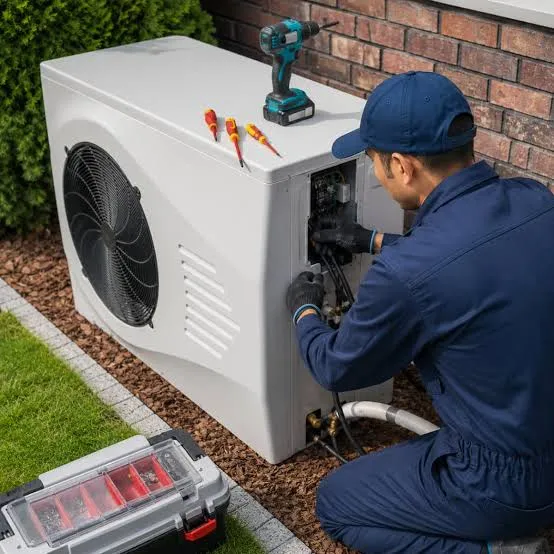
Frost on a heat pump’s outdoor coil on a cold, damp Bay County morning is normal, and the defrost cycle clears it in a few minutes. While defrost runs you may see steam rolling off the unit, hear a whoosh, and notice the outdoor fan stop while the compressor keeps humming. That is the system working as designed. A solid block of ice that does not clear, ice building on top of the unit, or a fan blade scraping against ice is a fault, and it needs a technician.
Below: why our winters frost coils so readily, what defrost actually does, how to tell harmless frost from a failed defrost, what not to do to a frozen unit, and what the usual repairs cost.
- Thin, even frost that melts in a few minutes is normal on damp mornings in the 30s and low 40s.
- Steam, a whoosh and a paused outdoor fan are signs of a normal defrost.
- A block that survives an hour or two of running, ice on the top panel, or a fan hitting ice means defrost is failing.
- Never chip, pry or cover the unit. Switch to EM HEAT and call.
- Typical Bay County market ranges, not a Quincy’s quote: defrost board or sensor $300 to $750, reversing valve $500 to $1,400.
- Why damp Gulf Coast mornings frost a coil faster than dry cold
- What a defrost cycle does, step by step
- Normal defrost or a fault: a side-by-side check
- Six reasons a heat pump stops clearing its own ice
- Frozen outdoor unit: what to do and what to leave alone
- What defrost repairs cost in Bay County
- Winter frost is not the same as a frozen AC coil
Why damp Gulf Coast mornings frost a coil faster than dry cold
In heating mode the outdoor coil is the cold side of the system. Refrigerant runs through it well below the outdoor air temperature so the coil can soak up heat from that air and carry it indoors. On a 38 degree morning the coil surface can sit below freezing even though the air around it is not.
Moisture condenses on those cold fins and freezes. How fast the frost builds depends mostly on how much water the air holds. Dry cold leaves little to freeze. A Bay County winter morning brings damp air off the Gulf and the bays, fog and heavy dew, so the coil frosts quickly and a heat pump here may defrost several times on a chilly night. We get a handful of nights near or below freezing most winters, but frost is most common on the in-between mornings: 30s and low 40s, still air, high humidity.
What a defrost cycle does, step by step
Frost blankets the coil, blocks airflow and cuts the heat the system can collect. Defrost removes it.
- The control decides it is time. Time-and-temperature systems use a sensor clipped to the outdoor coil plus a timer on the defrost board. Once the coil is cold enough to frost and the timer runs out, typically after 30 to 90 minutes of running in frosting weather, defrost begins. Demand-defrost systems compare coil and outdoor temperatures (or pressures) and defrost only when frost is actually building.
- The reversing valve shifts to cooling. For a few minutes the heat pump runs as it does in July, sending hot refrigerant gas to the outdoor coil. The whoosh is the valve moving and the pressures swapping sides.
- The outdoor fan stops. With no fan, the heat stays in the coil and melts the frost. Steam rises off the top and water runs out of the base.
- Backup heat may come on indoors. Many systems bring on the electric strips so the registers do not blow cold air while the indoor coil is briefly the cold side, and the thermostat may show AUX. Our guide to AUX heat, EM heat and the January bill explains that light.
- Defrost ends. When the coil sensor reads warm, or a time limit runs out, the valve shifts back, the fan restarts with a last puff of vapor, and heating resumes.
The cycle typically lasts a few minutes. Inside, most people notice only a change in sound or a short spell of cooler air.
Normal defrost or a fault: a side-by-side check
You can answer all of these from the back door, without opening anything.
| What you notice | Normal when | A fault when |
|---|---|---|
| White frost on the coil | It coats the fins evenly and melts at the next defrost | It thickens for hours and never melts back to bare metal |
| Steam off the top | It lasts a few minutes, then stops | It smells like burning, or smoke comes from the electrical side |
| Fan stopped, compressor running | Only during defrost | The fan stays off while heating, or will not restart |
| Whoosh from the unit | As defrost starts and as it ends | Banging, grinding or a hiss that never stops |
| Ice on the top panel or grille | Not part of normal operation | Roof water dripping on the unit, or a defrost that is not clearing the coil |
| Fan noise | A steady hum | Ticking or scraping as the blades strike ice |
| Cooler air from the vents | A few minutes during defrost | Long stretches of cool air, or AUX lit most of the day |
If the air feels weak all day, not just during defrost, read heat pump blowing lukewarm air, which includes a simple thermometer check.
Outdoor unit iced over this morning?
Tell us what you are seeing. We quote the trip charge on the call and the repair in writing before any work starts.
Six reasons a heat pump stops clearing its own ice
- Defrost board or coil sensor. A sensor that drifts or slips off the tubing tells the board the coil is warm when it is frozen, so defrost never starts. A board with a failed relay or timer does the same. This is the first place a technician looks.
- Reversing valve. Defrost depends on the valve shifting into cooling. A stuck valve or failed solenoid coil means no hot gas reaches the outdoor coil, and a valve that moves only partway gives a weak defrost that leaves ice behind.
- Low refrigerant. A short charge runs the outdoor coil colder, so it frosts faster and has less hot gas to melt it. Frost that returns right after every defrost, or forms unevenly, is the usual clue. Low charge means a leak, and topping off without fixing it only delays the next call.
- Outdoor fan relay or motor. A relay stuck closed keeps the fan blowing through defrost and carries the heat away. A dead motor or fan capacitor leaves the coil with no airflow in heating, and it ices fast.
- Water from the roof or gutter. A unit under a bare roof edge, an overflowing gutter or a downspout gets a steady drip that freezes on top faster than defrost can melt it. The fix is a gutter repair or diverter, not an HVAC part.
- A low spot. A sunken pad or a corner where rain collects leaves the unit standing in its own meltwater, which refreezes around the bottom of the coil. Raising the unit or regrading solves it.
Near the Gulf, add a salt-crusted or dirty coil. Anything that blocks air through the fins makes frost build faster.
Frozen outdoor unit: what to do and what to leave alone
Give it a fair chance first: a defrost cycle or two, or roughly an hour of running. If the ice melts back each time, the system is handling a damp morning. If it is still a solid block, do this:
- Switch the thermostat to EM HEAT. That locks out the heat pump and heats with the strips alone. It costs more to run, but it stops the compressor fighting a frozen coil and keeps the house warm until a technician arrives.
- Check the filter and replace it if it is matted. It will not cure outdoor ice, but it takes load off the system.
- Look above the unit for water dripping from the roof or a gutter, and mention it when you call.
- Call and describe what you see: ice on the coil or on top, a stopped or scraping fan, and how long it has been that way. A phone photo helps.
And leave these alone:
- Do not chip, pry or scrape the ice. The fins are thin aluminum over thin copper tubing. One slip turns a defrost repair into a refrigerant leak, typically $400 to $1,600 plus refrigerant in our market.
- Do not pour boiling water on the coil or aim a heat gun or torch at it.
- Do not cover the unit with a tarp or plastic. It needs air through the coil all winter, and a cover traps moisture.
- Do not keep cycling the breaker to force a restart. Repeated hard starts are tough on the compressor.
Heat pump stuck in ice?
Same day in most cases in Panama City and Panama City Beach. Flat trip charge quoted on the phone, repair price in writing before we start.
📞 Call (850) 235-8834What defrost repairs cost in Bay County
Typical Bay County market ranges with parts and labor, not a Quincy’s quote:
- Defrost control board or coil sensor: $300 to $750.
- Reversing valve: $500 to $1,400, including recovering and recharging the refrigerant.
- Refrigerant leak find and repair: $400 to $1,600, plus refrigerant.
- Outdoor fan motor: $350 to $850. A capacitor alone is $150 to $400.
Quincy’s quotes a flat trip charge on the phone before dispatch and prices the repair in writing before work begins. On a heat pump past about 12 years old, a reversing valve or leak repair deserves a replacement number beside it; a defrost board usually does not. More on that in heating repair in Panama City, heating repair in Panama City Beach and our heat pump repair service.
Winter frost is not the same as a frozen AC coil
Summer ice forms on the indoor coil and the copper line, usually from a dirty filter, weak airflow or a low charge, and no defrost cycle clears it. That is always a fault. If you are seeing ice in July rather than January, read our frozen AC coil guide.
Defrost questions from Panama City and Beach homeowners
Why is my heat pump steaming in the winter?
Steam rising from the outdoor unit on a cold, damp morning is almost always the defrost cycle melting frost off the coil. It looks like smoke but has no smell and stops within a few minutes. Smoke with a burning smell is a different matter and needs a call.
How long does a heat pump defrost cycle last?
Typically a few minutes. Defrost usually starts after 30 to 90 minutes of running in frosting weather and ends when the coil sensor reads warm or a time limit runs out. A unit that seems to defrost constantly, or never, has a control or refrigerant problem.
Why does the outdoor fan stop while the compressor keeps running?
That is defrost. The fan shuts off so the heat sent to the outdoor coil stays there and melts the frost. It should restart within a few minutes. If the fan stays off during normal heating, the fan motor, its capacitor or the relay that switches it may have failed.
Should I chip the ice off my heat pump?
No. The fins and tubing are thin enough to puncture with a screwdriver, and a puncture turns a defrost repair into a refrigerant leak repair. If a block of ice will not clear, switch the thermostat to EM HEAT and call for service.
How much does it cost to fix a heat pump that will not defrost?
As typical Bay County market ranges, not a Quincy’s quote, a defrost control board or sensor runs $300 to $750 and a reversing valve runs $500 to $1,400 with the refrigerant recovered and recharged. Sometimes the cure is fixing a gutter that drips on the unit.
Does a frosted heat pump waste electricity?
Light frost and short defrost cycles are part of normal winter running. A coil that stays iced is different: the backup strips end up carrying the house, and strips cost two to three times as much to run as a working heat pump. A frozen unit often shows up first on the power bill.