
AUX Heat vs EM Heat, and Why Your January Bill Doubled
AUX heat means your thermostat has automatically switched on the electric backup strips to help the heat pump. EM HEAT means someone has turned the heat pump off and the strips are heating the house alone. Strips cost two to three times as much to run as a working heat pump, so a heat pump that has quietly failed, or a thermostat that leans on the strips, shows up as a January bill far above December’s.
The house stays warm either way, so nobody calls. The first sign is the power bill. Here is what each light means, what strips cost at Bay County electric rates, and which settings and faults make a heat pump in Panama City or Panama City Beach lean on its backup.
- AUX is automatic and normal in short doses: cold mornings, defrost, catching up after a setback.
- EM HEAT is manual and locks the heat pump out. Use it only when the outdoor unit has failed or iced solid.
- About $1.40 an hour for a 10 kW strip kit at roughly 14 cents per kWh. A working heat pump delivers similar heat for a third to a half of that.
- AUX lit for hours on a mild day is a repair, not a setting.
What AUX and EM HEAT each mean on a heat pump thermostat
Most Bay County homes heat with a heat pump. A reversing valve flips the refrigerant flow, and the same outdoor unit that cooled all summer pulls heat out of the outdoor air and moves it indoors. Inside the air handler sits a bank of electric resistance elements, the heat strips, as backup.
AUX (some thermostats say AUX HEAT or backup heat) means the thermostat has energized some or all of the strips while the outdoor unit keeps running. It makes that call by itself and drops the strips once the house catches up.
EM HEAT, emergency heat, is a mode a person picks. It locks the heat pump out, and the strips carry the whole load until someone switches it back.
What heat strips cost per hour at Bay County electric rates
Bay County is served by FPL Northwest Florida, whose published 2026 residential rates put a typical 1,000 kWh Panhandle bill at about $141, roughly 14 cents per kilowatt-hour. Resistance heat is simple arithmetic from there: a strip kit rated at 10 kilowatts uses 10 kWh for every hour at full output.
| Scenario | Electricity used | Approximate cost |
|---|---|---|
| 10 kW strip kit, all elements on, one hour | 10 kWh | about $1.40 |
| Working heat pump, similar heat, one hour | a third to a half of that | roughly $0.47 to $0.70 |
| Strips running 3 extra hours a day for 30 days | 900 kWh | about $126 |
| Heat pump supplying that same heat | 300 to 450 kWh | roughly $42 to $63 |
An illustration, not a forecast. Strip kits come in several sizes, sequencers stage the elements, and your rate, house and weather will differ.
The bottom rows show how a bill doubles quietly. Ninety extra strip hours adds about 900 kWh, close to a whole typical month stacked on top of the normal bill. Compare the kWh line rather than the dollar total, and set it against last January if you have it. Why your power bill is so high covers the summer side.
Why AUX heat comes on, and which reasons are normal
- Cold mornings. A heat pump makes less heat as the outdoor temperature drops, just as the house loses heat faster. On the handful of nights near or below freezing that most Bay County winters bring, some AUX around dawn is expected.
- Big setpoint jumps. Push the thermostat up several degrees at once and many models call the strips to close the gap fast. A degree or two at a time usually lets the heat pump finish alone.
- Defrost. To melt frost off the outdoor coil, the system switches briefly into cooling mode with the outdoor fan off, and the strips usually come on to temper the air. Steam outside plus a few minutes of AUX is normal; our guide to heat pump defrost mode explains it.
- A failing heat pump. Low refrigerant, a reversing valve that will not shift, a dead outdoor fan motor or a compressor that will not start. The thermostat keeps the strips on to cover the shortfall and the rooms feel fine. This is the one that doubles the bill.
The first three sort themselves out within minutes. If AUX stays lit for hours on a 55-degree afternoon, the heat pump needs a technician.
Thermostat settings that make a heat pump overuse the strips
Big overnight setbacks. Dropping to 62 overnight and back to 70 at six in the morning saves a little heat pump runtime, then spends more on strips at breakfast. On a heat pump, a small setback or none usually costs less. Many thermostats have a heat pump recovery feature that starts warming earlier and more gently; make sure it is on.
Auxiliary heat lockout and balance point. Many heat pump thermostats let the installer block the strips above a chosen outdoor temperature and set how far the room must fall behind before strips join in. Too loose, and strips run on mild days the heat pump could handle. Too tight, and the house lags on the coldest nights. That is a setup job for a technician.
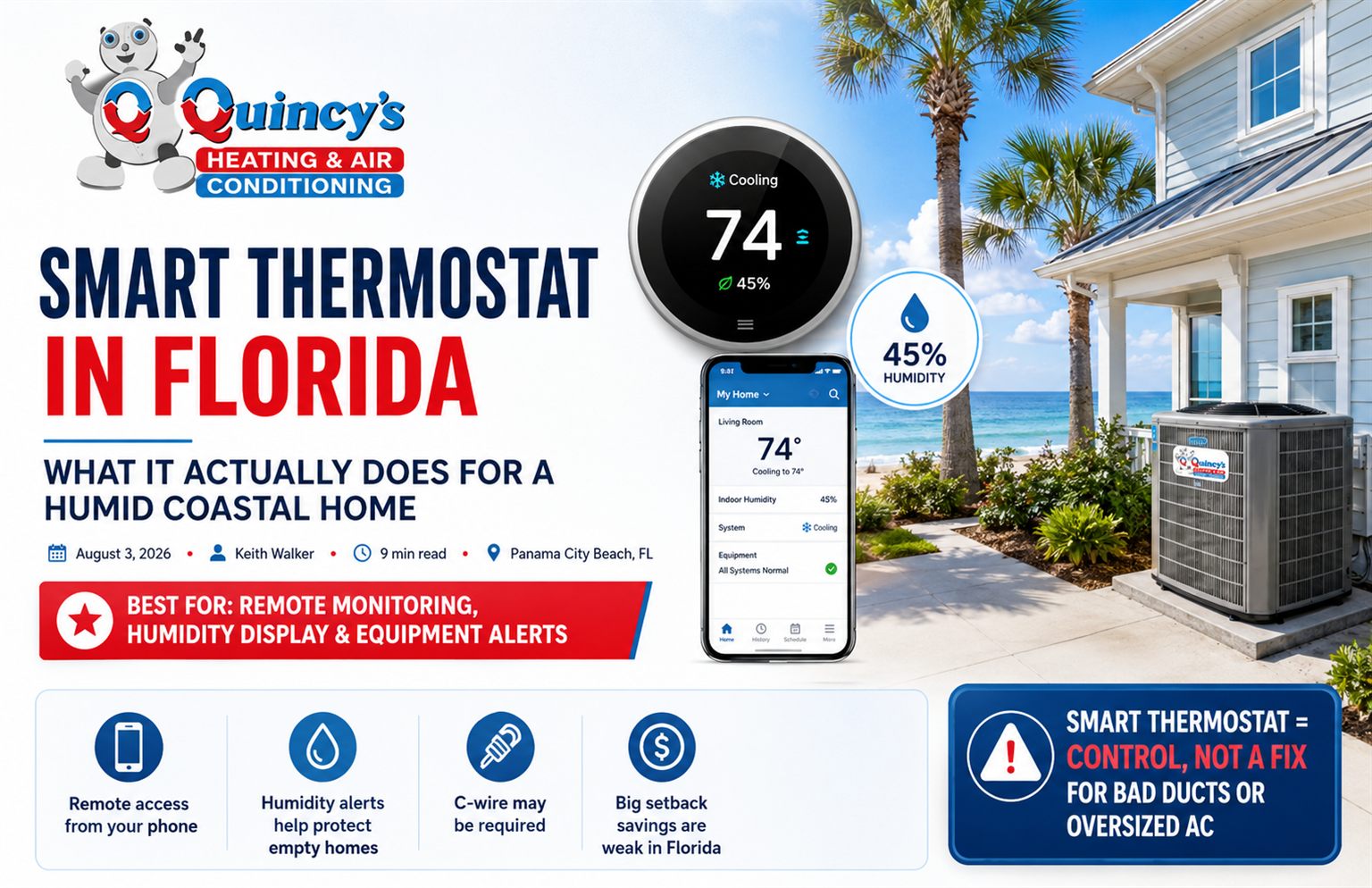
A new thermostat set up as conventional heat. Pick conventional or furnace during setup and the thermostat may call the strips for every heating demand while the heat pump sits idle. Pick the wrong reversing valve setting (most ask O or B) and the outdoor unit cools while the strips fight to heat. If the bill jumped the month the thermostat changed, check that first. Our piece on smart thermostats in Florida covers what to know before swapping one.
Want the price before anyone comes out?
Tell us what the system is doing. We quote the trip charge on the call and the repair in writing on site.
When EM HEAT is the right call, and when it is the expensive mistake
Emergency heat is the right call when:
- The outdoor coil is a solid block of ice that does not clear after defrost, not a light frost that comes and goes.
- The outdoor unit is not running, or it is grinding, screeching or banging.
- The outdoor breaker trips again after one reset.
- You are waiting for a booked repair.
In those cases EM HEAT keeps the family warm and stops a damaged heat pump from hurting itself further. It turns into the expensive mistake in three situations we see every winter:
- The vents feel lukewarm. Heat pump supply air usually runs around 90 to 100 degrees, warmer than the room but cooler than your skin, so a hand over the register reads it as cool. That is a healthy heat pump.
- There is steam or a whoosh outside. That is defrost, and it is over in a few minutes.
- It went on for a cold snap and stayed on. EM HEAT forgotten until March is the most common explanation we find for a winter bill that makes no sense.
If yours is on EM HEAT now and you are not sure why, switch back to HEAT, wait 20 minutes, and see whether the house holds temperature. If it does not, call.
January bill twice December’s?
We test the heat pump in heating mode and check what the strips draw, so you know which one has been heating your house. Same day in most cases.
📞 Call (850) 235-8834How to tell whether the heat pump is actually running
With the thermostat on HEAT and calling for warmth:
- Listen outside. The outdoor fan should turn and the compressor should hum. Air leaving the unit in heat mode feels colder than the outdoor air, because the coil is pulling heat out of it.
- Look at the coil. A thin, even frost in damp cold is normal. A silent unit with no fan and no frost on a cold morning is not heating anything.
- Measure a supply register. A kitchen thermometer reading around 90 to 100 degrees with AUX off is a heat pump doing its job. Cool air with the outdoor unit silent means something has failed.
- Check the breaker and the thermostat history. A tripped outdoor breaker is a classic way for the heat pump to stop while the strips carry on. Some smart thermostats also log heat pump hours separately from auxiliary hours.
| Thermostat shows | What is happening | Cost impact |
|---|---|---|
| HEAT, no AUX, outdoor unit running | Heat pump carrying the load | Cheapest way to heat |
| AUX briefly on a cold morning | Strips helping it catch up | Small, expected |
| AUX for minutes, steam outside | Defrost, strips tempering the air | Small, expected |
| AUX for hours on a mild day | Heat pump not keeping up or not running | High; book a repair |
| EM HEAT selected | Heat pump locked out, strips only | Two to three times heat pump cost |
| HEAT, house warm, outdoor unit silent | Strips alone: setup error or failed outdoor unit | As high as EM HEAT, no warning light |
If EM HEAT gives no warmth at all, the strips themselves have failed; see heat strip and sequencer replacement cost. If the outdoor unit has stopped, our heat pump repair page covers the usual causes. We take these calls through heating repair in Panama City and heating repair in Panama City Beach.
Questions about AUX, EM HEAT and winter bills
What is the difference between AUX heat and EM heat?
AUX heat is the thermostat adding the electric backup strips while the heat pump keeps running. EM heat is a mode a person selects that shuts the heat pump off and leaves the strips heating the house alone until someone switches it back.
Is it bad if my thermostat says AUX heat?
Not in short doses. A few minutes of AUX on a cold morning, after raising the setpoint, or during defrost is normal. AUX that stays lit for hours on a mild day means the heat pump is not keeping up or not running.
How much more does emergency heat cost to run?
Strips cost two to three times as much to run as a working heat pump. As an illustration at about 14 cents per kWh, a 10 kW strip kit running flat out costs about $1.40 an hour, against a third to a half of that for a heat pump.
Should I switch to emergency heat when it gets cold?
No. A working heat pump brings the strips in by itself when it needs help. Save EM heat for an outdoor unit that has stopped, is iced solid or keeps tripping its breaker, and only until the repair is done.
Why did my electric bill double in January?
Usually because the electric strips did far more of the heating than they should have: EM heat left on, a thermostat set up wrong, or a heat pump that failed quietly while the strips covered for it. The house stays warm, so the bill is the first warning.
Can I stop my thermostat from using auxiliary heat so much?
Often, yes. Raise the setpoint a degree or two at a time, keep overnight setbacks small, and have a technician check the auxiliary heat lockout and balance point settings. If AUX still runs for hours on mild days, the heat pump needs a repair.