
Why Is My Power Bill So High? Start With Your Air Conditioner
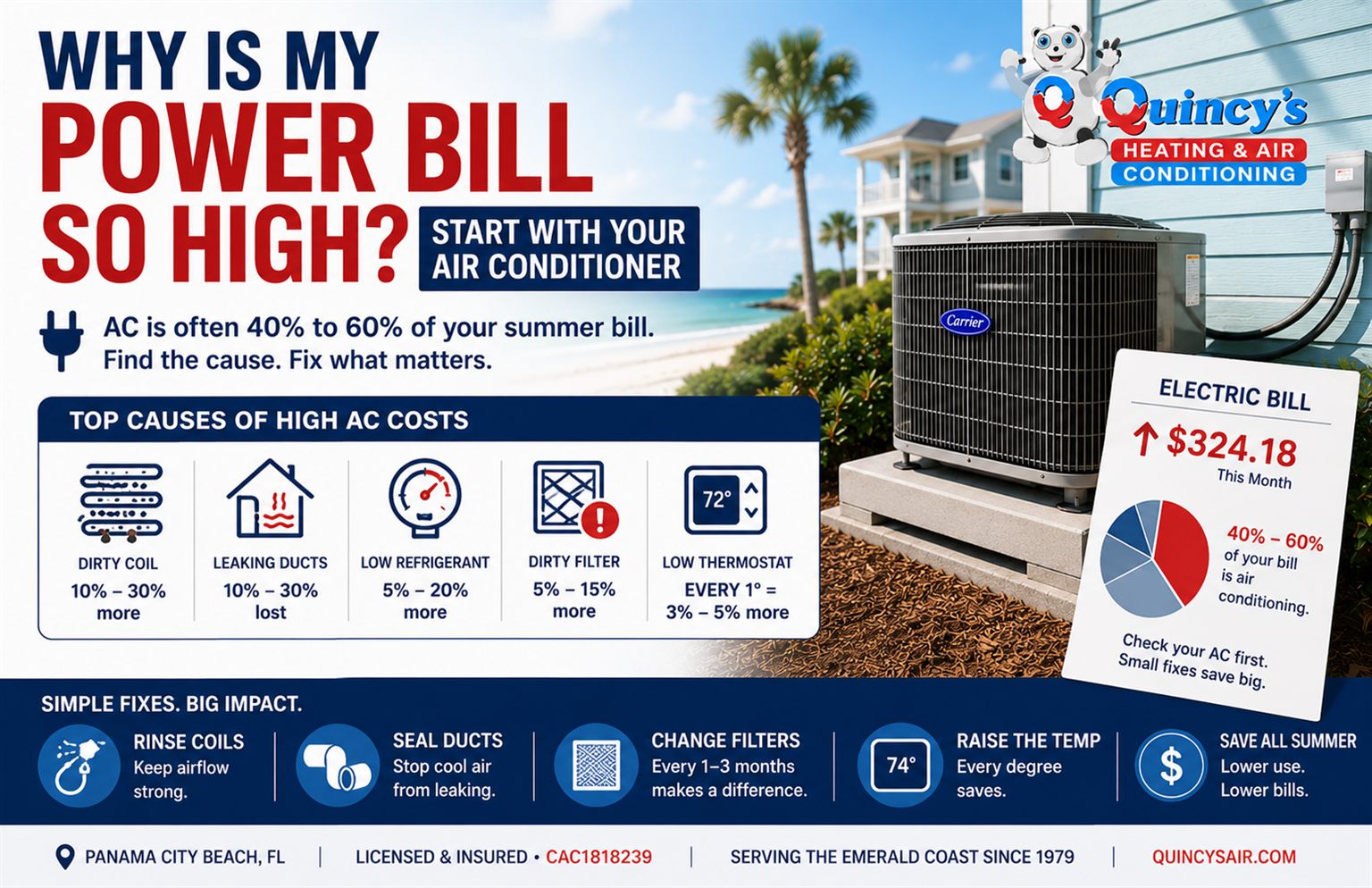
In a coastal Florida home, air conditioning is usually the single largest line on your summer power bill, often 40% to 60% of it. So if your bill jumped, start there. A salt-fouled outdoor coil, leaking attic ducts, low refrigerant or a filter nobody has changed can each add 5% to 30% more.
The harder part is working out which one is happening at your house, because most people spend money on the wrong one. Here is what really drives a high electric bill in a Florida summer, and which fixes are worth paying for.
- Cooling is 40% to 60% of a typical Emerald Coast summer bill.
- The biggest fixable losses are a dirty outdoor coil and leaking attic ducts, roughly 10% to 30% each.
- A clogged filter costs 5% to 15%, but rarely explains a doubled bill.
- Every degree you drop the thermostat adds roughly 3% to 5%.
- Closing vents and leaving the fan on ON make things worse, not better.
Where does a Florida power bill actually go?
Homes here do not spend money the way homes up north do. Our cooling season runs about eight months, and an outdoor unit in Panama City Beach works in salt air.
The result is a bill dominated by one appliance. These are typical industry estimates.
| What is using it | Share of a summer bill | Attack it first? |
|---|---|---|
| Air conditioning | 40% to 60% | Yes, by a wide margin |
| Water heating | 12% to 18% | A distant second |
| Pool pump, if fitted | 8% to 15% | Yes if it runs all day |
| Refrigeration | 4% to 8% | Only if ancient |
| Lighting | 3% to 6% | Marginal |
| Everything else | 13% to 26% | Marginal |
Typical industry estimates for coastal Florida homes in peak cooling months.
Compare the top two rows. Cutting AC energy use by a fifth beats switching every bulb in the house.
Why is my AC using too much electricity?
Eight things account for nearly all of it. Some are free to fix, one is not fixable at all.
| Cause | Typical impact on cooling cost | Fix difficulty |
|---|---|---|
| Dirty or salt-fouled outdoor coil | 10% to 30% higher | Easy to rinse, pro for a deep clean |
| Leaking or uninsulated attic ducts | 10% to 30% of cooled air lost | Professional |
| Low refrigerant from a leak | 5% to 20%, and it grows | Professional |
| Clogged air filter | 5% to 15% higher | Easy, do it yourself |
| Oversized system short cycling | 5% to 15%, plus humidity | Professional, often replacement |
| Aging low-SEER system, 12 years and up | 20% to 40% versus modern equipment | Professional, replacement |
| High humidity pushing the setpoint down | 10% to 20% higher | Mixed, depends on the cause |
| Extra run hours in a hot month | Whatever the weather did | Not fixable |
Typical industry estimates for the impact on cooling energy use. Your house will not match them exactly.
A dirty or salt-fouled outdoor coil
The outdoor unit can only throw heat away if air moves through the fins. Cover them in dust, clippings and a film of salt and head pressure climbs, the compressor pulls more amps for the same cooling, and run times stretch out.
Near the Gulf it happens faster, because salt holds dust and corrodes the aluminium underneath. Our guide to rinsing your outdoor AC coils covers it.
Leaking or uninsulated ductwork in a hot attic
This is the one homeowners never think of and the one that costs the most. A Panama City Beach attic hits 130 to 150 degrees in July, and your ducts run through it.
Every loose connection or crushed run dumps air you paid to cool into that oven, and the return pulls hot attic air back in. Typical estimates put losses in older Florida duct systems at 10% to 30%. The tells are listed in signs of leaky ductwork, and sealing and insulating fixes them.
Low refrigerant from a leak
Refrigerant is not fuel. It does not get used up, so a low charge means a hole somewhere, and topping it off without finding that hole is money thrown in the yard.
An undercharged system moves less heat per hour, runs longer, freezes the coil and eventually punishes the compressor. Ranges are in our AC repair cost guide.
A clogged air filter
Cheap, easy, and slightly oversold. A filthy filter restricts airflow across the indoor coil, raising energy use by roughly 5% to 15% and, if bad enough, freezing the coil solid. Change it, it costs $10 to $40. But if your bill doubled, a filter is the first thing to rule out, not the answer.
An oversized system that short cycles
Bigger is not better. A system sized too large cools the air quickly, shuts off, and repeats. Every start pulls a large inrush of current, and it never settles into the steady state where it is efficient.
Short runs also leave the coil too warm to strip humidity out, so the house ends up 72 degrees and clammy. Which is why a Manual J load calculation is performed when necessary.
An aging, low-SEER system
Efficiency standards have moved a long way. A 10 SEER unit from the early 2000s uses roughly 35% to 40% more energy than a modern 15.2 SEER2 system doing the same work.
That shows up every month, but it is the most expensive fix here. Replace when the system is failing, not to chase a lower bill. See our new AC installation page.
Humidity that makes you set the thermostat lower
This looks like a comfort problem and behaves like an energy problem. At 45% relative humidity, 76 degrees feels fine. At 65% it feels sticky, so people drop the thermostat to 72 and pay 12% to 15% more to fix a moisture problem. The cure is the humidity, covered in humidity problems in Panama City Beach.
Run hours: the boring answer
Sometimes nothing is wrong. A hot July, a week of houseguests, or somebody home all day at 71 degrees moves a bill without a single fault. Compare against the same month last year. May to August always goes up. August to August tells you something.
Not sure what your AC needs?
Drop your number. We'll call back within minutes during business hours.
What can I check myself in 20 minutes?
Before you pay a trip charge, run through these. No tools beyond a hose and a thermometer.
- Pull last year's bill for the same month. Year over year is the only comparison that means anything.
- Look at the filter. If you cannot see light through it, replace it today.
- Clear the outdoor unit. Grass clippings out of the fins, two feet of space all around.
- Rinse the coil with plain water, if accessible. Power off at the disconnect first, normal hose pressure only.
- Check the fan setting. It should say AUTO, not ON.
- Measure the temperature split. Supply air should run 16 to 22 degrees cooler than the return.
- Glance into the attic. Look for a flex duct off its boot or a run crushed under storage.
Items 2, 3 and 4 hold the real money. Item 6 tells you when to call.
DIY fixes versus professional fixes
The same list by who does it. Figures are typical Emerald Coast market ranges, not quotes from Quincy's.
| Fix | DIY or pro | Typical saving on cooling cost | Typical cost |
|---|---|---|---|
| Replace a clogged filter | DIY | 5% to 15% | $10 to $40 |
| Rinse the outdoor coil with water | DIY | 5% to 15% | Free |
| Switch the fan from ON to AUTO | DIY | 2% to 5% | Free |
| Raise the setpoint two degrees | DIY | 6% to 10% | Free |
| Deep clean a salt-crusted condenser coil | Pro | 5% to 20% | $150 to $400 |
| Seal and insulate attic ductwork | Pro | 10% to 25% | $800 to $3,000 |
| Find and repair a refrigerant leak | Pro | 5% to 20% | $400 to $1,600 |
| Replace a 12 year old low-SEER system | Pro | 20% to 40% | Quoted per home |
Typical Panama City Beach area market ranges for orientation, not a quote from Quincy's.
What thermostat setting is cheapest in a Florida summer?
Roughly 3% to 5% per degree. The table indexes everything to 76 degrees so you can see what your habit costs.
| Setpoint | Relative cooling cost | What it feels like in high humidity |
|---|---|---|
| 68 °F | about 128% | Cold, and the coil may freeze on a humid day |
| 70 °F | about 121% | Cool, may not hold it at 95 outside |
| 72 °F | about 114% | Comfortable for most people |
| 74 °F | about 107% | Comfortable if humidity is controlled |
| 76 °F | 100% (baseline) | Fine at 45% humidity, sticky at 65% |
| 78 °F | about 93% | Warm unless the house is dry |
| 80 °F | about 86% | Reasonable while nobody is home |
Figures assume 3.5% per degree, a typical industry estimate. Results vary with insulation and duct condition.
Two things people get wrong. First, setting 68 does not cool the house any faster than 74. A single-stage system has one speed, so you overshoot and pay for it.
Second, deep setbacks backfire here. Bumping to 85 all day sounds thrifty, but the house soaks up heat and humidity, and pulling that back out eats the savings. Keep setbacks to 2 to 4 degrees.
How do I reduce my AC energy bill for good?
Spend money in this order, best return first.
- The free stuff. Filter, coil rinse, clearance, fan on AUTO, sensible setpoint. Do it before you spend a dollar.
- Regular maintenance. Twice a year somebody checks refrigerant pressures if the temperature difference is out of range, washes the coil with water if accessible, and clears the drain line. Our maintenance plan is $292 a year with 10% off repairs.
- Ductwork. If the house is over 15 years old and the ducts were never touched, this is usually the largest saving.
- Insulation. Attic insulation in older Bay County homes has often settled below R-38. Topping it up cuts the heat your AC fights.
- Equipment. Last, and only when the system is failing or a repair crosses half the price of a new one.
That order is deliberate. We would rather sell a $292 plan that finds a loose duct than a system you do not need yet.
What does not actually move the needle
Plenty of common advice either does nothing or makes things worse.
- Closing vents in unused rooms. Raises static pressure, works the blower harder and pushes more air out through duct gaps. It costs more than it saves.
- Leaving the fan on ON. Between cycles the blower re-evaporates moisture off the coil and pushes it back into the house. Humidity rises and so does the bill.
- Shutting the AC off all day in August. The house soaks up heat and moisture, and recovery costs more than you saved.
- Shading the outdoor unit. Worth a percent or two at best, and restricting airflow hurts more than shade helps.
- Plug-in energy saver gadgets. Nothing you plug into a wall socket reduces what a compressor draws.
- Swapping every bulb to LED. Worth doing, but lighting is 3% to 6% of a summer bill. It will not explain a $150 jump.
The pattern is simple. Anything that restricts airflow costs you money, even when it feels like it should save it.
If the free checks are done and the bill still does not add up, it is time to put gauges on the system. We cover Panama City Beach, Bay County, South Walton and Washington County, and reach about 95% of calls the same day.
Bill jumped and you cannot work out why?
We will test the system and tell you what is costing you money. No hard sales.
📞 Call (850) 235-8834Frequently asked questions
Why is my power bill so high all of a sudden?
Compare the bill to the same month last year, not to last month. If it is up sharply year over year in similar weather, something changed on the equipment side. The usual suspects in a coastal Florida home are a salt-fouled outdoor coil, a refrigerant leak, a loose attic duct, or a neglected filter.
How much does a dirty AC coil add to my electric bill?
Typical industry estimates put a dirty condenser coil at 10% to 30% higher cooling cost, and near the Gulf that film builds faster because salt holds dust and corrodes the fins. Rinsing the coil with plain water, if it is accessible, costs nothing and helps. A salt-crusted coil needs professional cleaning.
Does turning the thermostat down lower cool the house faster?
No. A single-stage air conditioner has one speed, so setting 68 instead of 74 does not cool the house any faster. It runs longer and overshoots the temperature you wanted. All you add is run time and cost, roughly 3% to 5% for every degree below your normal setpoint.
What temperature should I set my thermostat to in a Florida summer?
Most Emerald Coast homes land between 74 and 78 degrees. Every degree you raise the setpoint cuts cooling cost by roughly 3% to 5%. Keep setbacks modest, about 2 to 4 degrees while you are out, because a deep setback lets humidity climb and the system spends the savings pulling it back out.
Can leaky ductwork really raise my power bill that much?
Yes. Attics in Panama City Beach reach 130 to 150 degrees in July, so every gap in the duct system dumps cooled air into that oven and draws hot attic air back in. Typical estimates put duct losses in older Florida homes at 10% to 30%. Sealing and insulating is a high-return fix.
Will a new high-SEER2 AC actually lower my Florida power bill?
It will, though how much depends on what you are replacing. Moving from a 10 SEER system installed in the early 2000s to a modern 15.2 SEER2 unit typically cuts cooling energy by 25% to 40%. Those savings take years to repay the equipment, so replace when the old system is failing.