
Smart Thermostat in Florida: What It Actually Does for a Humid Coastal Home
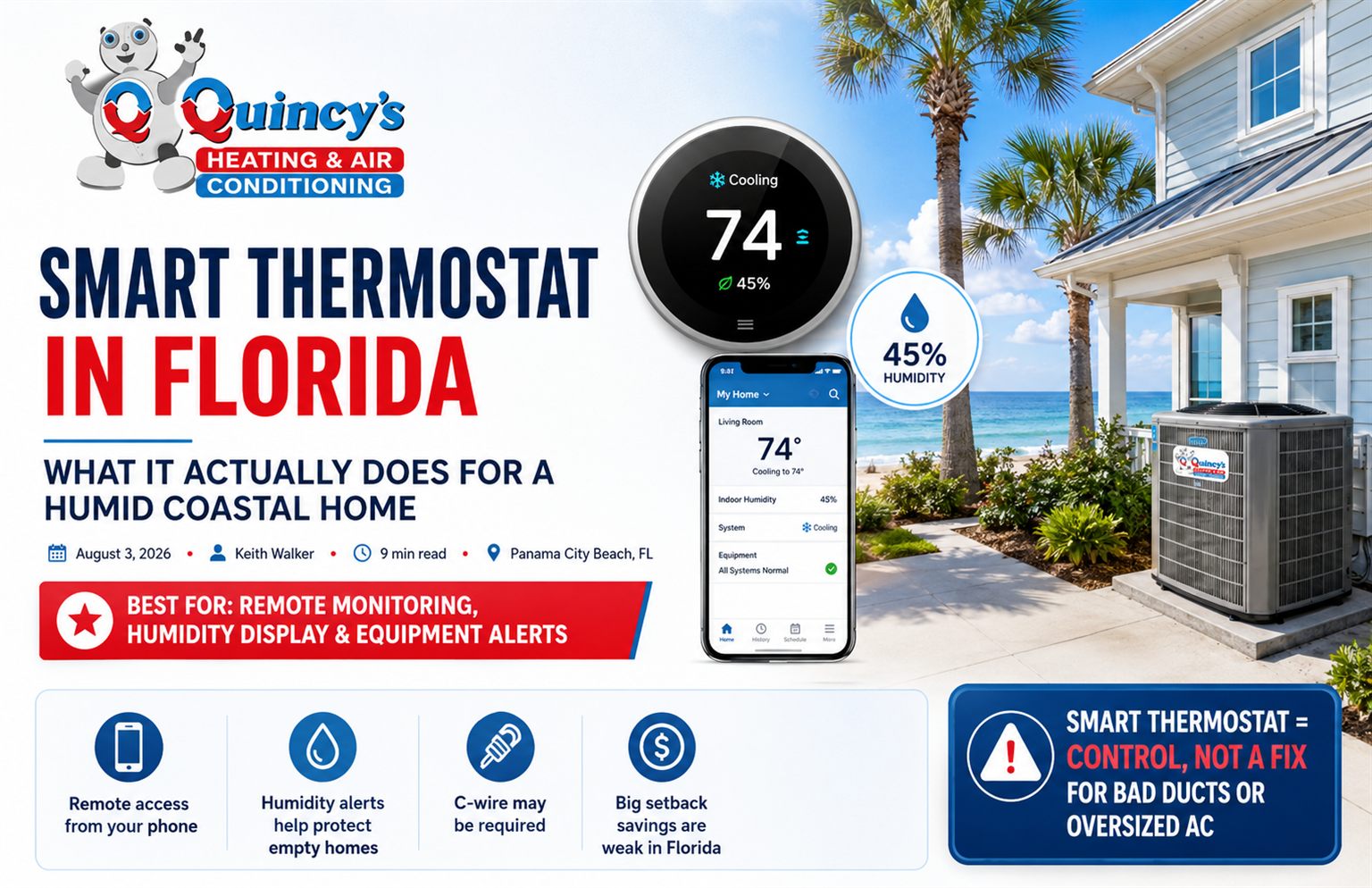
A smart thermostat in Florida is worth it for remote monitoring, humidity display and equipment alerts, not for the big savings numbers on the box. Those savings come from deep setback scheduling, which works in cold climates. In a humid coastal home, letting the house drift up also lets moisture in, and removing it costs energy.
The manufacturers are not lying about their numbers. They are quoting results from a heating climate and letting you assume those carry over to Bay County. They do not.
- Setback savings are weak in Florida. Warming the house also raises humidity, and pulling that back out costs runtime.
- Remote monitoring is the real win here, especially for beach rentals, condos and second homes sitting empty.
- The C wire stops a lot of retrofits in older homes. Check the wall before you buy.
- A thermostat that displays humidity is not the same as one that controls it.
- No thermostat fixes an oversized system or leaky ducts. Those are equipment problems.
Why do smart thermostat savings claims not travel to Florida?
The headline numbers, usually 10% to 15%, come from one behaviour: setback scheduling. You leave for work, the thermostat lets the house drift, the equipment stops, you save money.
In Ohio in January that is close to free money. The house cools down, nothing bad happens, and the furnace burns a little extra gas when you get home.
Florida in July does not work that way. Your AC does two jobs at once: dropping temperature (sensible cooling) and wringing water out of the air (latent cooling). Let the house climb from 74 to 82 for eight hours and indoor humidity climbs with it, soaking into drywall and carpet.
Drop the setpoint again and the system must pull all that moisture back out before the house feels right. That takes runtime, which is what you were avoiding. You can hit 72 degrees and still feel clammy.
The honest version: a smart thermostat here saves in the low single digits. If someone quotes you 15%, they are reading a brochure written for a heating market.
| Feature | What it does | Usefulness in Florida |
|---|---|---|
| Remote access from your phone | Change setpoint from anywhere | High. Essential for rentals and second homes |
| High temperature and humidity alerts | Pushes a warning if the house drifts | High. Catches a failure before mould does |
| Humidity display | Shows indoor relative humidity | High. You cannot manage what you cannot see |
| Dehumidify or dry mode | Overcools slightly or slows the blower to pull moisture | High, if the equipment supports it |
| Variable speed and two stage control | Runs the system on low stage for longer | High. Long low-stage runs dehumidify best |
| Filter and maintenance reminders | Tracks runtime hours, not calendar days | Medium to high. Coastal systems run hard |
| Runtime reporting | Hours run per day | Medium. Early warning of a problem |
| Deep setback scheduling | Big temperature swings while away | Low. The humidity penalty eats the savings |
| Learning or auto-schedule | Builds a schedule from your habits | Low. Same problem, less control |
| Geofencing | Adjusts when your phone leaves home | Low to medium. Useful only with small swings |
The useful half of that table is about moisture. The weak half is about temperature scheduling.
Not sure what your AC needs?
Drop your number. We'll call back within minutes during business hours.
Which smart thermostat features actually matter in Florida?
Three are worth real money on the Emerald Coast. The rest are nice to have.
Remote monitoring for empty houses
This one genuinely pays for itself, and it has nothing to do with energy. Panama City Beach and 30A are full of rentals and second homes that sit empty for weeks. If a capacitor fails in a locked-up house in August, nobody finds out until someone opens the door to a 95 degree room at 75% humidity.
A thermostat that texts you when indoor temperature crosses a threshold turns a mould remediation job into a service call. For a rental in Panama City Beach, that alone justifies the purchase.
Humidity sensing and display
Target 45% to 55% relative humidity. Above 60% you get musty smells, condensation on vents and the conditions mould needs. Most homeowners have never had a number to look at, so they only notice once something visible happens.
Displaying humidity is a sensor. Controlling it means commanding the equipment differently, which is a separate capability. The full picture is in our guide to humidity problems in Panama City Beach homes.
Compatibility with variable speed equipment
This gets overlooked and it matters most. Two stage and variable speed systems dehumidify well because they run long and slow instead of blasting for ten minutes and stopping. A cheap thermostat wired to a communicating system can drop it into single stage operation, throwing away the behaviour you paid for. Check compatibility first. Sometimes the manufacturer's own control is the smarter choice.
What is the best thermostat for humidity control?
The best thermostat for humidity control is one with a dedicated dehumidify mode and a spare accessory terminal, installed on equipment that can actually respond to it.
Two mechanisms matter. The first is overcooling: when humidity runs above target, the thermostat lets the system go 1 to 3 degrees past setpoint to keep the coil cold and dripping longer. You trade a colder house for drier air.
The second is blower speed reduction. A slower indoor fan means air spends longer on a cold coil, so more water condenses out. Not every system allows it, and pushing too far risks freezing the coil, covered in AC short cycling and what it costs.
The third option, often the right one on the coast, is a whole-home dehumidifier wired to the accessory terminal. It runs independently of cooling, which matters in spring and autumn when the house is humid but barely needs cooling.
Smart vs programmable vs basic: which thermostat do you need?
Plenty of homes here run perfectly well on a $30 thermostat. Whether you need more depends entirely on how the house is used.
| Basic (non-programmable) | Programmable | Smart (Wi-Fi) | |
|---|---|---|---|
| Typical hardware cost | $25 to $60 | $50 to $130 | $120 to $300 |
| Needs a C wire | No | Usually no | Usually yes |
| Shows humidity | No | Some models | Most models |
| Dehumidify control | No | Rare | Some models |
| Remote access | No | No | Yes |
| Away alerts | No | No | Yes |
| Filter reminders | No | Basic timer | Runtime based |
| Realistic Florida savings | Baseline | 0% to 3% | 2% to 8% |
| Best for | Someone home all day, set and forget | Predictable weekday schedule | Rentals, second homes, travellers |
Hardware costs reflect typical retail pricing in the Panama City Beach area in 2026 and exclude installation. They are not a quote from Quincy's.
The honest recommendation: if you are home every day, a basic thermostat set once and left alone beats fancy scheduling, because steady wins when humidity is the enemy. If your house sits empty for stretches, buy the smart one. Not for the savings, for the alerts.
Do you need a C wire for a smart thermostat?
Almost certainly yes, and this is where a lot of weekend projects stop dead.
A smart thermostat runs a Wi-Fi radio and a lit screen around the clock, so it needs continuous 24 volt power. That is what the C wire (common wire) provides.
Pull your thermostat off the wall and look at the terminals. A typical heat pump uses R, Y, G, W or aux, O or B for the reversing valve, and C. Many Florida homes built before the mid 2000s have five conductors and no spare, which turns a $200 upgrade into a service call.
Your options, best first:
- Run new thermostat cable. An 18/8 cable gives you every conductor you will need plus spares.
- Use an unused conductor. If the cable has a spare in the wall, a technician can land it on C at both ends.
- Fit a power adapter kit at the air handler. Sends power over the existing wires. It works, but adds a board that can fail.
- Choose a battery powered model. Fewer options, shorter feature lists, batteries to change. A last resort.
Typical Emerald Coast rates run $150 to $350 for a straightforward thermostat swap and $150 to $400 more to add a C wire. Those are area ranges, not Quincy's quotes. See our breakdown of AC repair costs in Panama City Beach.
One warning. Wiring a heat pump thermostat wrong can lock the reversing valve backwards or short a transformer. If the wire colours do not match the diagram in the box, stop and call somebody.
What a smart thermostat can fix, and what it cannot
This is where the disappointment comes from. People buy a thermostat expecting it to solve a comfort problem that was never about the thermostat.
| A smart thermostat CAN help with | A smart thermostat CANNOT fix |
|---|---|
| Forgetting to adjust the house before a trip | An oversized system that satisfies temperature before removing moisture |
| Not knowing your indoor humidity number | Leaky return ducts pulling humid attic air into the system |
| Finding out late that the AC quit while you were away | A dirty or undersized evaporator coil |
| Forgetting filter changes | Low refrigerant charge from a leak |
| Squeezing more dehumidification from capable equipment | Poor insulation or leaky windows letting outside air in |
| Spotting a system that is running far more hours than usual | A failing capacitor, contactor or blower motor |
| Small, sensible setbacks that do not wreck humidity | Ductwork sized wrong for the equipment |
The right column is the important one. An oversized air conditioner is the most common cause of a cold, clammy Florida house. It drops the temperature in eight minutes and shuts off before removing enough water. No smart feature makes a 5 ton system behave like a 3 ton one.
Duct leakage is a close second. Return ducts crossing a 130 degree attic, with joints that have given up, pull hot wet air into the system. You are paying to dehumidify the attic. See signs your ductwork is leaking air.
And if the house is not getting cold at all, the thermostat is rarely the culprit. Work through AC not cooling but running first. A weak capacitor or low charge looks like a thermostat problem until someone puts gauges on it.
How to choose a smart thermostat for a Florida home
Five steps, in this order.
- Identify your equipment first. Heat pump or straight cool? Single stage, two stage or variable speed? Communicating or conventional? This decides everything else.
- Check the wall for a C wire before you spend a dollar. Photograph the terminal block with the wire colours visible.
- Decide between humidity control and humidity display. If the house sits above 60% in summer you need control, possibly a dedicated dehumidifier.
- Confirm compatibility with the manufacturer's tool for your exact model number, not a "works with most systems" claim on the box.
- Set it up conservatively. Setbacks of 2 to 4 degrees, humidity target 45% to 55%, alerts on for high temperature and humidity.
Resist letting the learning feature build an aggressive schedule. A house held at 76 all day feels better than one swinging between 72 and 82, and costs about the same.
If the old thermostat is misbehaving, confirm it is actually the fault first. Our AC repair service covers diagnosis, and a technician can tell you in minutes whether the control is bad or reporting a real equipment problem.
Whichever thermostat you land on, it does not replace maintenance. Twice a year somebody should check the capacitor, clear the drain line and wash the outdoor coil with water where it is accessible. Our maintenance plan is $292 a year for a single-system home and includes 10% off repairs.
Want to know if your system can even use a smart thermostat?
Tell us your equipment and we'll give you a straight answer. No hard sales.
📞 Call (850) 235-8834Frequently asked questions
Is a smart thermostat worth it in Florida?
It is worth it for control and visibility, not the savings printed on the box. Remote access, a humidity reading, high temperature alerts and filter reminders all earn their keep in a coastal home. The advertised 10% to 15% comes from deep setback scheduling, which works poorly against Florida humidity.
What is the best thermostat for humidity control?
The best thermostat for humidity control has a dedicated dehumidify mode and a spare accessory terminal, paired with equipment that can act on it. That lets it overcool by 1 to 3 degrees or slow the blower to wring more moisture out. A thermostat that only displays humidity cannot do either.
Do I need a C wire for a smart thermostat?
Most smart thermostats need a C wire, or common wire, because a Wi-Fi radio and a lit screen draw continuous power. Plenty of Florida homes built before the mid 2000s have only four or five wires at the wall and no C. Budget $150 to $400 to have one added properly.
Is a Nest thermostat good for a Florida home?
A Nest works fine as a control, reads humidity on screen, and its remote access is genuinely useful for a beach rental. Its weakness in Florida is dedicated dehumidification. Thermostats with a separate dehumidify output give you more direct control over moisture. Check the model spec sheet against your equipment first.
Can a smart thermostat fix high humidity in my house?
No. A thermostat is a switch with a screen. If your house sits at 60% relative humidity, the cause is usually an oversized system, leaky return ducts pulling humid attic air, a dirty coil, or low refrigerant charge. A smart thermostat shows you the number but fixes none of those.
Should I set my thermostat back while I am away in summer?
Use a small setback, not a big one. On the Emerald Coast, 2 to 4 degrees above your normal setting saves energy without letting humidity run away. Jumping from 74 to 82 for eight hours lets moisture soak into drywall and carpet. For an empty vacation home, 78 to 80 is a sensible ceiling.