We will be straight with you, because a lot of HVAC advertising is not: we are not a 24-hour call center. We run emergency service on evenings, weekends and holidays for genuine no-cooling situations, and the phone is answered by someone who works at the company. We are on Highway 79 in Panama City Beach, so a Panama City call is a straight run across the Hathaway Bridge.
After-hours service costs more than a weekday call. Knowing which situation you are in saves you the premium, so here is the honest version.
Indoor temperature rising with no cooling at all, especially in July and August when an inland Panama City house can reach genuinely dangerous temperatures within hours. This is what after-hours service exists for.
Why an AC stops cooling →A burning, hot-plastic or electrical smell from the air handler or outdoor unit means you should shut the system off at the breaker and call. This is a safety issue, not a comfort one, and it does not wait until morning.
Strange AC noises & smells →Active water from an air handler in the attic is doing damage every hour it continues. Shut the system off, and call. The underlying cause is usually a blocked drain line and a float switch that did not do its job.
Water leaking from the AC →Elderly residents, infants, or anyone with a medical condition affected by heat changes the calculation entirely. Do not wait it out to save a service fee — call and tell us that is the situation.
Panama City AC service →One room that has never cooled properly, a slightly noisy outdoor unit, a system that cools but not quite as hard as it used to, or a thermostat you are unsure about. We would rather tell you that than charge you the after-hours premium.
Standard AC repair →
Local trucks, local technicians, a short run from PCB to Panama City.
You are told the after-hours rate before we come out.
If it can wait until Monday, we will say so.
Not a dispatch service reading from a script.
Capacitors, contactors and common parts are on board.
Highway 79 to Panama City is a short run.
Call and describe it. We will tell you honestly whether it needs someone tonight or whether it will keep until a normal-rate weekday visit.
An inland Panama City house without air conditioning heats up faster than most people expect — there is no evening sea breeze doing part of the work. A few things genuinely help while you wait, and a couple of common instincts make it worse.
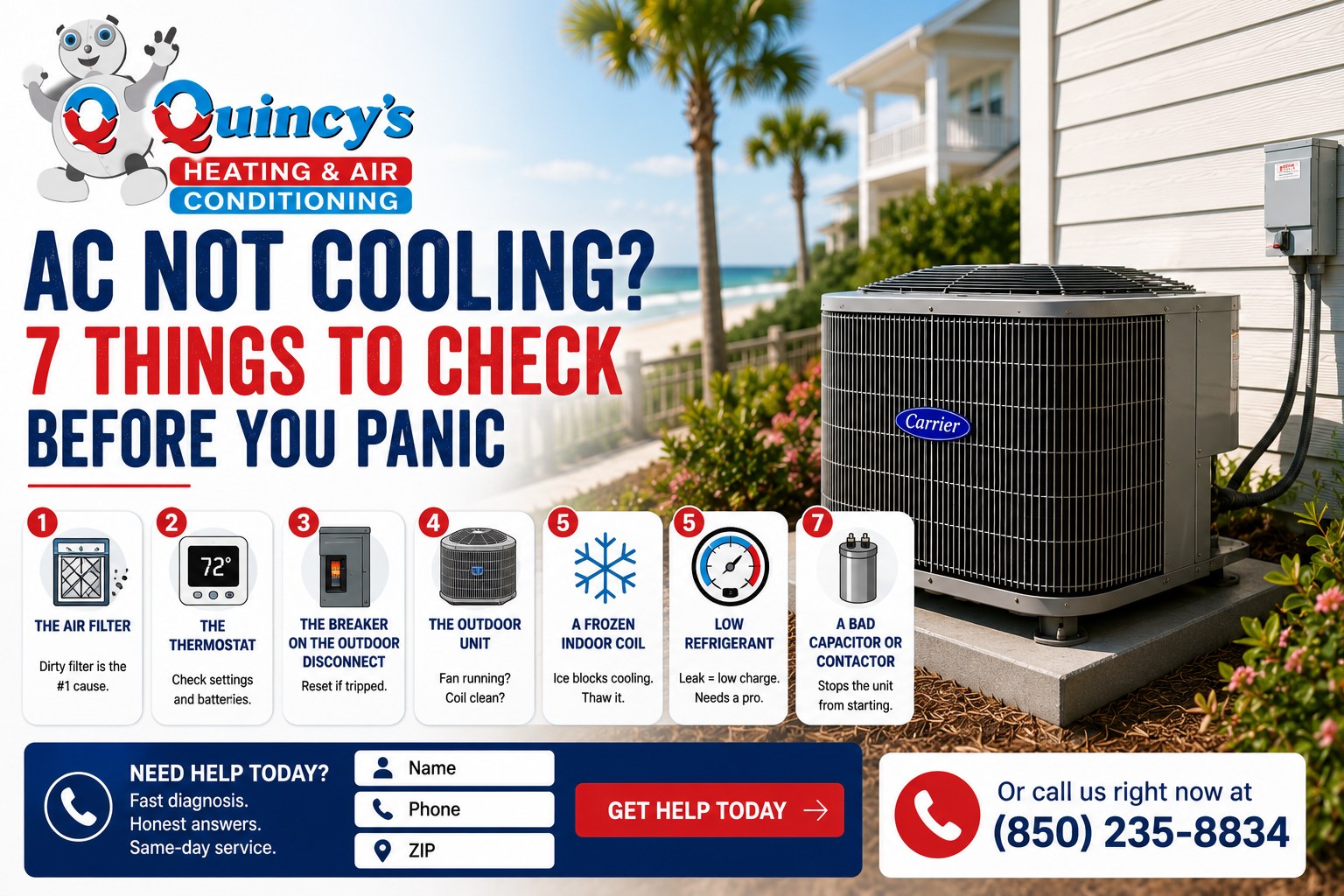
A surprising share of after-hours calls turn out to be one of three things, and all of them you can check in two minutes before paying anyone to drive out.
First, the breakers. There are usually two — the indoor air handler circuit and the outdoor disconnect near the condenser. A breaker that has tripped will sometimes look almost normal; push it fully off and then back on. If it trips again immediately, stop and call, because that is a fault, not a nuisance trip.
Second, the filter. A filter that has not been changed in a year can restrict airflow enough to freeze the evaporator coil into a block of ice, and a frozen coil produces exactly the symptom of a broken air conditioner: the system runs, but nothing cold comes out. If you can see ice on the copper lines or the indoor coil, switch the thermostat to OFF and the fan to ON and let it thaw for a few hours — then change the filter.
Third, the drain pan. If the pan under the air handler is full, the float switch has cut the system deliberately to stop water reaching your ceiling. That is the safety working as designed, and the fix is the drain line.
Close blinds and curtains on the south and west sides — radiant gain through glass is the largest single heat source in most Panama City homes in the afternoon. Keep the ceiling fans running; they do not cool the air, but moving air across skin makes a meaningful difference to how the heat feels.
Avoid the oven and the dryer. Run them after dark if at all. Keep the house closed up during the day rather than opening windows — outdoor humidity inland is high enough that opening up mostly imports moisture, which makes recovery slower once the system is running again.
And drink water. It sounds obvious, but heat illness in an un-airconditioned Florida house comes on faster than people expect, particularly for older residents. If anyone in the house is elderly, very young, pregnant or on medication that affects heat tolerance, treat it as urgent rather than inconvenient.
An emergency visit costs more than a standard weekday service call. That is a straightforward reflection of a technician coming out in the evening or on a Sunday, and we would rather tell you the rate on the phone than surprise you at the door.
What we will not do is take advantage of the situation. If you describe a symptom that is clearly not urgent — a room that has never cooled well, an outdoor unit that has always been a bit noisy, a system that still cools but seems weaker than last year — we will tell you it can wait until a weekday and book it then. It costs us a call-out and saves you the premium, and it is the reason a lot of Panama City customers stayed with us after the first time.
You also get the flat trip charge structure either way: you know what the diagnostic costs before we start, and the repair price comes before the work, not after. More on how our AC repair works →
Capacitors lead by a wide margin. They are cheap, they fail in the heat, and a failed run capacitor leaves the compressor humming and refusing to start — which is why we carry them on every truck. Contactors are second: the electrical relay that switches the outdoor unit on, which pits and burns out after enough cycles.
Then it is drain line blockages tripping float switches, which we discussed above and which are entirely preventable. After that, frozen coils from airflow restriction, failed condenser fan motors, and refrigerant leaks that have finally reached the point where the system cannot hold temperature.
Almost all of the top of that list is caught by maintenance. A capacitor measuring low, a contactor with pitted points, a drain line half full of sludge — those are visible in a spring visit and cheap to deal with then. It is genuinely the difference between a scheduled appointment in April and a Sunday phone call in July. Panama City maintenance plans →
Most emergency HVAC numbers route to a dispatch service that takes your details and passes them on. Ours does not. When you call Quincy's after hours you get someone connected to the company, who can tell you what the rate is, roughly when a technician can be there, and whether what you are describing genuinely needs someone tonight.
Most emergency failures are visible months earlier. Panama City maintenance →
Cold-snap emergencies work differently. Panama City heating repair →
Sometimes the emergency answer is a replacement. Panama City AC installation →
We run emergency service on evenings, weekends and holidays for genuine no-cooling situations, but we will not claim to be a 24-hour operation because we are not one. The phone is answered by someone who works at the company rather than a dispatch service, and if you call in the middle of the night we will tell you honestly when someone can be there.
More than a standard weekday call — that is the honest answer, and we tell you the rate on the phone before we come out rather than at the door. You also get our flat trip charge structure, so you know the diagnostic cost before we start and the repair price before the work. If what you are describing can safely wait for weekday rates, we will say so.
No cooling at all with the indoor temperature climbing; a burning, hot-plastic or electrical smell; water actively coming through a ceiling; or anyone in the house who is elderly, very young, pregnant or medically vulnerable to heat. Those warrant a call tonight. One room cooling unevenly, a slightly noisy outdoor unit, or a system that cools but less strongly than last year can wait for a weekday visit.
We are based on Highway 79 in Panama City Beach, and a Panama City call is a straight run across the Hathaway Bridge — it is one of our regular service areas, not an outlying one. Actual timing depends on how many calls are already in the queue, which on the hottest days of the year can be a lot. We will give you a realistic window on the phone.
Switch the thermostat to OFF and set the fan to ON. That runs air over the coil and thaws it without the compressor making more ice. Give it several hours — do not chip at it or aim a heat gun at it. Then change the filter, because restricted airflow is the most common cause. If it freezes again after thawing, that is usually a refrigerant or airflow fault and needs a technician.
Usually yes. If the system is running constantly without cooling, it is either frozen, low on refrigerant, or has a failed compressor or fan — and in all three cases leaving it running risks turning a repair into a replacement. Shut it off at the thermostat, and if there is any burning smell, shut it off at the breaker.
Yes, and it is a large part of what we do in Bay County. Power surges when the grid comes back are hard on capacitors, contactors and control boards, and flooded outdoor units need checking before they are energized. If your system has been through standing water, do not switch it on — call us.
In most cases, yes. Our trucks carry capacitors, contactors, fan motors and common parts, and the failures that strand people after hours are mostly on that list. Where a part has to be ordered we will tell you straight away and, where we can, get the system running in some limited fashion in the meantime.