An inland Panama City system does more work per season than the same unit sitting in a beachside neighborhood. No Gulf breeze means longer run cycles, more compressor hours, and a lot more water pulled out of the air — which is why the two failures we see most here, clogged drain lines and fouled coils, are both maintenance problems. Two visits a year, $292 for a single-system home, and 10% off any repair.
Longer run hours, heavier humidity load, and oak-shaded lots that pack outdoor coils with debris far faster than open beachside properties.
Without the Gulf breeze, a Panama City system holds the same indoor temperature with longer cycles. More hours means more wear on capacitors, contactors and the compressor — and it means the interval that keeps a beach house healthy is doing less for you here.
What the plan covers →High indoor humidity means the system is pulling gallons of water out of the air, and all of it has to leave through one narrow PVC line. Blocked lines back up into the pan, trip the float switch, and shut the system down — almost always on the hottest day of the year.
Water leaking from the AC →The older, heavily shaded neighborhoods inland — The Cove, Forest Park, St. Andrews — pack outdoor condenser coils with pollen, leaf litter and seed far faster than an open beachside lot. A dirty coil raises head pressure and quietly adds to every bill.
Spring AC checkup →Systems rarely fail overnight. Charge drifts, coils foul, capacitors weaken — and the bill creeps up for two summers before the unit finally quits. Maintenance is mostly about catching the drift while it is still cheap.
AC short cycling →Most manufacturer warranties on newer equipment require documented annual maintenance to stay valid. If you had a system installed in the last few years, the maintenance record is part of what you paid for.
Panama City AC installation →
Scheduled visits, same technicians, in your neighborhood.
Spring before the heat, fall before the first cold snap.
Flat annual price. Additional systems discounted.
All year, on any repair, plan members.
You do not have to remember — we call you.
Plan members get moved up when it breaks anyway.
That is the normal starting point. The first visit is where we find the drain line that is half blocked and the capacitor reading low — before either one strands you in August.
There is a wide gap between a genuine maintenance visit and the $39 “tune-up” that exists to get a salesperson into your attic. Here is what we actually do, what it prevents, and why the inland Bay County version of this job is not the same as the beachside one.
If we had to pick one item on the checklist that saves Panama City homeowners the most money, it would be this. Your air conditioner is a dehumidifier that happens to cool, and in an inland Florida summer it pulls a startling volume of water out of the house — all of which exits through a single narrow PVC line, usually running somewhere inconvenient.
That line grows biological sludge. When it blocks, water backs up into the drain pan, the float switch does its job and shuts the whole system down, and you discover this on a Saturday afternoon in July. Or the float switch does not do its job, and you find out when the ceiling below the air handler stains.
We clear and flush the line on every visit and test that the float switch actually cuts the system. It takes a few minutes and it prevents the single most common emergency call we get. Why AC systems leak water →
A condenser coil packed with pollen, oak debris and dryer lint makes the compressor work against higher head pressure to reject the same heat. You do not notice it as a failure — you notice it as a bill that is fifteen percent higher than it should be, and as a compressor that dies two years earlier than it needed to.
The inland neighborhoods are noticeably harder on coils than the beach. Mature oaks and pines over The Cove, Forest Park and St. Andrews drop material continuously, and a shaded lot that keeps the house cool also keeps the coil damp, which makes debris stick rather than blow off.
So we wash the condenser coil properly, and we inspect the indoor evaporator coil and blower wheel — a blower wheel caked with dust moves dramatically less air than a clean one, and restricted airflow is behind a large share of “it is running but not cooling well” complaints.
Capacitors are the most common single failure on a Florida air conditioner, and they are one of the few parts that tell you they are going. A capacitor rated at 45 microfarads that measures 38 is still working — and will strand you within a season or two.
We measure it rather than eyeballing it, along with contactor condition, compressor and fan motor amp draw, and the tightness of the electrical connections (heat cycling loosens them, and a loose lug is how a contactor burns). Those numbers get recorded, which means the next visit can compare against the last one. Drift over time is far more informative than a single reading, and it is the difference between predicting a failure and reacting to one. What capacitor replacement costs →
“Topping off the freon” is not maintenance. A sealed system does not consume refrigerant — if the charge is low, there is a leak, and adding refrigerant without finding it is selling you the same gas twice.
We verify the charge against superheat and subcooling rather than pressure alone, because pressure on its own does not tell you whether the system is actually right. If the charge is genuinely low, we say so and talk about finding the leak. If it is correct, we leave it alone.
Spring visit before the heat arrives, fall visit before the first cold snap. That is not arbitrary. The spring visit is about the cooling season you are walking into — coils, charge, drain line, capacitor — and it happens while we can still get you scheduled quickly.
The fall visit is genuinely more valuable in Panama City than most people expect, because heating equipment here sits unused for ten months and then gets asked for everything at once during a two-day cold snap. Reversing valves stick, defrost boards fail, and heat strip sequencers burn out — and the fall visit is when we find those while it is still 70°F outside and nobody in the house is cold. Panama City heating repair →
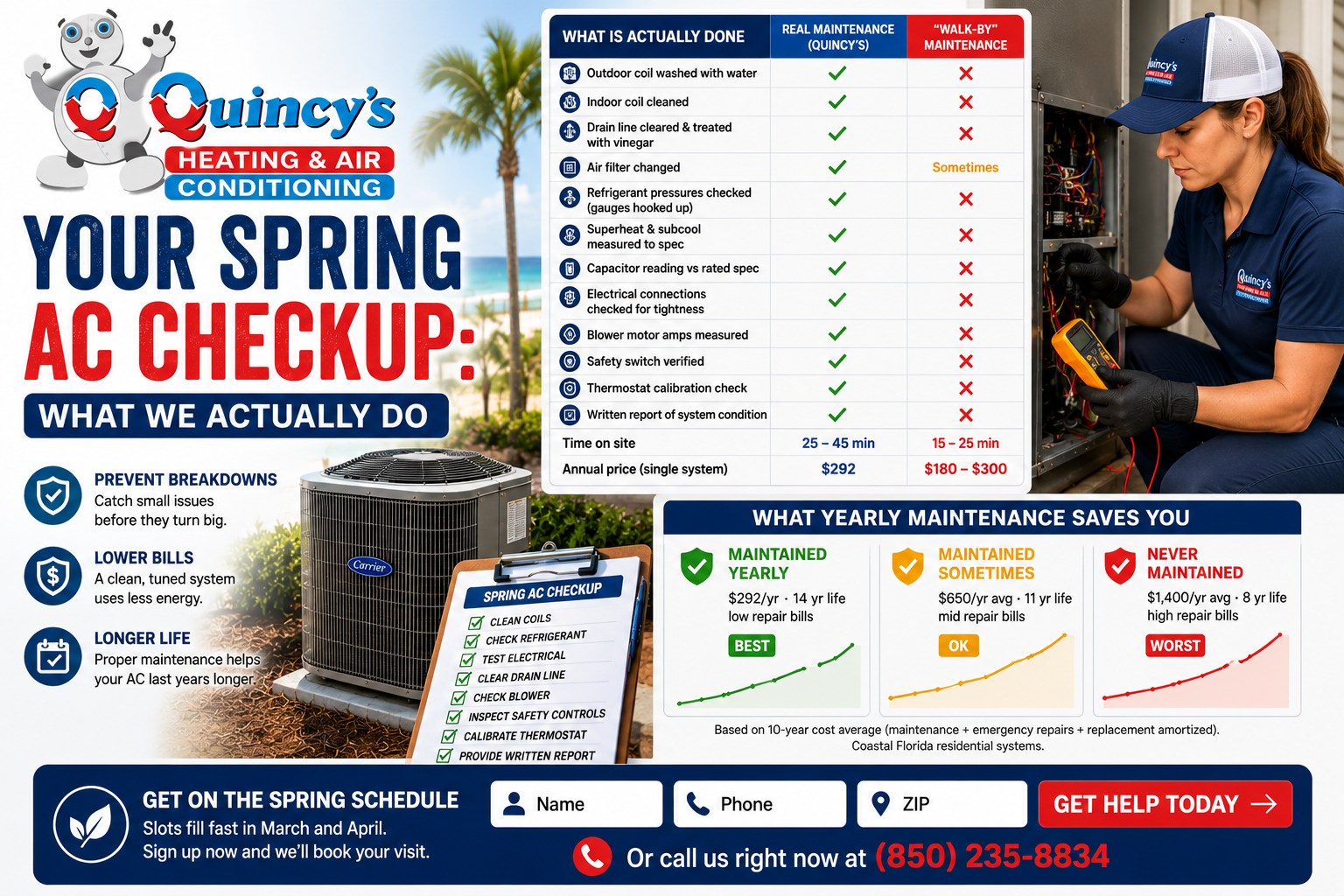
One flat annual price covering two full visits, with additional systems discounted. Plan members get 10% off any repair for the whole year and move up the queue when something does go wrong in the middle of August. We call you to schedule — remembering is our job, not yours.
When maintenance finds something that needs fixing, plan members get 10% off. Panama City AC repair →
The fall visit is really a heating visit. Here is why that matters here. Panama City heating repair →
Maintenance plans across Bay County, including builder-warranty documentation. Lynn Haven maintenance →
$292 a year for a single-system home. That covers two full visits — spring before the heat and fall before the first cold snap — and includes 10% off any repair for the whole year. Additional systems on the same property are discounted. There is no long contract and no hidden trip fee on plan visits.
Twice a year. Inland Bay County systems accumulate more run hours per season than beachside ones because there is no Gulf breeze doing part of the work, and the humidity load means drain lines and coils need attention more often than a once-a-year visit provides. The fall visit doubles as your heating check, which matters because heat pump faults only show up in heating mode.
The condenser coil is pulled and washed rather than glanced at; the evaporator coil and blower wheel are inspected; the drain line is cleared and flushed and the float switch tested; refrigerant charge is verified against superheat and subcooling; capacitor microfarads, contactor condition and motor amp draws are measured and recorded; electrical connections are torqued; and the filter is changed with airflow checked. You get the readings in writing.
It stops it climbing, which is the more honest way to put it. A fouled condenser coil, a restricted blower wheel or a charge that has drifted low all make the system work harder for the same cooling — and those losses arrive gradually enough that most people never connect them to the bill. Restoring the system to spec brings the bill back to where it should be; it will not make an old system perform like a new one.
In most cases yes, and this catches people out. The majority of manufacturer warranties on newer equipment require documented annual maintenance by a licensed contractor. If a compressor fails in year six and there is no service record, the claim can be denied. Our plan produces that documentation as a matter of course.
Yes — arguably more, because that is when the warranty documentation requirement is live. A new system will not fail from neglect in year two, but the drain line will still block, the coil will still foul, and the warranty condition still applies. Maintenance on newer equipment is mostly about protecting the investment you just made.
We tell you what it is, what it costs, and whether it needs doing now or can wait — and plan members get 10% off. We do not carry out repairs without asking, and we do not manufacture problems. If the system is fine, we will tell you it is fine and you get the readings to prove it.
Plan members get priority scheduling, which in practice means you get moved up the queue on the day everyone in Bay County calls at once. Same-day service in most cases. Call (850) 235-8834.