Maintaining a fifteen year old air conditioner is not the same job as servicing a new one, and pretending otherwise does Callaway homeowners no favors. On older equipment the point of a visit is partly upkeep and partly honest triage — keeping the thing running well, while telling you plainly how much life is realistically left. $292 a year for a single-system home, two visits, 10% off any repair.
Equipment well past its first decade, tenants who never see a filter, attic ductwork patched in a hurry after 2018, and owners who need real numbers rather than reassurance.
On a system in its teens, a visit is not preventive in the usual sense — it is about keeping a known-tired machine running safely through another summer while you plan. We will tell you which of those two situations you are in.
Callaway AC installation →When a tenant moves out and another moves in, the air conditioner is the one appliance nobody inspects. Between-tenant visits are the cheapest maintenance an owner can buy, because that is the only moment the house is empty and accessible.
Rental property AC care →A filter that has been in place for a year does not just get dirty — it starves the system of airflow until the evaporator coil ices over and the house stops cooling. It is the most common call we take in 32404 and it is entirely preventable.
How often to change a filter →Ductwork across Callaway was repaired fast in the months after Hurricane Michael, and plenty of it has never been checked since. We put eyes on it during maintenance rather than waiting for a room to stop cooling.
Signs of leaky ductwork →If you own property in Callaway you are not looking for reassurance, you are looking for a budget. Written readings from each visit let you see a system trending down over two years instead of finding out in July.
Why power bills climb →
Scheduled visits, written readings, straight answers about older equipment.
We will tell you when a system is worth keeping going.
Two visits. Additional systems and properties discounted.
Between tenants, when the house is empty and accessible.
So you can see a system trending down before it quits.
All year, on any repair, for plan members.
A single visit between tenants gives you a written condition report and a realistic replacement year, which is a lot cheaper than an after-hours call in August with a family in the house.
Most maintenance writing assumes a healthy system a few years old. That is not the typical Callaway situation. Here is how we approach the equipment that is actually in these houses, and what an owner or landlord should expect to get out of a visit.
There is a point in a system's life where maintenance stops being about extending it much and starts being about knowing where you stand. A unit in its teens is not going to be restored to factory performance by a service visit, and any contractor implying otherwise is selling something.
What a visit genuinely does at that age is two things. It keeps the consumable failures — capacitor, contactor, blocked drain, starved filter — from turning a working system into a dead one in the middle of August. And it produces a set of measurements that tell you how the machine is actually trending.
That second part is what owners care about most. A capacitor rated at 45 microfarads reading 41 this spring and 36 next spring is a system telling you something. Compressor amp draw creeping up year over year is a system telling you something. We write the numbers down, so the replacement conversation eventually happens on a schedule you chose rather than on the hottest afternoon of the year.
If we could fix one habit across 32404 it would be this one. A pleated filter left in place for a year does not politely get dirty and carry on. It progressively restricts airflow across the evaporator coil until the coil temperature drops below freezing, and then the coil ices over solid.
What the homeowner or tenant experiences is an air conditioner that runs and runs and blows almost nothing, then mysteriously works again the next morning after the ice melts, then fails again by afternoon. It looks like a serious equipment fault. It is usually a filter and, by the time we arrive, a soaked drain pan.
In owner-occupied houses this is easily solved by a reminder. In rentals it is structural: the tenant does not own the equipment, often does not know where the filter lives, and has no reason to buy one. Which is exactly why we push landlords toward scheduled visits rather than hoping. What a frozen coil actually means →
Turnover is the one predictable moment when a rental is empty, accessible, and nobody is inconvenienced by us being there for an hour. It is also the moment when problems the last tenant never reported are still fixable rather than urgent.
We find thermostats left in emergency heat, filters that predate the previous lease, drain lines already backing into the pan, and outdoor units with the fan grille full of debris. None of that gets reported by a tenant on their way out. All of it lands on the next tenant, at which point it is your emergency.
For owners with several properties around Callaway and Cedar Grove, it is worth having one conversation covering all of them — a service history per address, visits scheduled around your turnovers, and one invoice format you can actually file. Callaway AC repair and service →
This is the part of the visit we spend more time on in Callaway than anywhere else in Bay County. A great deal of duct repair happened here very quickly after October 2018, under conditions where getting a family back into a livable house was the only thing that mattered.
Seven years on, some of those repairs are still perfectly sound. Others are flex runs that were reconnected and have worked loose, taped joints that have let go in attic heat, and insulation that was never fully restored. The symptom is a room that never quite keeps up, or a system that runs far longer than it should for the house size.
We look at it on maintenance visits rather than waiting for a complaint, because a duct problem masquerades as an equipment problem and people replace perfectly good equipment because of it. Ductwork and insulation work →
We are not going to tell you a service visit will slash what you pay. On a system in its teens fighting leaky attic ducts, maintenance stops the bill climbing further and returns the equipment to whatever its realistic best is. That is a genuine saving and it is worth the money, but it is not a transformation.
If your bill is the actual problem — and in Callaway, with no Gulf breeze and older housing stock, it often is — then the honest answer usually involves ductwork, insulation and eventually equipment, in that order of cost-effectiveness. We would rather tell you that plainly than take your money for a tune-up and let you discover it in July.
What we do commit to is this: readings in writing, a straight answer about remaining life, and no repair carried out without asking you first.
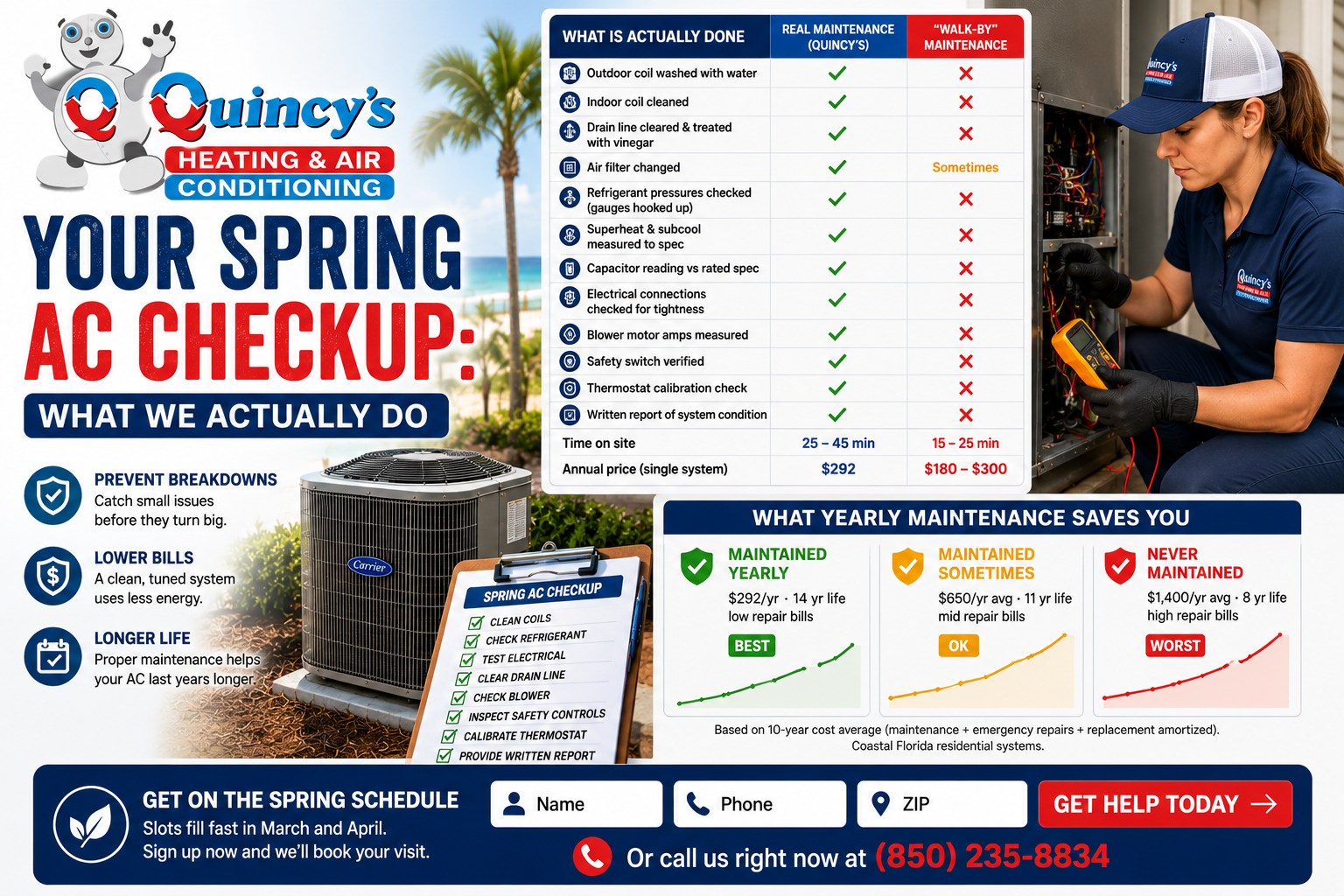
One flat annual price covering two full visits on a single-system home. Additional systems and additional properties are discounted, which matters here because a lot of our Callaway plan members own more than one address. Plan members get 10% off any repair all year and move up the queue when something fails in August.
Same-day in most cases across 32404. Plan members get 10% off. Callaway AC repair →
The fall visit is really a heating check. Here is why that matters in rentals. Callaway heating repair →
When the numbers say the old unit has had its run. Callaway AC installation →
Yes, but for a different reason than on a new one. It will not make a fifteen year old unit perform like new. What it does is stop the cheap consumable failures — capacitor, contactor, blocked drain, starved filter — from killing a working system in August, and it gives you measured readings so you can see the decline coming and budget for replacement on your own schedule.
$292 a year for a single-system home, covering two full visits and including 10% off any repair for the whole year. Additional systems are discounted, and so are additional properties — which matters here, because a good number of our Callaway plan members own more than one address around 32404.
Yes, and it is a large share of what we do here. We schedule visits around your turnovers so the property is empty and accessible, produce a written condition report per address, and invoice in a format you can actually file. If you own several units it is worth one conversation covering all of them.
Almost always restricted airflow, and in Callaway rentals it is almost always a filter that has not been changed in a very long time. Starved airflow drops the evaporator coil below freezing, ice forms, and the system blows almost nothing until the ice melts overnight. Left alone it soaks the drain pan and can damage the compressor, so it is worth fixing rather than living with.
Between tenants, without question. It is the one moment the house is empty, nobody is inconvenienced, and the problems the last tenant never bothered to report are still cheap to fix rather than urgent. Thermostats left on emergency heat, drain lines already backing up and year-old filters are all standard turnover findings.
It stops it climbing and returns the system to its realistic best, which is a real saving but not a transformation. If the bill itself is the problem — and with older housing east of the bay and no Gulf breeze, it often is — the honest sequence is usually ductwork, then insulation, then equipment. We will tell you that rather than sell you a tune-up and let you find out in July.
We inspect the accessible attic runs, and in Callaway we pay particular attention to repairs made in the months after Hurricane Michael. A good number have held up fine; others have worked loose or lost their tape in attic heat. Duct problems imitate equipment problems, and people replace perfectly good systems because of them.
We tell you what it is, what it costs, and whether it needs doing now or can wait until the next visit — and plan members get 10% off. We never carry out a repair without asking first. If the system is simply old but sound, we will say exactly that and give you the readings behind it.