
Mini Split vs Central AC: An Honest Comparison for Florida Homes
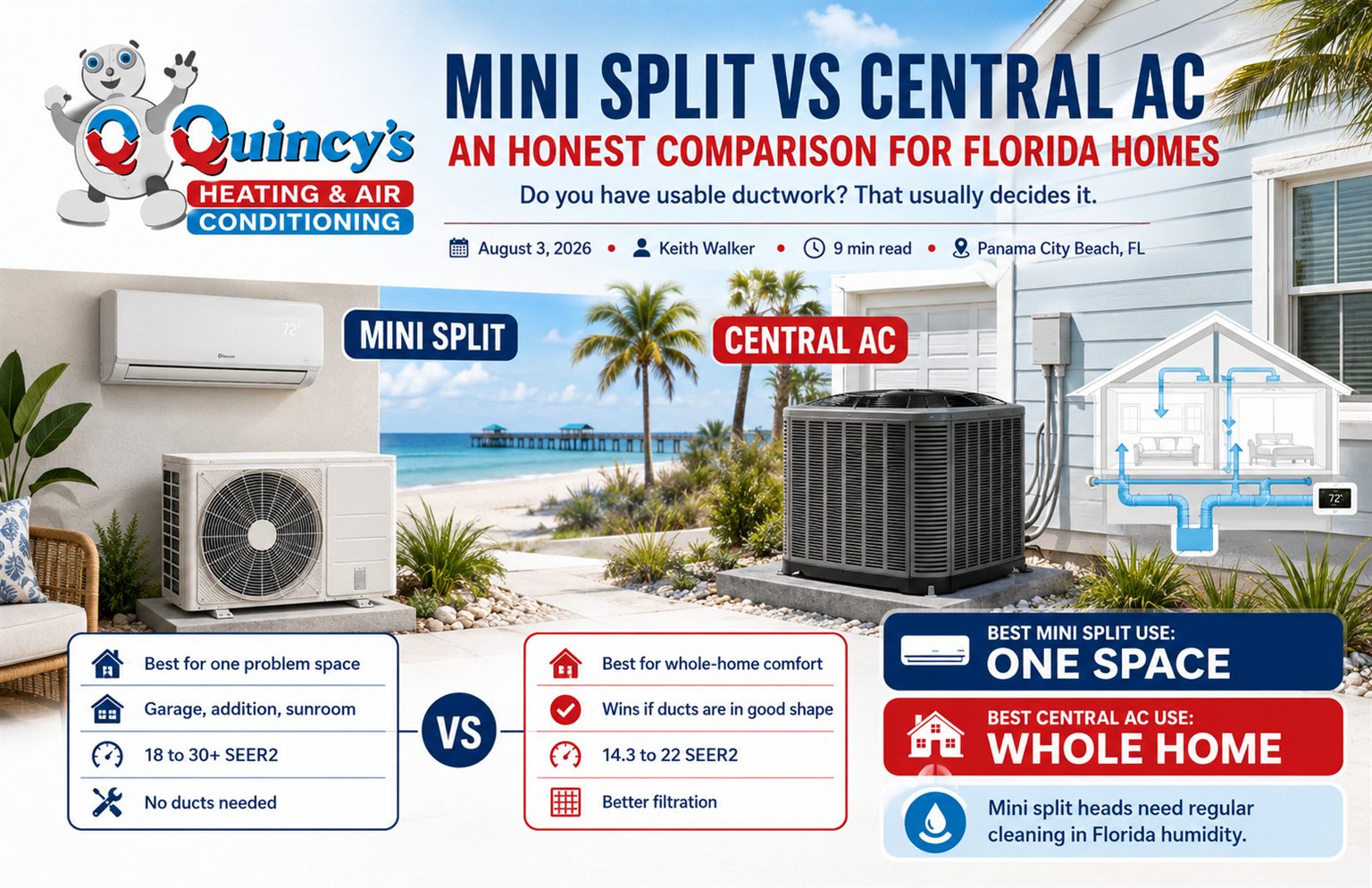
Mini split vs central AC comes down to one question: do you have usable ductwork? A ductless mini split is the better choice for a single space your central system was never sized to cool, like a garage, an addition or a sunroom. Central AC still wins for whole-home comfort in a house with decent ducts.
Plenty of contractors push one or the other, usually whichever they install most. Here is the honest version of where each one wins on the Emerald Coast.
- Best for one problem space: garage, addition, sunroom, converted attic or guest suite.
- Central is usually cheaper whole-home if the ducts are worth keeping.
- Mini splits hit 18 to 30+ SEER2 with no duct losses, but many heads cost more.
- Most modern mini splits are heat pumps, so the same unit heats and cools.
- Heads get mouldy in Florida if you skip cleaning: filters every 2 to 4 weeks, blower wheel every 1 to 2 years.
What is a ductless mini split?
A ductless mini split has two pieces. Outside sits a small condensing unit. Inside sits an air handler, called a head, mounted on the wall, in the ceiling, or tucked into a soffit.
Between them runs a line set: two copper refrigerant lines, a control wire and a condensate drain, passed through a hole about three inches across. That is the whole install. No trunk, no return, no boxes in the attic.
The head blows air straight into the room. A central system pushes air from one air handler through duct to every register. That difference drives everything below. Worth knowing too: most mini splits sold today are heat pumps, so they heat as well as cool. See heat pump vs air conditioner.
Mini split vs central AC: the head to head comparison
Here is the straight comparison. Both columns assume good equipment properly installed.
| Factor | Ductless mini split | Central ducted AC |
|---|---|---|
| Ductwork | None needed | Required, and its condition decides everything |
| Zoning | Every head is its own thermostat | One zone unless you add dampers |
| Typical efficiency | 18 to 30+ SEER2 | 14.3 to 22 SEER2 |
| Duct losses | Zero, no ducts | Leaky attic ducts waste 20% to 30% |
| Cost, whole house | Usually more, one head per zone | Usually less if ducts already exist |
| Humidity control | Very good sized right, poor oversized | Very good, easier to get right |
| Indoor noise | 19 to 32 dB, but it is in the room | Air handler sits in a closet or attic |
| Air filtration | Thin mesh only, no filter cabinet | Takes 4 inch media filters and REME HALO |
| Heating | Heat pump built in on most models | Needs a heat pump or a furnace |
| Maintenance | Every head cleaned, mould if ignored | One filter, one coil, one drain |
Mini splits win on flexibility and zoning. Central wins on filtration, simplicity and whole-home value. Neither is a scam and neither is magic.
When is a mini split for a garage or addition the right call?
The clearest signal: you need to condition a space your ducts do not reach. Extending a trunk means opening ceilings and hoping the system has spare capacity. A mini split sidesteps it: one hole, one line set, one head, usually done in a day.
| Your situation | Better fit | Why |
|---|---|---|
| Garage or workshop you want usable in July | Mini split | No ducts out there, and garage air should stay out of the house |
| Room addition or bump out | Mini split | Existing system is rarely sized for the extra load |
| Sunroom or Florida room with lots of glass | Mini split | Solar gain a shared zone cannot match |
| Converted attic or bonus room | Mini split | Hot, hard to duct, needs its own thermostat |
| Guest suite or rental lockout | Mini split | Separate control, runs only when occupied |
| One bedroom always 5 degrees hotter | Fix ducts first | Usually airflow or a duct fault, not a missing system |
| Whole house, ducts in decent shape | Central AC | Cheaper, one filter, better filtration options |
| Whole house, no ductwork at all | Ductless, multi zone | Cheaper than building ducts from nothing |
| Whole house, ducts crushed or mouldy | Get both numbers | New ducts plus central can beat five ductless heads |
Notice the sixth row. If one room runs hotter than the rest, a mini split treats a symptom. Usually it is a duct fault: see why some rooms are hotter than others. Sealing a disconnected duct is far cheaper than new equipment.
Not sure which system fits your space?
Drop your number. We'll call back within minutes during business hours.
When is central AC still the better answer?
If your ducts are intact, sealed and reasonably sized, replacing central with central is normally the better decision. You are reusing infrastructure that costs five figures to build from scratch.
Filtration. A central return takes a 4 inch or 5 inch media filter and gives you somewhere to fit air purification like a REME HALO. A mini split head has a thin mesh screen and nowhere to add anything better.
One system to maintain. One filter, one coil, one drain. A five zone ductless house means five filters and five blower wheels, so five times the neglect risk.
Even comfort. A good duct system mixes air across the house and holds humidity flat. Ductless conditions only the room the head is in, so hallways and bathrooms end up outside the party.
The caveat: that assumes your ducts are worth keeping. If they are torn or soaked, you are really comparing central plus new ductwork to ductless. Get both numbers.
What does a ductless mini split cost in Florida?
These are typical Emerald Coast market ranges for orientation, not quotes from Quincy's. Price moves with line set length, electrical work, equipment tier and whether you need a coastal rated coil.
| Configuration | What it typically covers | Typical installed range |
|---|---|---|
| Single zone, 9,000 BTU wall head | Bedroom, office or small guest room | $4,000 to $6,000 |
| Single zone, 12,000 BTU wall head | Large bedroom, sunroom, converted space | $4,500 to $7,000 |
| Single zone, 18,000 to 24,000 BTU | Two car garage, workshop, bonus room | $5,500 to $9,000 |
| Single zone ceiling cassette | Same coverage, flush in the ceiling | $6,500 to $10,500 |
| Three zone multi split | Three heads on one outdoor unit | $10,500 to $16,000 |
| Whole-home ductless, 5+ zones | Replaces a central system entirely | $20,000 to $35,000 |
| Central AC replacement, 3 to 4 ton | New equipment on existing usable ducts | $9,000 to $16,000 |
| Central AC plus full duct replacement | Equipment and a new duct system | $16,000 to $28,000 |
Ranges reflect typical installed pricing across the Panama City Beach area in 2026, for orientation only. They are not a quote from Quincy's.
The arithmetic is blunt. One room: ductless wins easily. Two or three rooms: it is close. Five or more rooms with usable ducts: central almost always wins. Either way, financing through Synchrony is available subject to credit approval.
How do they compare on zoning, efficiency and humidity?
Zoning is the mini split's real trick. Every head has its own thermostat, so the guest room can sit at 78 while the master holds 71, with no dampers and no control board. A single stage central system gives you one temperature and a lot of arguing.
Efficiency favours ductless on paper, and the gap is real but smaller than it looks. A 22 SEER2 head delivers close to that in the room. The same rating on a central system pushing air through leaky attic ducts can lose 20% to 30% before it reaches a register. Seal those ducts and central claws most of it back.
Humidity is decided by sizing. Inverter compressors ramp down and run long and slow, which is what strips moisture out of Gulf air. An oversized head satisfies in ten minutes, shuts off, and leaves a cold clammy room at 65% relative humidity. Ductless is less forgiving because there is no whole-house averaging to hide behind, which is where a Manual J load calculation earns its keep. We perform one when necessary.
Noise is a genuine tradeoff. A head runs quiet, often 19 to 32 decibels on low, but it is in the room and you hear the fan change speed. A central air handler sits in a closet. Light sleepers often prefer central in a bedroom.
Do wall heads really look that bad?
This is the objection we hear most, and it is fair. A white plastic box high on the wall is not what anyone pictures in a finished living room.
Placement helps more than people expect: a head above a door disappears fast. Outdoors, running the line set in a painted line set cover instead of bare foil tape is most of what separates a tidy install from an ugly one.
The bigger point: you do not have to use a wall head at all. A ceiling cassette mounts flush with only a square grille showing and blows in four directions, so it reads like a normal register. It costs roughly $1,500 to $3,000 more per zone and needs depth above the ceiling. There are also floor consoles, and short ducted units hidden in a soffit.
What maintenance does a mini split need in Florida?
Here is the part sales conversations skip. Mini split heads get mouldy in Florida humidity if nobody cleans them. A central system pulls air through a thick filter before it touches the coil. A mini split has only a thin mesh screen, so dust reaches the blower wheel and evaporator, which stay damp all summer. Damp plus dust equals mould.
Do these five things and it stays clean.
- Rinse the mesh filters every 2 to 4 weeks in cooling season. Rinse, dry fully, replace.
- Run the dry or fan mode after cooling so the coil is not left wet overnight.
- Keep the condensate line clear. Ductless drains are small and gravity fed, so algae backs water down your wall.
- Have the blower wheel and coil deep cleaned every 1 to 2 years. Cover off, bib on, not a wipe with a rag.
- Rinse the outdoor unit with water where it is accessible. Salt attacks a small condenser too.
We go through what survives near the water in our guide to the best AC system for coastal homes, and coastal coils are standard options within the selections we offer.
Ductless heads are covered under our maintenance plan the same as a central system, at $292 a year for a single-system home with 10% off repairs. With four heads that schedule is the difference between equipment that lasts and equipment that smells.
So is a mini split worth it?
Worth it for the right job, oversold for the wrong one. To make a garage, addition, sunroom, converted attic or guest suite comfortable, ductless is usually the cheapest and least disruptive route.
If you are replacing a system in a house with usable ducts, central normally gives the same comfort for less money and better filtration. Whole-home ductless makes sense mainly when the ducts are gone or were never there.
Either way the install matters more than the badge. Correct sizing, a proper line set, a safety switch on every install and a coil suited to salt air beat a fancier brand fitted carelessly, which is what we cover on our new AC installation page. We serve Panama City Beach, Bay County, South Walton and Washington County, and reach about 95% of calls the same day.
Want a straight answer on ductless vs central?
We will look at your ducts, your space and your budget, then tell you which fits. No hard sales.
📞 Call (850) 235-8834Frequently asked questions
Is a mini split worth it in Florida?
For one problem space, yes. A ductless mini split is usually worth it in a garage, addition, sunroom, converted attic or guest suite, because running new ductwork to those spaces costs more than the mini split does. For a whole house that already has usable ducts, a central system normally gives the same comfort for less money.
How much does a mini split cost to install in Panama City Beach?
Typical Emerald Coast market ranges run about $4,000 to $7,000 installed for a single-zone wall head covering one room, and roughly $8,000 to $16,000 for a two or three zone system. Whole-home ductless with five or more heads often passes $20,000. Those are area ranges, not a quote from Quincy's.
Can a mini split replace a whole central AC system?
It can, and in a house with no ductwork at all it often should. The catch is that ductless needs one indoor head per zone, so a four bedroom house may need five or six heads plus one or two outdoor units. That usually costs more than a central system and leaves you five or six filters to clean.
Do mini splits handle Florida humidity well?
A correctly sized mini split dehumidifies well because the inverter compressor runs at low speed for long stretches instead of cycling on and off. Long, slow runtime is what pulls moisture out of the air. An oversized head cools the room fast, shuts off, and leaves it cold and clammy at high humidity.
Why do mini split heads get mouldy and what stops it?
The blower wheel and evaporator inside a wall head stay wet all summer in Florida, and dust sticks to that damp surface until mould grows on it. There is no filter cabinet to catch the dust first. Rinse the mesh filters every 2 to 4 weeks and have the blower wheel deep cleaned every 1 to 2 years.
Do mini splits provide heat as well as cooling?
Most modern mini splits are heat pumps, so the same unit heats and cools by reversing the refrigerant flow. On the Emerald Coast that covers essentially the whole winter, since our cold snaps rarely sit below freezing for long. There is no gas line and no electric strip heat in the room.