
AC Refrigerant Leak Repair Cost in Panama City Beach (2026)
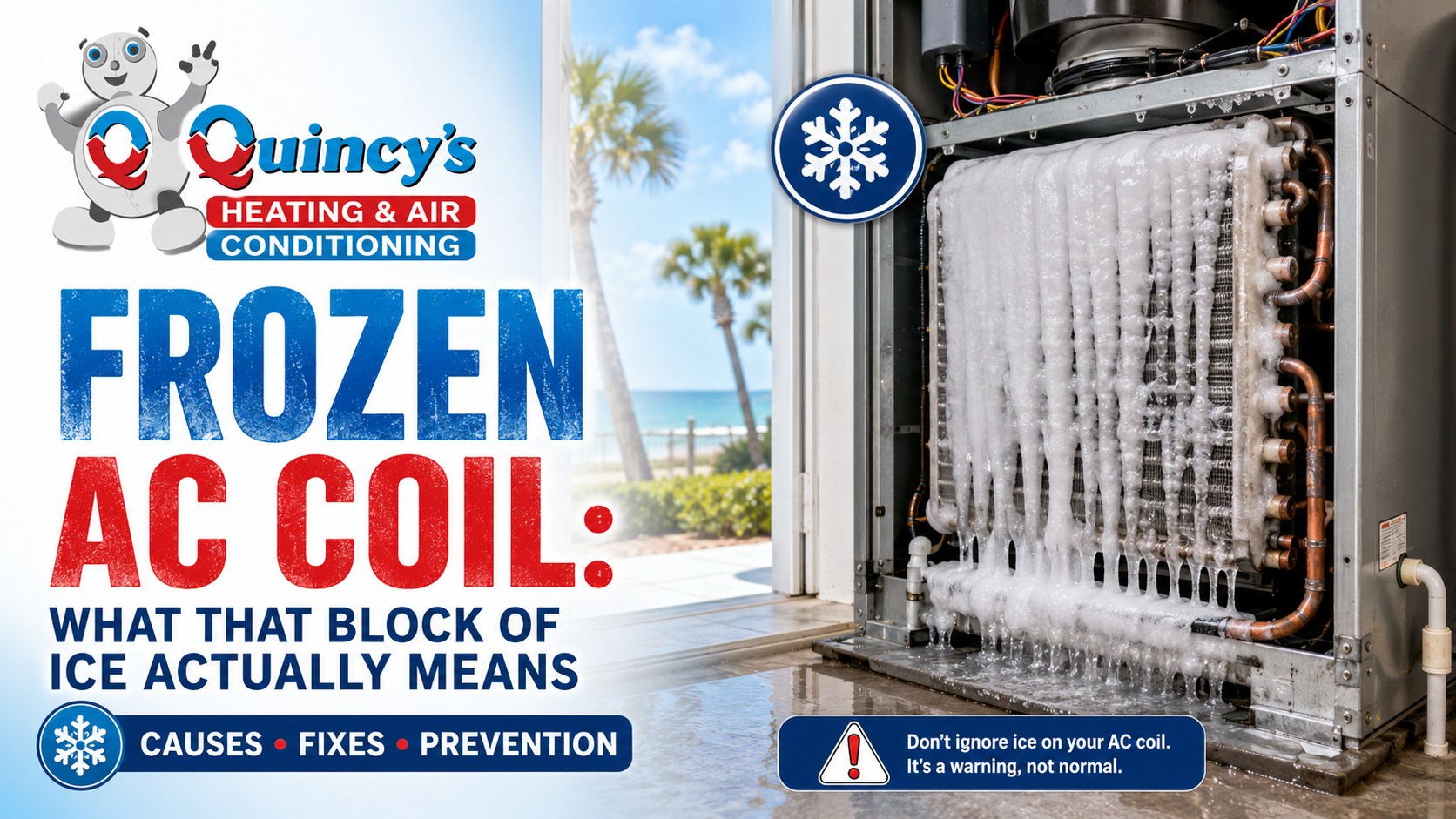
Expect $400 to $1,600 to find and repair an AC refrigerant leak in 2026, plus the refrigerant itself by the pound. An air conditioner never uses refrigerant up. If yours is low, it is leaking, and a recharge without a repair means paying for the same thing again next summer.
This is the repair homeowners get taken advantage of on most, and the reason is simple. "You're low on Freon" sounds like a diagnosis. It isn't. It is a measurement, like saying your tire is low on air. The question is where it went.
- Refrigerant is not consumed. Low charge always means a leak.
- A proper leak search runs $150 to $450 beyond the trip charge.
- R-22 is $100 to $250 per pound in 2026, which usually ends the repair conversation.
- New R-410A ducted equipment ended on 1 January 2026, so service prices keep climbing.
- Two recharges in two summers means you are renting refrigerant, not fixing an AC.
Why your AC cannot "use up" refrigerant
An air conditioner is a sealed loop. The refrigerant inside changes state over and over, liquid to vapor and back, moving heat out of your house. It is never burned and never spent. The charge put in at installation is meant to still be there the day the system is scrapped.
So there is no such thing as an AC that is "just a little low" from age or use. If a technician measures a low charge, refrigerant escaped through an opening, and that opening is still there.
A recharge treats the symptom. New refrigerant starts leaving through the same hole immediately, sometimes over two years, sometimes in three weeks. Either way you pay full per-pound price again.
What are the symptoms of an AC low on refrigerant?
Low charge has a distinct signature. Any one of these could be something else, but together they point hard at refrigerant loss.
- Air comes out cool but not cold, and the house drifts up a few degrees by afternoon.
- Ice on the suction line or indoor coil. Lower pressure means a colder coil, which freezes humid Gulf air solid.
- Longer run times, with the thermostat never satisfying.
- Humidity climbing indoors, which on the coast shows up as clammy rooms before heat.
- A hissing or bubbling sound near the indoor coil or lineset.
- Water around the air handler after a frozen coil thaws.
If ice is forming right now, shut the system off and let it thaw, because nobody can read pressures on a frozen system. Our guide to what a frozen AC coil means covers that sequence. If the air is warm with no ice, AC not cooling but running covers the other suspects.
One clue separates a leak from an airflow problem: if the coil ices while the filter is clean, suspect refrigerant.
How do technicians actually find a refrigerant leak?
No single tool finds every leak. A good technician works down a ladder of methods, escalating only if the leak stays hidden. The usual order:
- Visual and oil-trace inspection. Refrigerant carries compressor oil with it, so an old leak often leaves an oily, dirt-caked smudge at the exact spot.
- Electronic leak detector. A heated diode or infrared sniffer swept along coils, joints and the lineset. Fast and sensitive, but it gets confused by wind, cleaning chemicals and salt spray, which is exactly the beach-side environment.
- Bubble test. Soap solution brushed onto a suspect joint under pressure. Old fashioned and cheap, still the best confirmation once the detector narrows things down.
- Nitrogen pressure test. The system is recovered, pressurized with dry nitrogen and watched on a gauge. Holding pressure means that section is tight. This is the definitive test, and it catches slow leaks a detector walks right past.
- UV dye. Fluorescent dye goes in with the charge, the system runs for days, and the technician returns with a UV lamp. It is the go-to for intermittent leaks, and the reason some searches need two visits.
Evaporator leaks are hardest, because the coil sits in a sealed cabinet in an attic or closet. Reaching it often means pulling the coil, which is labor before any repair happens.
Why does refrigerant leak diagnosis cost money?
Because it is the actual work. Adding refrigerant takes fifteen minutes. Proving where a pinhole sits in eighty feet of copper takes gauges, nitrogen, a recovery machine, a calibrated detector and often two trips.
You pay a trip charge for a licensed technician to come out and diagnose. A dedicated leak search goes beyond that: hours of extra work with specialized equipment.
| Method | Typical added cost | Time | Best at finding |
|---|---|---|---|
| Visual and oil trace | In the trip charge | Minutes | Old, obvious leaks |
| Electronic detector sweep | $150 to $350 | 1 to 2 hours | Accessible joints, coils |
| Bubble test | Usually bundled | Minutes | The exact spot |
| Nitrogen pressure test | $200 to $500 | 2 to 4 hours | Slow leaks |
| UV dye plus return visit | $150 to $400 | Two visits | Intermittent leaks |
| Pulling the evaporator coil | $250 to $600 | Half a day | Suspected coil leaks |
Typical Panama City Beach area parts-and-labor pricing for 2026, for orientation only. Not a quote from Quincy's.
Paying $300 to find a leak is cheaper than paying $700 for refrigerant twice. The homeowners who get hurt here declined the search to save a couple hundred dollars, then bought a full charge two summers running.
Told you're low on refrigerant?
Drop your number. We'll call back within minutes during business hours.
Where do AC refrigerant leaks actually happen?
Leaks are not random. Location determines almost everything about whether fixing one is smart. A valve core is a twenty dollar part. An evaporator coil is a small fortune.
Around Panama City Beach, salt changes the odds. It attacks brazed joints and the thin copper of outdoor coils, so units within a mile of the Gulf corrode and leak earlier than identical units in Chipley.
| Leak location | Typical repair range | Usually worth fixing? |
|---|---|---|
| Schrader valve or valve core | $100 to $250 | Yes, always. Cheapest leak there is |
| Service port caps and seals | $75 to $200 | Yes. Minutes of labor |
| Brazed joint at the condenser | $300 to $800 | Yes under 12 years |
| Accessible lineset section | $400 to $1,000 | Usually yes |
| Buried or in-wall lineset | $800 to $2,500 | Depends. Rerouting gets costly |
| Filter drier or accumulator joint | $300 to $700 | Yes |
| Condenser coil (outdoor) | $900 to $2,200 | Rarely past 10 years on the coast |
| Evaporator coil (indoor) | $1,200 to $2,800 | No past 12 years. Price new equipment |
| Compressor body or terminals | $1,500 to $3,500 | No. Replace the system |
Evaporator coils deserve a note. Many fail from formicary corrosion: microscopic tunneling in the copper caused by acids off-gassing from household cleaners, adhesives and new carpet. The pinholes are so small they leak for a year unnoticed. It is not something you did wrong.
How much does a refrigerant recharge cost in 2026?
Refrigerant is priced by the pound, installed, and what a pound costs depends on which refrigerant your system uses. 2026 is a strange year for that.
A residential system holds roughly 2 to 4 pounds per ton, so a 3 ton unit holds about 6 to 12 pounds. Do that arithmetic against the numbers below before you agree to anything.
| Refrigerant | Status in 2026 | Typical installed cost per pound | Price trend |
|---|---|---|---|
| R-22 (older "Freon") | Production and import banned since 2020. Service stock is reclaimed only | $100 to $250 | Rising sharply |
| R-410A | New ducted residential equipment manufacture ended 1 January 2026. Servicing existing systems is still legal | $75 to $150 | Rising year over year |
| R-454B | The current standard in new equipment. Mildly flammable (A2L), needs certified technicians and rated tools | $70 to $130 | Stable to easing |
Refrigerant pricing moves with supply and is quoted at the time of service. Typical Emerald Coast ranges, not a quote from Quincy's.
Three things follow, and they drive most of the money decisions here.
R-22 systems are finished. None has been produced or imported since 2020, so every pound is reclaimed stock. Charging a leaking R-22 system can cost more than the equipment is worth. That is replacement money.
R-410A is on the clock. The HFC phase-down ended manufacture of new R-410A ducted residential equipment on 1 January 2026. Your system is not illegal and nobody is coming to take it. But the servicing pool only shrinks, so each year a recharge costs more than the last.
R-454B changes who can touch it. New systems ship with an A2L refrigerant, which is mildly flammable. That means A2L-certified technicians, rated leak detection and different service equipment. Safe in normal operation, but not for a handyman with a gauge set. More on our new AC installation page.
Recharge only, find and fix, or replace?
This is the decision, and it is clearer than people expect once age and leak location are on the table.
| Recharge only | Find and fix the leak | Replace the system | |
|---|---|---|---|
| Typical spend | $300 to $1,200 | $500 to $2,400 all in | New system pricing |
| How long it lasts | Weeks to a couple of seasons | Years, if the repair is sound | The life of the equipment |
| Makes sense when | Replacement is already scheduled | System is under 12 years and the leak is accessible | R-22, coil leak, or age past 12 years |
| Main risk | Paying the same bill again next summer | A second leak elsewhere in an old system | Larger up-front cost |
| Cost trend over time | Gets worse every year | One time cost | Lower operating cost |
Our line is simple. Under 12 years with an accessible leak, fix it. Past 12 years with a coil leak, or anything running R-22, put the money toward equipment. The full arithmetic is in when to replace your AC versus repair it, and the wider price context sits in what AC repair costs in Panama City Beach.
When recharging an old leaking system stops being rational
There is a point where topping off stops being a repair and becomes a subscription. You have crossed it when any of these are true.
- You have added refrigerant twice in two summers to the same system.
- The refrigerant bill alone is approaching half the cost of new equipment.
- The system runs R-22 and the leak is anywhere other than a valve core.
- The leak is in the evaporator coil on a unit past 12 years.
- The outdoor coil is visibly corroded through from years of salt exposure.
None of that means you must replace anything today. A recharge to get through August while you price equipment is reasonable, as long as you know that is what you are buying. Being sold one every year as maintenance is not.
Here is the honest part: regular service does not prevent leaks, and anyone claiming otherwise is selling. What it does is catch one early, while the charge is only slightly low and the coil has not iced. We check refrigerant pressures if the temperature difference is out of range, on site 25 to 45 minutes per system. Our maintenance plan is $292 a year for a single-system home with 10% off repairs.
If your system is low right now, get a real diagnosis before buying a pound of anything. We cover Panama City Beach, Bay County, South Walton and Washington County, reach about 95% of calls the same day, and our AC repair page shows how we work. No hard sales. If your unit is not worth the refrigerant, we will say so.
Low on refrigerant? Find out where it went.
We will locate the leak, tell you what the repair costs, and be straight about whether the system is worth it.
📞 Call (850) 235-8834Frequently asked questions
How much does AC refrigerant leak repair cost?
Finding and repairing a refrigerant leak typically runs $400 to $1,600 on the Emerald Coast, with the refrigerant charged by the pound on top. A leaking Schrader valve core sits at the bottom of that range and an evaporator coil replacement well above it. The leak search alone is usually $150 to $450.
Why is my AC low on refrigerant if nothing is broken?
An air conditioner is a sealed system. It does not burn refrigerant or use it up the way a car uses fuel. The same charge is meant to circulate for the life of the equipment. If the system is low, refrigerant escaped through a hole, a bad joint or a leaking valve.
Can I just add refrigerant and skip the leak repair?
You can, and it is sometimes the right short-term call on a system you already plan to replace. Just know what you are buying: the new charge leaves through the same hole the old one did. A slow leak may buy a season, a fast leak only a few weeks.
How much does a refrigerant recharge cost in 2026?
Typical installed pricing on the Emerald Coast in 2026 runs about $75 to $150 per pound for R-410A, $100 to $250 for R-22, and $70 to $130 for R-454B. Systems hold roughly 2 to 4 pounds per ton, so a 3 ton unit filled from empty can reach $600 to $1,200.
Is R-410A being phased out and what does that mean for my AC?
Yes. Manufacture of new R-410A ducted residential equipment ended on 1 January 2026 under the HFC phase-down. Your existing system is legal, safe and fine to keep running. What changes is supply: it is serviced from a shrinking pool, so the price per pound climbs every year.
When should I stop fixing leaks and replace the system?
Replace when the numbers stop working. Any R-22 system with a real leak is effectively done. So is most equipment past 12 years needing an evaporator coil, because the coil alone approaches half the cost of new. Two recharges in two summers means you are renting refrigerant.