
R-410A vs R-454B: What the 2026 Refrigerant Change Means for Panama City Beach Homeowners
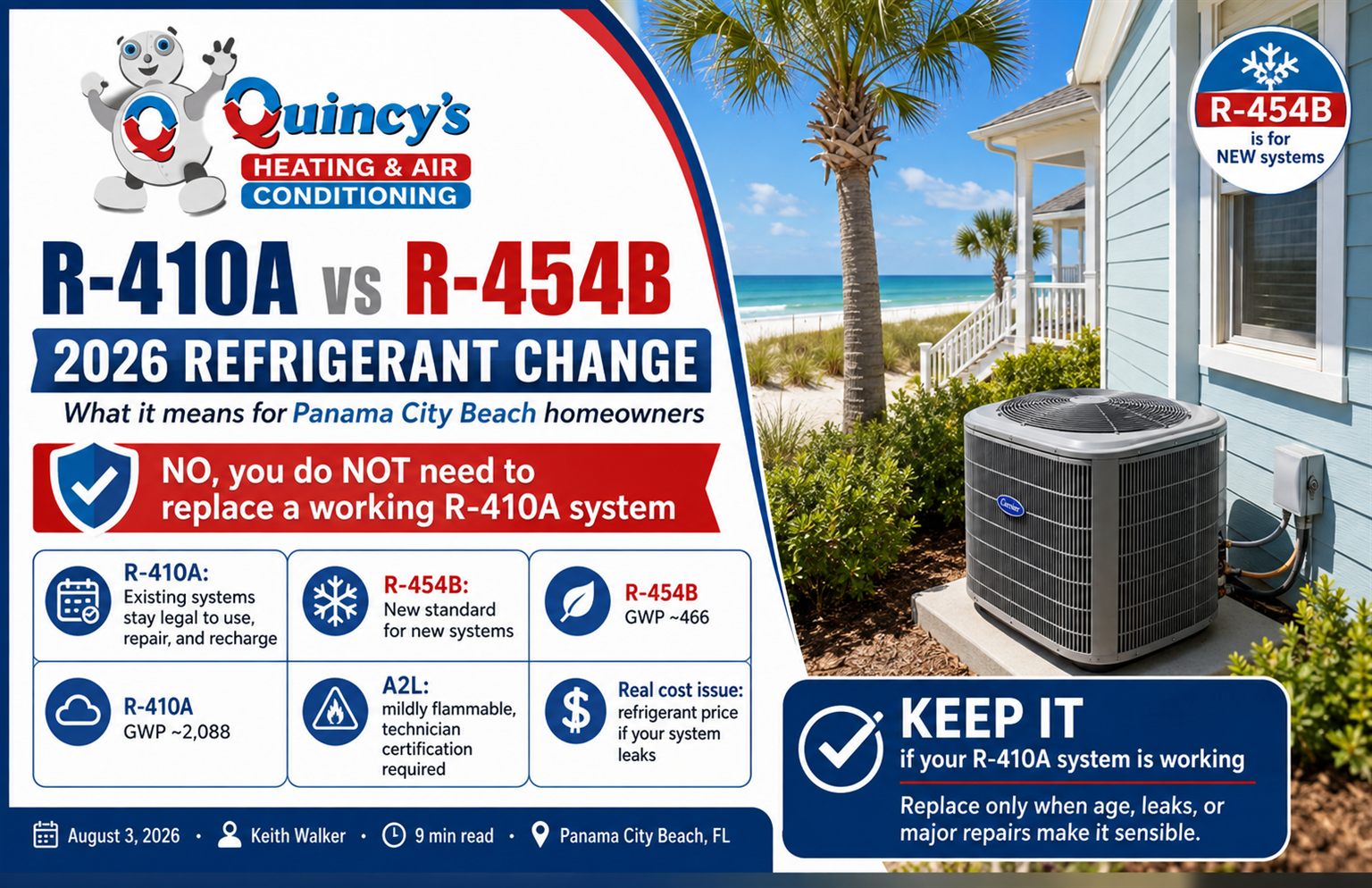
No, you do not need to replace a working R-410A air conditioner. Manufacture of new ducted air conditioners and heat pumps using high-GWP refrigerant ended on 1 January 2026, and R-454B is now the standard in new systems. Existing R-410A units can legally be used, repaired and recharged for the rest of their useful life.
The R-410A vs R-454B question comes up on nearly every quote we write in Panama City Beach now, usually because somebody heard their air conditioner is about to become illegal. It is not. Here is what changed, what did not, and the one situation where it affects your wallet.
- Nothing requires you to replace a working R-410A system. The rule applies to factories building new equipment, not to homeowners.
- R-454B has a GWP around 466 versus roughly 2,088 for R-410A. That is the whole reason for the change.
- R-454B is A2L, meaning mildly flammable, so only A2L-certified technicians may install and service it.
- The only real cost issue is refrigerant price. It matters if your system leaks, and not at all if it does not.
- The 8 to 10 percent launch premium on A2L equipment has largely normalised during 2026.
What actually changed on 1 January 2026?
One thing changed: manufacturers stopped building new ducted air conditioners and heat pumps that use high-GWP refrigerant. That is a rule about what comes off a production line, not about what sits beside your house.
Most of the worry comes from filling in the blanks. Here is the blank-free version.
| Item | Changed on 1 Jan 2026? | What it means for you |
|---|---|---|
| New ducted AC and heat pumps built with high-GWP refrigerant | Yes, ended | Anything new you buy now uses R-454B or another low-GWP refrigerant |
| Your existing R-410A system | No change | Keep running it. No deadline, no ban, no forced replacement |
| Repairing an R-410A system | No change | Capacitors, motors, coils, boards: all still available and still fine to fix |
| Recharging an R-410A system | No change legally | Still allowed. Virgin and reclaimed R-410A remain available |
| Price of R-410A refrigerant | Rising | The phase-down tightens supply, so per-pound cost drifts up each year |
| Who may service A2L equipment | Yes, tightened | New systems need an A2L-certified tech with A2L-rated tools |
| Converting your old unit to R-454B | Not permitted | Different oils and safety design. It is a replacement, not a retrofit |
If you read one row of that table, read the second. The R-410A phase out is a manufacturing phase-down, and the EPA position is consistent: equipment already installed can be used and serviced through its useful life.
What is R-454B refrigerant?
R-454B is a blend of about 68.9% R-32 and 31.1% R-1234yf. It replaced R-410A as the main refrigerant in residential systems because its global warming potential is around 466, against roughly 2,088 for R-410A. That is a reduction of close to 78%.
In the house it does not feel like anything. R-454B cools about as well as R-410A and runs at broadly similar pressures. The differences are all on our side: different gauges, different recovery equipment, different training.
Where the three refrigerants a Florida homeowner might have stand in 2026:
| Refrigerant | GWP | Status in 2026 | What it means for you |
|---|---|---|---|
| R-22 (older systems, roughly pre-2010) | About 1,810 | Production ended 2020. Reclaimed only, and expensive | If it leaks, replace the system. Recharging is rarely good value |
| R-410A (most systems installed 2010 to 2025) | About 2,088 | New ducted equipment ended 1 Jan 2026. Refrigerant still available | Keep running it. Budget more for a recharge if it ever leaks |
| R-454B (new systems from 2025 onward) | About 466 | Current standard, all major brands at full production | What you will get on a new install. A2L-certified service required |
Notice that R-410A has a slightly higher GWP than the R-22 it replaced. R-410A was brought in to stop ozone damage, not to cut greenhouse impact. R-454B addresses the second problem, which is why the industry moved again after only fifteen years.
Not sure what refrigerant your system uses?
Drop your number. We'll call back within minutes during business hours.
Is A2L refrigerant dangerous in a house?
R-454B carries an A2L classification, meaning mildly flammable. That word does unnecessary damage on a spec sheet, so it is worth being precise.
A2L sits at the bottom of the flammability scale. It takes a high concentration plus a sustained ignition source to burn, and it will not sustain a flame the way propane will. R-410A is A1, non-flammable, so this is a genuine change in category. It is not a change in your day-to-day risk.
The safety work is engineered into the equipment rather than left to the homeowner. New A2L systems ship with refrigerant leak detection in the indoor unit. If it senses refrigerant, it shuts the compressor down and runs the blower to disperse whatever escaped.
The part that matters when choosing a contractor: only A2L-certified technicians may install and service R-454B equipment. Recovery machines, leak detectors and gauges all had to be upgraded, and every tech needed certification. Ask any company quoting you whether their technicians are A2L-certified. You should get a straight answer.
Do I need to replace my R-410A system?
Almost certainly not. We will be blunt here, because a few outfits have used 2026 as a sales tool.
A working R-410A air conditioner should be kept and run until it is genuinely worn out. Replacing a healthy eight-year-old system to "get ahead of the refrigerant change" wastes thousands of dollars and years of remaining equipment life. If anyone tells you otherwise, get a second opinion.
The one honest consideration is leaks. R-410A supply is tightening, so the price per pound drifts up every year. A system that holds its charge never needs refrigerant and never notices. A system already topped up twice is a different story.
| Your situation | Lean toward | Why |
|---|---|---|
| R-410A system, any age, running fine, no leaks | Keep it | Nothing about 2026 applies to you. Run it out |
| Under 10 years, one non-refrigerant repair needed | Repair | Electrical and motor parts are unaffected and widely stocked |
| 10 to 14 years, small leak, holds charge a season | Repair, then plan | Fix the leak, budget for replacement in the next few years |
| 10 to 14 years, repeat leaks, annual top-ups | Get both numbers | Rising R-410A cost turns a recurring bill into a bad investment |
| Over 14 years, compressor or evaporator coil failed | Replace | Big spend on a system near the end of its life on the coast |
| Still running R-22 | Replace | Reclaimed R-22 pricing already makes repairs poor value |
| Told you must replace because of the 2026 law | Second opinion | No such requirement exists for homeowners |
The full version of that decision, with the numbers, is in when to replace your AC versus repair it. The refrigerant change barely moves those thresholds. It just adds weight to the replace side once a system leaks.
What the R-410A phase out does to repair costs
Day-to-day repairs are unaffected. A capacitor, a contactor, a fan motor, a control board, a clogged drain line: none of these touch the refrigerant circuit, and none changed in price because of the phase-down.
What did change is the cost of putting refrigerant back in. These are typical Emerald Coast market ranges, not Quincy's quotes, and they exist to help you sanity-check a number.
| Job | Typical range | Trend |
|---|---|---|
| Leak search and pressure test | $150 to $450 | Flat |
| Accessible leak repair plus recharge, R-410A | $400 to $1,600 | Rising with refrigerant cost |
| Full R-410A recharge on a 3 ton system | $600 to $1,400 | Rising each year |
| Evaporator coil replacement, R-410A | $1,200 to $2,800 | Flat, but consider replacement |
| Non-refrigerant repairs (electrical, motors, drains) | $100 to $1,100 | Unaffected by the phase-down |
Ranges reflect typical parts-and-labor pricing across the Panama City Beach area in 2026, for orientation only. Not a quote from Quincy's. See also our guide to AC repair costs in Panama City Beach.
The takeaway is narrow and worth repeating: the R-410A phase out only costs you money if your system leaks. Our AC repair visits include checking refrigerant pressures if the temperature difference is out of range.
Buying a new system in 2026
If you have landed on replacement for ordinary reasons (age, a failed compressor, a corroded coil), you are buying an R-454B system. Here is the order we would work through it.
- Confirm the refrigerant on the quote. It should say R-454B. If a quote still lists R-410A equipment, ask how old that inventory is.
- Ask whether the technicians are A2L-certified. Install and service both require it. This is the most useful question you can ask right now.
- Size the system properly. A Manual J load calculation is performed when necessary. Oversizing is the most common cause of a humid house in Florida.
- Specify the coastal protection. Coastal coils are standard options within the selections we offer, and near the Gulf they matter far more than the refrigerant does.
- Confirm a safety switch is included. We fit one on every install, and A2L leak detection is additional to it.
- Compare on installed quality, not the box. Duct sizing, charge accuracy and drain routing decide how it performs for fifteen years.
On price: A2L equipment carried roughly an 8 to 10 percent premium at launch, driven by redesigned cabinets, new components and built-in leak detection. That premium has largely normalised during 2026 now that all major manufacturers are at full production. Size, efficiency and ductwork move your number far more.
We cover what a proper installation includes on our new AC installation page, and financing through Synchrony is available subject to credit approval. On brands and coil options, the best AC system for coastal homes covers what holds up near the water.
What this means on the Emerald Coast specifically
Keep this in proportion. On the Gulf, what kills air conditioners is not refrigerant policy. It is salt.
Salt air corrodes the aluminium fins and copper tubing on outdoor coils and attacks electrical contacts. A unit a few hundred yards from the water in Panama City Beach can reach the end of its life years before an identical one in Chipley. The mechanism is covered in how salt air destroys AC units.
Two consequences. Coastal systems develop refrigerant leaks earlier, because corrosion eats through thin coil tubing, so rising R-410A cost lands harder here than inland. And the coil coating on a new system affects your ownership costs far more than the refrigerant inside it.
Rinsing the outdoor coil with water where it is accessible, and having someone look at the system twice a year, is what extends its life here. Our maintenance plan is $292 a year for a single-system home and includes 10% off repairs. Visits run 25 to 45 minutes per system, and catching a small leak on one is how you avoid the expensive version of this.
So: no panic, no deadline, no forced replacement. Run your R-410A system until it tells you it is done. When that day comes you will buy an R-454B system that works the same way with a quarter of the climate impact.
Told you have to replace your AC because of the 2026 change?
We will tell you honestly whether your system needs replacing or not. No hard sales.
📞 Call (850) 235-8834Frequently asked questions
Do I need to replace my R-410A system in 2026?
No. There is no rule anywhere requiring a homeowner to replace a working R-410A air conditioner. The EPA position is that existing systems may be used, serviced and recharged through their useful life. What ended on 1 January 2026 was the manufacture of new ducted equipment using high-GWP refrigerant, which is a rule aimed at factories, not at the unit sitting beside your house.
What is R-454B refrigerant and how is it different from R-410A?
R-454B is a blend of R-32 and R-1234yf with a global warming potential around 466, compared with roughly 2,088 for R-410A. It cools about as well as R-410A and runs at similar pressures, so a new R-454B system feels no different in the house. The two are not interchangeable, and R-454B carries an A2L mildly flammable classification that R-410A does not.
Is A2L refrigerant safe to have in my home?
Yes, when the equipment is installed correctly. A2L means mildly flammable, which is a long way from propane or gasoline. It takes a high concentration and a sustained ignition source to burn. New A2L systems ship with leak detection built in that shuts the unit down and runs the blower if refrigerant is sensed, and only A2L-certified technicians may install or service them.
Will recharging my R-410A system cost more every year?
Most likely yes. R-410A is in a scheduled phase-down, so supply tightens and the per-pound price drifts upward each year. Reclaimed R-410A will stay available for a long time, so nobody is going to be stranded. This only matters if your system leaks. A sealed system that holds its charge never needs refrigerant, and the price of R-410A is irrelevant to it.
Did the new refrigerant law in 2026 make new AC systems more expensive?
At launch, A2L equipment carried roughly an 8 to 10 percent price premium over the R-410A models it replaced, because of new components, redesigned cabinets and leak detection. That premium has largely normalised during 2026 now that every major manufacturer is at full production. Pricing on a new install today is driven far more by system size, efficiency and ductwork than by the refrigerant inside it.
Can my old R-410A system be converted to run on R-454B?
No, and you should be cautious of anyone who offers to do it. R-454B needs different compressor oils, different safety design and A2L-rated components throughout. Dropping it into equipment never certified for it voids the warranty and creates a real safety issue. When your R-410A system reaches the end of its life, you replace it with a new R-454B system rather than converting the old one.