
New AC Cost in Panama City Beach: What a System Really Runs in 2026
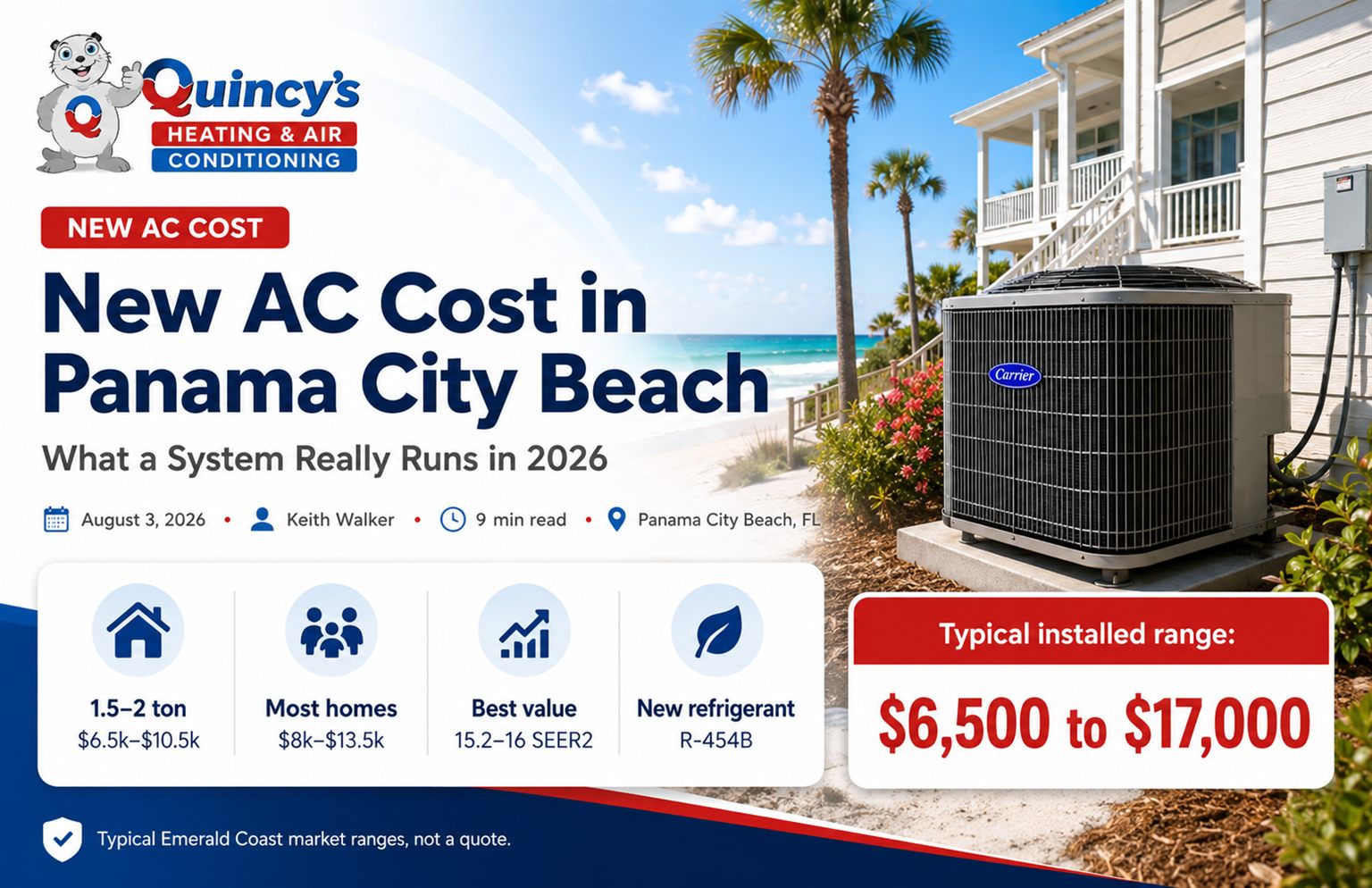
A new AC in Panama City Beach typically costs $6,500 to $17,000 installed in 2026, depending on tonnage, efficiency and what the install involves. Most 1,500 to 2,000 square foot homes here land between $8,000 and $13,500 for a complete, permitted replacement of both the outdoor unit and the air handler.
The width of that range is the whole story. Two homeowners on the same street can get quotes $6,000 apart for the same job. Here is what moves the number: size, efficiency tier, the refrigerant change, and the parts of an install the cheapest bid leaves out.
- Size drives the base price. Figure 450 to 600 square feet per ton in Florida, then verify with a load calculation.
- Mid tier efficiency pays back here. Florida's nine month cooling season makes 15.2 to 16 SEER2 the sweet spot for most homes.
- R-454B replaced R-410A in new ducted equipment from 1 January 2026. The early price bump has normalised.
- Do not panic-replace a working R-410A system. Nothing about your existing unit became illegal or unserviceable.
- The cheapest quote is cheapest for a reason. Compare line items, not bottom lines.
How much does a new AC cost in Panama City Beach?
These are typical Emerald Coast market ranges for 2026, not Quincy's quotes. They assume a full changeout: new outdoor unit, new indoor air handler or coil, and the labor to fit them properly. Replacing only the outdoor unit and leaving a mismatched indoor coil is cheaper up front and a bad idea.
| System size | Rough home size (Florida) | Typical installed range | Common around here |
|---|---|---|---|
| 1.5 ton | 600 to 900 sq ft | $6,500 to $9,500 | Beach condos, small cottages |
| 2 ton | 900 to 1,200 sq ft | $7,000 to $10,500 | Condos, older beach homes |
| 2.5 ton | 1,200 to 1,500 sq ft | $7,500 to $11,500 | Smaller single family homes |
| 3 ton | 1,400 to 1,800 sq ft | $8,000 to $12,500 | Most common size we install |
| 3.5 ton | 1,700 to 2,100 sq ft | $8,500 to $13,500 | Newer subdivision home |
| 4 ton | 2,000 to 2,400 sq ft | $9,500 to $15,000 | Larger homes, some rentals |
| 5 ton | 2,400 to 3,000 sq ft | $10,500 to $17,000 | Gulf front and 30A homes |
Ranges reflect typical installed pricing across the Panama City Beach area in 2026, covering equipment and labor. They are not a quote from Quincy's.
The bottom of each range is a single stage system at the regional minimum going into an easy attic or closet. The top is a variable speed system with a new lineset, new pad and duct work. Access is a real cost driver, so multi-storey beach homes sit high in the range.
If your current system still works, none of these numbers apply yet. Our guide on when to replace your AC versus repair it covers the point where spending stops making sense, and what AC repair costs here is the other half.
Want a real number for your house?
Drop your number. We'll call back within minutes during business hours.
What size AC do I need for my square footage?
Air conditioners are sold in tons. One ton is 12,000 BTU per hour of cooling, and residential systems run 1.5 to 5 tons in half ton steps.
The rule of thumb in Florida is 450 to 600 square feet per ton. A tight 2018 build with good windows sits near 600. A 1970s block house with single pane glass sits near 450. That spread is why square footage alone gets you to the right neighbourhood and no further.
What changes the answer: ceiling height, west-facing glass, attic insulation, duct leakage and shade. Two identical floor plans, one under oaks and one facing the Gulf, do not need the same equipment.
We perform a Manual J load calculation when necessary, not as a box-ticking exercise on every job. If the existing system has kept the house comfortable for fifteen years, matching that capacity is often right. If it never quite kept up, or the house has been renovated, the calculation earns its keep.
Be suspicious of anyone who wants to go up a size "to be safe." Oversized systems cool fast and dehumidify badly. They satisfy the thermostat before running long enough to pull moisture from the air, so the house ends up 74 degrees and clammy. On the coast that is a mould problem.
Does a higher SEER2 rating pay back in Florida?
SEER2 is the current efficiency measure for cooling equipment. The minimum for a split system in the Southeast region, which includes Florida, is 14.3 SEER2. Anything above that costs more to buy and less to run.
Florida is one of the few places where this arithmetic works in your favour. We run cooling roughly nine months a year, so a percentage saved on the cooling bill is saved across most of the calendar, not just July and August.
| Efficiency tier | Typical premium over baseline | Who it suits |
|---|---|---|
| 14.3 SEER2, single stage | Baseline | Rentals, flips, anyone selling soon |
| 15.2 to 16 SEER2, single stage | $500 to $1,200 | Most owner-occupied homes. The value sweet spot |
| 16 to 18 SEER2, two stage | $1,500 to $3,000 | Full-time residents who want better humidity control |
| 18 to 20+ SEER2, variable speed | $3,500 to $7,000 | Large homes, long ownership, quiet operation |
Here is the honest payback maths. A typical Panama City Beach household spends $1,600 to $2,000 a year on cooling. Moving from 14.3 to 16 SEER2 cuts cooling energy by roughly 11 percent, call it $180 to $220 a year against a premium of $500 to $1,200. That pays back in four to seven years.
Push on to 20 SEER2 and the savings are bigger, maybe 28 percent, but the premium is several thousand dollars and payback stretches past eight to ten years. At that point you are not buying it for the energy bill.
What you are buying at the top tier is humidity control. A variable speed system runs long, slow cycles, and long cycles are what wring water out of coastal air. If your house feels sticky at 74 degrees, that is the fix. Our comparison of the best AC system for coastal homes goes deeper.
What the R-454B changeover did to prices
Manufacture of new R-410A ducted equipment ended on 1 January 2026 under the refrigerant phase-down. New split systems now ship with R-454B, a lower global warming potential refrigerant.
When the transition began, R-454B equipment carried roughly an 8 to 10 percent premium over the R-410A models it replaced. Manufacturers were retooling and supply was thin. That gap has largely normalised through 2026 as production caught up, which is why the ranges above sit near 2025 pricing.
Now the part that matters most. Do not replace a working R-410A system because of this rule. The regulation governs manufacture of new equipment. It does not make your system illegal or unserviceable, and R-454B is not poured into an R-410A unit.
R-410A remains available for servicing existing equipment, from remaining stock and reclaimed supply. It will get more expensive, the way R-22 did. That is a reason to weigh refrigerant cost when an old system springs a big leak, not a reason to scrap a healthy six-year-old condenser.
If a contractor leads with refrigerant urgency instead of a diagnosis, that tells you something about them, not about your AC.
What does a proper HVAC installation include?
Equipment is maybe 55 to 65 percent of what you pay. The rest is labor and materials, and that is where quotes diverge. Two bids can both say "3 ton, 16 SEER2, installed" and describe different jobs.
| Line item | A complete installation | Often missing from the cheapest bid |
|---|---|---|
| Load calculation | Manual J performed when necessary | Size copied off the old nameplate |
| Lineset | Flushed, or replaced when the job requires it | Reused as-is with old oil still in it |
| Metering device | New device matched to the new equipment | Old TXV or piston left in place |
| Indoor coil or air handler | Replaced and matched to the condenser | Outdoor unit only, mismatched pairing |
| Equipment pad | New pad, set level | Old cracked or sinking pad reused |
| Condensate safety switch | Safety switch on every install | Omitted to save fifteen minutes |
| Permit and inspection | Pulled and inspected | Not pulled |
| Electrical | Disconnect, whip and breaker sized and checked | Corroded coastal disconnect reused |
| Duct transitions and plenum | Rebuilt and sealed to the new cabinet | Taped over and left |
| Coil protection | Coastal coils are standard options within the selections we offer | Not offered or not discussed |
| Startup | Charge verified, airflow and temperature split checked | "It's blowing cold, we're done" |
| Old equipment | Hauled away and disposed of | Extra charge, or left beside the house |
Three of those deserve explaining. The lineset is the pair of copper lines between the outdoor unit and the indoor coil. It carries oil from the old compressor, and if that oil is not flushed out it can foul the new one. Invisible work, which is why it gets skipped.
The condensate safety switch is a float that shuts the system down when the drain pan fills. It costs very little, and without one a clogged drain line in August becomes a stained ceiling. We fit one on every install.
The permit is not bureaucracy for its own sake. An unpermitted changeout can complicate a home sale and give an insurer an opening at claim time.
On the coast, ask about coil protection. Salt air eats aluminium fins and copper tubing, and it is the biggest reason units here die younger than their inland twins. See our explainer on blue fin coating and coastal coil protection, and the full scope of our work on the new AC installation page.
Why the cheapest quote usually excludes something
Nobody in this trade buys equipment at a wildly different price, and labor rates do not vary by thousands. So when one bid lands $4,000 under the others, something has been removed from it. That is not always dishonest, but the difference often does not surface for eighteen months.
- Ask for the model numbers. Both the outdoor unit and the indoor unit. Without the indoor model number you cannot tell whether the pair is matched or whether the rated efficiency is real.
- Ask what happens to the lineset. Flushed, replaced or reused. Only three answers exist and one is a problem.
- Ask whether a permit is being pulled. If the answer is vague, that is your answer.
- Ask who registers the warranty. Parts warranties usually need registering within a set window after installation, and unregistered equipment can drop to a much shorter term.
- Put the bids on one page, line by line. Once the scopes match, compare the totals. The gap is usually far smaller than it first looked.
Financing changes what is affordable, not what is sensible. We offer financing through Synchrony, subject to credit approval. Do the monthly maths on a mid tier system before defaulting to the cheapest box.
Whatever you install lasts longer here with regular service. Salt air is relentless and drain lines clog every summer. Our maintenance plan runs $292 a year for a single-system home and includes 10% off repairs. On a five figure system, that is cheap insurance.
If you are in Panama City Beach, Bay County, South Walton or Washington County and want a straight number, we will come look. No hard sales, and we will tell you honestly if your system has years left.
Want a real price for a new system?
We'll size it properly, show you the tiers, and tell you if you can wait. No hard sales.
📞 Call (850) 235-8834Frequently asked questions
How much does a new AC cost in Panama City Beach?
Typical installed prices on the Emerald Coast in 2026 run from about $6,500 for a small 1.5 ton system to around $17,000 for a large 5 ton variable speed system. Most homes of 1,500 to 2,000 square feet land in the $8,000 to $13,500 band for a complete, permitted changeout. These are market ranges, not a quote from Quincy's.
How much does a 3 ton AC cost installed?
A 3 ton system installed on the Emerald Coast typically runs $8,000 to $12,500 in 2026. The low end is a single stage unit near the 14.3 SEER2 regional minimum. The high end is a variable speed unit with a new lineset, new pad and duct transition work. A 3 ton system suits roughly 1,400 to 1,800 square feet in Florida.
What size AC do I need for my square footage?
A rough Florida guide is 450 to 600 square feet per ton, so a 1,600 square foot home usually lands on 3 tons. Square footage alone is a starting point, not an answer. Ceiling height, window area, insulation, duct leakage and afternoon sun all move the number. We perform a Manual J load calculation when necessary rather than guessing off the old nameplate.
Is a higher SEER2 unit worth the money in Florida?
Usually up to a point. Florida runs a nine month cooling season, so efficiency gains compound faster here than almost anywhere else. Moving from the 14.3 SEER2 minimum to the 15.2 to 16 range typically pays for itself in four to seven years. Going to 18 to 20 plus SEER2 rarely pays back on energy alone. That tier is bought for humidity control.
Should I replace a working R-410A system in 2026?
No. Manufacture of new R-410A ducted equipment ended on 1 January 2026, but that rule covers building new equipment, not running or servicing what you already own. R-410A remains available for servicing existing systems, and your unit does not become illegal or unserviceable. Replace it when it fails, or when repairs stop making financial sense.
Why is one HVAC installation quote thousands cheaper?
Almost always because something was left out. The usual omissions are the permit, the lineset flush or replacement, a new level pad, a matched metering device, resealed duct transitions, haul-away and a float safety switch. Sometimes the indoor coil is not being replaced at all. Ask each contractor to name every line item.