
AC Not Working After a Storm: A Panama City Beach Safety Guide
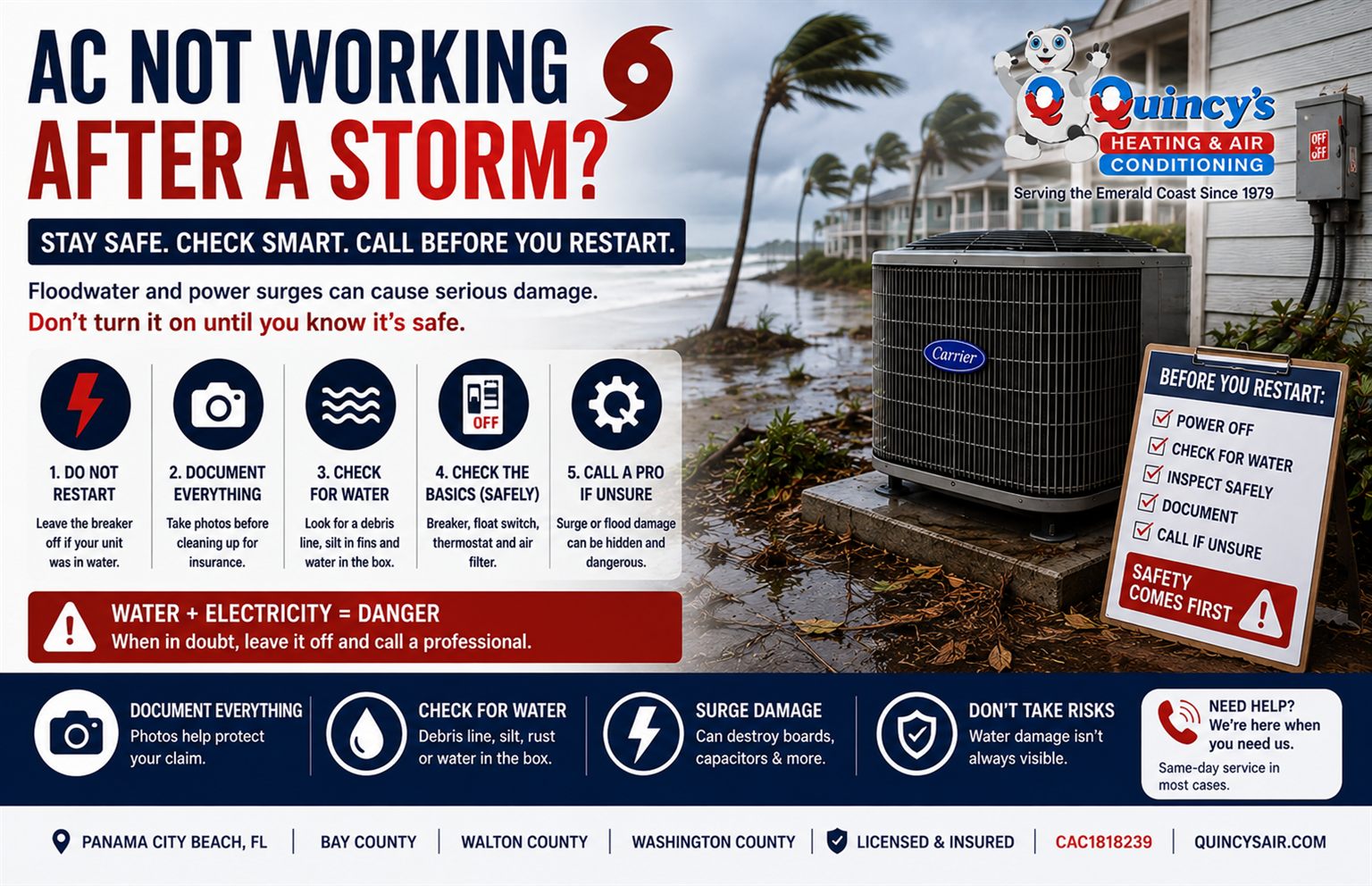
If your AC is not working after a storm, do not restart it until you know whether it took water. A submerged unit can arc or catch fire the moment it is energized. Leave the breaker off, photograph everything before you clean up, then check the breaker, the float switch and the thermostat.
The power comes back at two in the morning, the fridge hums, the lights work, and the house stays hot. That is the most common call we take in the week after a storm. Some end in a $200 part. A few do not.
- Never energize a unit that has been under water. Not even to test it.
- Check for a debris line on the cabinet, silt in the fins and a water mark on the disconnect.
- Photograph everything before you clear a single branch. An adjuster cannot value damage you cleaned up.
- Surges usually kill the capacitor, contactor, transformer or board. Those are repairable. Flooding is not.
- A submerged outdoor unit is normally a replacement, and that is a safety judgement, not an upsell.
The one rule: do not restart a unit that has been under water
Everything else here is negotiable. This is not. If floodwater or storm surge reached the inside of your outdoor unit or your air handler, the system stays off until a technician has opened it and looked.
The compressor is a motor sealed in a steel can, its windings insulated with a thin varnish coating. Water past that coating gives 240 volts a path it was never meant to take. The contactor, control board and transformer are just as exposed. Energizing it can weld contacts, arc, or start a closet fire.
On the Gulf it is worse than plain water. Storm surge is salt water, which conducts and keeps corroding long after everything looks dry. Add the silt inside the cabinet and you get a unit that runs fine for three weeks, then fails hard. It is the fast version of how salt air destroys AC units.
So leave the breaker off, leave the outdoor disconnect pulled, and do not try it to see what happens. Trying it is how a repairable unit becomes a house fire.
How do I tell if my AC unit took water?
You do not need to open anything. The evidence is on the outside of the cabinet, and it washes away fast, so look before the next rain.
Look for a debris line. Water leaves a horizontal band of grass, pine straw, seaweed or grey silt at its high point. On a condenser it shows as a dirty stripe across the fins.
Look for silt in the fins. Rain rinses fins from the top down, floodwater packs them from the bottom up. Grey mud in the lower few inches of the coil means the unit stood in it.
Look at the disconnect box beside the condenser. A rust streak, mud line or water stain means water reached your electrical connections. That is the worst version of this.
Check the indoor half. Air handlers in garages and closets flood as often as condensers. Look for a stain line on the cabinet, wet insulation and damaged drywall at the base of the wall.
| Water exposure | What it reached | Likely outcome |
|---|---|---|
| Wind driven rain only | Cabinet exterior | Fine. Units are built for rain. |
| Inches into the cabinet, fresh water | Base pan, lower coil | Often salvageable after a professional clean and test. |
| Inches into the cabinet, salt water | Base pan, coil, wiring | Guarded. Salt keeps corroding. Expect a shorter life. |
| Above the compressor terminals | Terminals, contactor | Usually replace. Windings cannot be cleared. |
| Into the electrical compartment | Contactor, capacitor, board | Replace the condenser. Do not energize it. |
| Fully submerged | Everything | Total loss. No reasonable debate. |
| Air handler stood in water | Blower, board, insulation | Usually replace. Wet insulation grows mold. |
General guidance for typical residential split systems. A licensed technician makes the final call.
What is safe to check yourself after a storm?
Assume you have ruled out water. Plenty of post storm no cool calls come down to something small, and there is no reason to pay a trip charge to learn a float switch tripped.
| What you are seeing | Likely cause | Safe to check yourself? |
|---|---|---|
| Nothing at all, thermostat blank | Tripped breaker, or no power to the air handler | Yes. Check the panel. |
| Thermostat on, nothing responds | Tripped condensate float switch | Yes. Look at the drain pan. |
| Thermostat lost its schedule | Power interruption cleared the programming | Yes. Reprogram, check batteries. |
| Blower runs, outdoor unit silent, warm air | Blown disconnect fuse, or contactor | No. That box stays live. |
| Outdoor unit hums, fan will not spin | Surge damaged run capacitor | No. Capacitors hold a charge. |
| Breaker trips the instant you reset it | Short circuit, often water damage | No. Stop and call. |
| Burning smell or scorch marks | Arcing or a failed component | No. Kill the power now. |
| Runs but barely cools, packed with debris | Blocked coil or bent fins | Yes, with the disconnect pulled. |
The order to work through it
- Look before you touch. Photograph the outdoor unit from all four sides and the air handler, before you move one branch.
- Rule out water. Debris line, silt in the fins, water mark on the disconnect. If any of those are there, stop and call.
- Wait about 30 minutes after power is restored, then set the thermostat to off and reset the breaker once. If it trips again, leave it off.
- Check the condensate float switch. An outage lets the drain pan back up, and that switch cuts the system off before water reaches your ceiling. See water leaking from your AC.
- Clear debris from around the condenser with the disconnect pulled. Give it two feet of clearance.
- Set the thermostat to cool, a few degrees below room temperature, and listen. If the outdoor unit starts and the air turns cold, you are done.
- If it still will not run, stop guessing. Repeated start attempts on a damaged compressor turn a repair into a replacement.
AC down after the storm?
Drop your number. We'll call back within minutes during business hours.
What does AC power surge damage look like?
Lightning gets the blame, but most surge damage we see happens on the way back up. When the utility re-energizes a circuit, voltage does not arrive as a clean flat line. Low voltage is worse than no voltage: it makes a compressor draw more current, and current makes heat.
Generators do their own damage. An undersized portable generator running a 3 ton condenser is a slow way to kill a compressor. Check its rated running watts against the nameplate first.
What actually fails, roughly in the order we find it:
- Run capacitor. The most common failure, often visibly bulged.
- Contactor. Pitted or welded contacts.
- Low voltage transformer and fuse. A dead thermostat with a live outdoor unit.
- Control or defrost board. Blackened traces, and back ordered after a big storm.
- Smart thermostat. Sensitive electronics on a low voltage circuit.
- ECM blower motor module. Expensive, and it fails before the motor.
- Compressor windings. A grounded winding ends the conversation.
Typical Emerald Coast market ranges run roughly $150 to $350 for a capacitor or contactor, $400 to $900 for a control board, and $1,500 to $3,500 for a compressor. Those are area ranges, not a quote from us. A burning smell is one of the signs of a genuine AC emergency every time.
For next time: a hard-wired surge protective device at the panel, plus one at the condenser disconnect, costs a fraction of a compressor. It is on the checklist in protecting your AC before a hurricane.
When is a storm damaged air conditioner repairable, and when is it a total loss?
The dividing line is simple. Surge damage is usually a repair. Flood damage usually is not. Electrical parts outside the sealed system get swapped in an afternoon. Contamination inside the equipment does not get undone.
A unit is worth repairing when water never got inside, the failure is one identifiable component, the system is under roughly 10 years old and the refrigerant lines are intact.
It is a total loss when it was submerged, when salt water reached the electrical compartment, when the windings read a ground fault, or when the cabinet is crushed and the lines are torn open. An open system pulls in moisture, and R-410A recharges keep getting more expensive.
Telling someone their flooded condenser needs replacing is not a sales tactic. Nobody can look at a silt filled compressor and certify the winding insulation is intact, because no test proves it. A contractor who cleans it up and re-energizes it is putting their name on a fire risk in your house.
There is a practical point in your favour too. If the damage is a covered loss, a settlement for replacement often beats paying out of pocket for a repair with no warranty. See when to replace your AC versus repair it, what a proper new AC installation includes, and financing through Synchrony, subject to credit approval.
How do I document storm damage for an HVAC insurance claim?
Most of the money in a storm damage HVAC insurance claim is won or lost in the first hour, before an adjuster sees anything. The biggest mistake homeowners make is tidying up first.
One distinction matters before you file. Wind, falling debris and lightning are generally covered by a standard Florida homeowners policy, subject to a hurricane deductible that is often 2% to 5% of your dwelling coverage. Rising water and storm surge generally need a separate flood policy.
Florida also puts a clock on it. State law gives owners a limited window to report a new claim, generally one year from the date of loss. Confirm the deadline with your carrier.
Storm damage HVAC insurance claim: documentation checklist
| What to capture | Why it matters | When |
|---|---|---|
| Wide photos of the outdoor unit, all four sides | Proves condition at the time of loss | Before you clear anything |
| Close photo of the debris or water line | Establishes how deep the water got | Before the next rain |
| The disconnect box and any water mark | Shows electrical exposure | Before cleanup |
| Model and serial plate, indoor and outdoor | Adjuster needs age, tonnage, efficiency | Early, before it corrodes |
| Air handler, closet floor, wet insulation | Supports the indoor half of the claim | Before drying or demo |
| Original photo files, not screenshots | Metadata carries the date and time | Back them up off your phone |
| Dated written assessment and itemised estimate | The technical basis of the settlement | Within a few days |
| Maintenance records and declarations page | Blocks a wear and tear denial, shows your deductible | Before you file |
Two habits help. Photograph each unit's data plate now, while it is dry and legible, and keep service paperwork somewhere you can reach without power. Customers on our maintenance plan already have that history on file.
Ask for the assessment in writing, dated, with model and serial numbers, the damage observed and the conclusion. "Unit is bad" helps nobody. "Silt line 11 inches above the pad, silt in the electrical compartment, unit condemned" is what gets a claim paid.
Storms are the one part of owning a home on the Gulf you can genuinely prepare for. If your system is down right now anywhere in Bay County, South Walton or Washington County, we have been doing this since 1979 and reach about 95% of calls the same day. See our AC repair page, or send us the details. No hard sales.
Storm damage? Get a straight assessment.
We will tell you what the water and the surge actually did, in writing, dated, for your claim. No hard sales.
📞 Call (850) 235-8834Frequently asked questions
My AC is not working after a storm. Is it safe to turn it back on?
Only if the equipment stayed dry. If the outdoor unit or the air handler sat in floodwater, leave the breaker off and call a licensed technician. Water in the compressor windings, the contactor or the control board can arc or start a fire the moment you energize it.
What should I do if my AC unit flooded?
Leave it off. Do not pull the panel, do not hose it down, and do not reset the breaker to see what happens. Photograph the unit from all four sides before you clear debris, record the model and serial numbers, then call a licensed contractor and your insurance carrier.
How can I tell if a power surge damaged my air conditioner?
The usual signs are a system that will not start after power returns, a blank thermostat, a humming outdoor unit whose fan will not turn, or a breaker that trips the instant you reset it. Surges most often kill the run capacitor, the contactor, the transformer or the control board.
Does homeowners insurance cover hurricane damage to an air conditioner?
It depends how the damage happened. Wind, falling debris and lightning are generally covered under a standard Florida homeowners policy, subject to a hurricane deductible that is often 2% to 5% of your dwelling coverage. Rising water and storm surge generally need a separate flood policy.
Can a flooded outdoor AC unit be repaired instead of replaced?
Rarely, and only when the water stayed below the electrical compartment and the compressor terminals. Once salt water and silt reach the windings, corrosion keeps working after everything dries and no test proves the insulation is intact. A submerged condenser is normally a replacement.
How long should I wait before running my AC after the power comes back?
Give it about 30 minutes. Utility restoration often arrives with voltage swings, and a brownout is harder on a compressor than a clean outage. Many systems also hold a short cycle delay of up to five minutes. On generator power, confirm the generator is properly sized first.