
How to Protect Your AC During a Hurricane: A Bay County Checklist
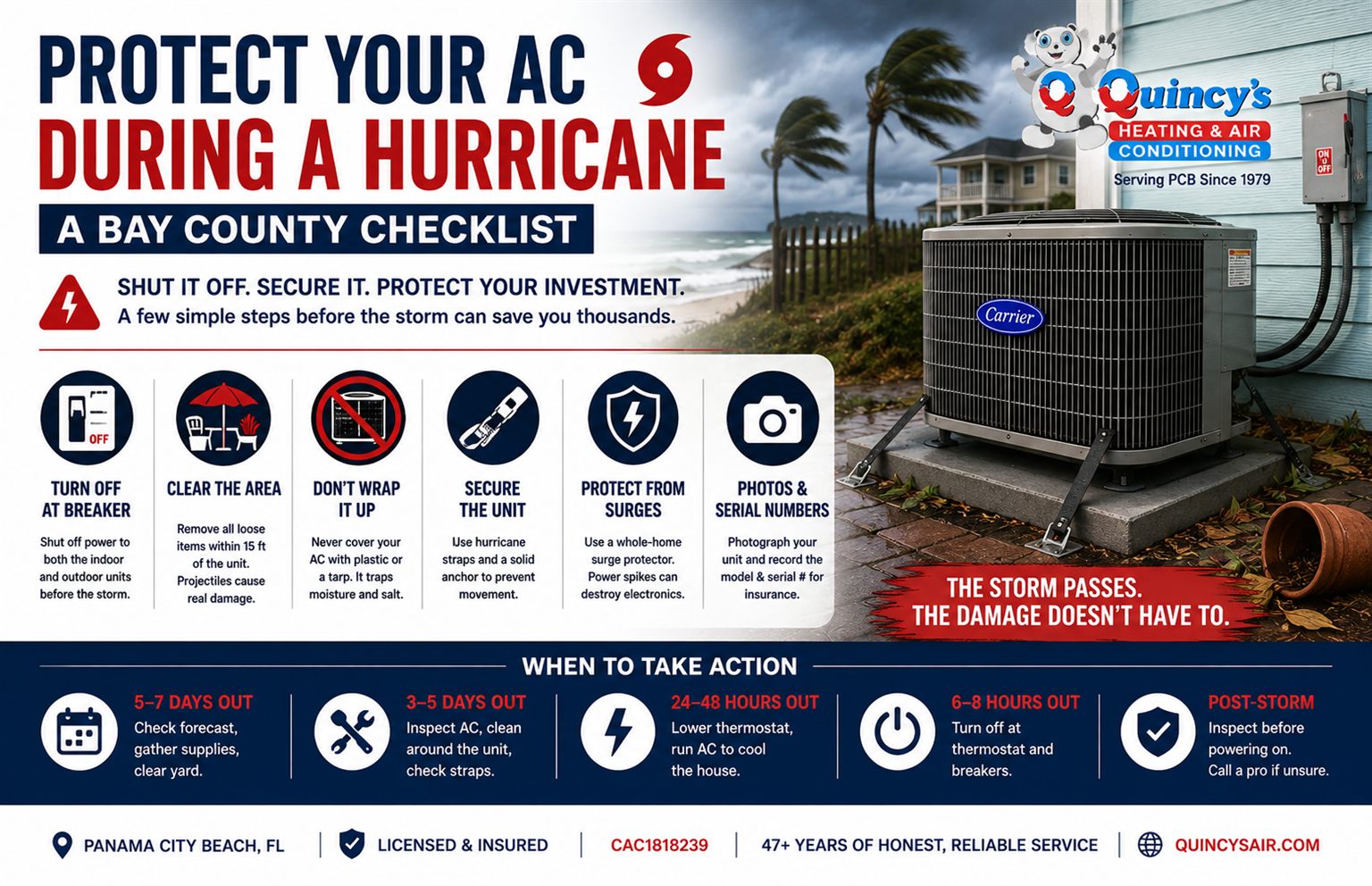
Shut your AC off at the breaker before the storm arrives, not after. The thing that kills most Gulf Coast air conditioners is not wind, it is the voltage spike when the utility restores power. Then clear every loose item in the yard, never wrap the unit in plastic, and photograph the model and serial plate for insurance.
That is the short version of how to protect your AC during a hurricane on the Emerald Coast. We have worked this coast since 1979, and the pattern repeats after every named storm: the units that come back on are the ones that were switched off and tied down.
- Surge on power restoration kills more AC units than wind. Cut the breaker early.
- Never wrap the condenser in plastic. It traps salt and stops nothing.
- Loose yard items are the real projectile risk. Clear a 15 foot radius.
- Photograph the unit and log the serial number before the storm.
- Never restart a unit that has been under water, even if it looks dry.
Should I turn off my AC during a hurricane?
Yes. Off at the thermostat first, then trip the breakers. Both of them: the air handler has one and the outdoor condenser has another.
When a hurricane takes the grid down it rarely goes cleanly. You get flickers, a brownout, the outage, and days later the utility energizes the line and voltage comes back hard. That restoration spike kills control boards, contactors and compressor windings. A unit on a tripped breaker is invisible to it.
Run the house cold first. Six to eight hours out, drop the thermostat to about 70 degrees and close the blinds. A tight house holds that for hours after the power goes.
What actually damages an AC in a hurricane?
Most people picture wind carrying the condenser off. It happens, but it is not the common failure. The honest ranking:
| Threat | What it damages | What actually prevents it |
|---|---|---|
| Surge on power restoration | Control board, contactor, compressor windings | Breaker off, plus a whole-home surge device |
| Brownouts and flickers | Compressor, fan motors, start components | Breaker off until power is steady |
| Flying debris | Coil fins, fan grille, cabinet, line set | Clearing loose yard items. A tarp does nothing |
| Uplift and sliding | Sheared line set, lost refrigerant charge | Straps and a properly anchored pad |
| Storm surge or flooding | Everything electrical, plus the compressor. A total loss | Elevating the pad above base flood elevation |
| Salt spray and driven rain | Coil fins, contactor, low voltage wiring | A latched disconnect cover, then a rinse |
Four of those six come down to two free actions: the breaker and the yard.
How do I protect an outdoor AC unit in a storm?
Clear the projectiles. Everything loose within about 15 feet of the condenser goes in the garage: patio furniture, the grill, planters, umbrellas, trash cans, pool toys, loose pavers, and especially decorative rock. Rock in 90 mph wind is buckshot on an aluminium coil.
Then look up. Dead palm fronds and limbs over the unit come down first and hardest. Bag them while there is still a pickup.
Why you must not wrap the unit in plastic
This is the most common mistake we see, and it does real harm. A tarp over your condenser traps salt and moisture against the coil and the electrical compartment, the exact condition that drives coastal salt air corrosion. It also does not stop a flying roof tile. It catches wind like a sail, tears loose, and takes the fan grille with it.
Leave it uncovered. More on that in should you cover your AC unit.
| Do this | Do NOT do this | Why |
|---|---|---|
| Shut off at the thermostat, then both breakers | Let it run until the power drops | The restoration spike destroys boards |
| Leave the condenser uncovered | Wrap it in plastic sheeting or a tarp | Plastic traps salt and becomes a sail |
| Move loose yard items indoors | Stack furniture or plywood against the unit | It becomes the debris that hits the unit |
| Photograph the unit and the data plate | Assume the insurer takes your word | Pre-storm photos are your best evidence |
| Wait for steady power, then restart | Flip the breaker back when the lights blink | Early restoration voltage often spikes |
Do hurricane straps for an AC unit actually help?
Yes, for the job they do. Straps hold the condenser to its pad and the pad to the ground. Florida code requires outdoor equipment to be anchored for the local design wind speed, and coastal Bay County parcels sit in a high wind zone, generally 130 to 150 mph.
Straps will not stop debris, and a strapped unit still takes fin damage. But it will not slide, tip or tumble, and a tumbling condenser shears the line set, turning a repairable unit into a replacement. Anyone here who lived through Michael in 2018 saw the difference.
What to check on your straps right now
- Corrosion at the hardware. Within a mile of the Gulf, plain galvanized bolts rust through in a few years. Stainless lasts far longer.
- Loose nuts. Vibration backs them off. A wrench fixes it in two minutes.
- Pad anchoring. A poly pad on sand is not anchored. It needs ground augers or wedge anchors.
Strap kit materials typically run $60 to $200 here. Adding the check to a scheduled tune-up is the cheap way to do it. Our maintenance plan is $292 a year for a single-system home and includes 10% off repairs.
Raise the pad if you are in a flood-prone spot
Water is the one damage type that is almost always a total loss. Get the condenser above the base flood elevation for your parcel, on a stand rather than a slab on grade. Typical cost here is $300 to $1,200. Off-season work, not a storm-week job.
Want your unit checked before the next storm?
Drop your number. We'll call back within minutes during business hours.
Whole-home surge protection belongs on the pre-season list
Cutting the breaker protects you from the storm you saw coming. It does nothing for the transformer that blows on a random Tuesday in July. That is what a surge device is for.
Two layers are worth knowing. A Type 2 whole-home surge protective device at the main panel covers the house, typically $300 to $700 installed here. A smaller HVAC surge protector at the outdoor disconnect sits in front of the equipment, typically $150 to $400. Coastal homes want both: a spike that costs a contactor on an old unit can cost a $400 to $1,200 board on an inverter system.
Those are typical Emerald Coast market ranges for orientation only. They are not a quote from Quincy's.
What to photograph and record for insurance
Do this now, while the equipment is intact and the sun is out.
- All four sides of the outdoor unit, close enough to show the fins.
- The data plate, the sticker carrying the model and serial number. Sharp and readable.
- The pad, straps and anchors, to show it was secured.
- The disconnect box and the line set where it enters the wall.
- The air handler and the floor around it, to show there was no prior water.
Then put the model and serial number somewhere that is not only your phone. Email them to yourself and text a copy to family out of the area. The serial number is how anyone establishes the age of the unit and whether a parts warranty applies.
Policies vary, so read yours before June rather than during a warning. Broadly, wind and debris damage sits under a homeowners policy while rising water needs separate flood coverage. Your agent confirms that.
The hurricane AC prep timeline for Florida homes
Most of this is not a 24 hour job. The items that save equipment get done in May.
| When | What to do | Why it matters | Time or cost |
|---|---|---|---|
| Start of season | Install a whole-home surge protector | Covers unplanned outages too | $300 to $700 |
| Replace corroded straps and anchors | Coastal hardware rusts through quietly | $60 to $200 | |
| Elevate the pad in flood-prone spots | Water damage is the total loss | $300 to $1,200 | |
| Photograph the unit, log model and serial | Sets condition and age for a claim | 10 minutes | |
| 72 hours out | Book anything needing a contractor | Nobody is free inside 48 hours | One call |
| Trim dead fronds and limbs over the unit | They come down first and hit hardest | 1 to 2 hours | |
| Change the air filter | You may run days on restored power | $15 to $40 | |
| 24 hours out | Clear a 15 foot radius of loose items | Debris is the top physical threat | 1 hour |
| Pre-cool the house to about 70 degrees | A tight house coasts for hours | Free | |
| Thermostat off, then both breakers | Immune to the restoration spike | Free | |
| After the storm | Never restart a submerged unit | Short circuit and fire risk | Free |
| Wait 20 to 30 minutes of steady power | Early restoration voltage is unstable | Free | |
| Clear coil debris, then rinse it | Salt keeps eating fins for months | 20 minutes |
The final 24 hours before landfall, in order
If you read one part of this page, read this. In sequence.
- Pre-cool the house. Six to eight hours out, set the thermostat to about 70 degrees and close the blinds.
- Clear the yard. Everything loose within 15 feet goes in the garage: furniture, grill, planters, trash cans, pavers, rock.
- Cut and bag dead fronds and limbs above the unit.
- Photograph everything. Four sides of the unit, the data plate, the pad and straps, the disconnect, the air handler.
- Record the model and serial number in a cloud note and copy it to someone outside the storm area.
- Check the straps and pad hardware. Tighten what a wrench will tighten. Not the moment to drill anchors.
- Close and latch the disconnect cover. A missing cover is a water path straight to the contactor.
- Turn the thermostat to Off and give it a minute so the compressor shuts down cleanly.
- Trip both breakers, air handler and condenser. Tape a note so nobody flips them back.
- Leave it off. Not when the lights first flicker. Wait for 20 to 30 minutes of steady power.
After the storm: the one rule that is not negotiable
Do not restart a unit that has been under water. Not partially submerged, not "it only got up to the base", not "it looks dry now". That goes for the condenser and for any air handler in a flooded garage or closet.
Saltwater leaves conductive residue in the compressor windings, the contactor and the control board. Energizing that is a genuine short circuit and fire risk, and it ruins any chance of a clean insurance assessment.
If it stayed dry, check this before restoring power:
- Look for debris packed into the coil. Leaves, sand and shingle grit block airflow and the system overheats within minutes.
- Check the unit is level on its pad and the line set is not kinked where it enters the wall.
- Look for oily residue on the line set or the ground. That is refrigerant oil, which means a leak.
- Rinse the coil gently with fresh water, power still off. Salt keeps eating fins for months.
If the breaker trips when you reset it, leave it off. Same if you hear grinding, smell burning, or it runs and never cools. Our guides to an AC that will not work after a storm and what counts as an AC emergency cover what should not wait.
We take post-storm calls across Panama City Beach, Bay County, South Walton and Washington County, and reach about 95% of calls the same day in normal conditions. After a major storm everyone is slower, so calling early gets you a better place in line. See our AC repair page or message us.
Storm damage, or just want it checked before the next one?
We will tell you what it needs and what it does not. No hard sales.
📞 Call (850) 235-8834Frequently asked questions
Should I turn off my AC during a hurricane?
Yes. Turn it off at the thermostat, then trip both the air handler breaker and the condenser breaker before the storm arrives. What kills most Gulf Coast air conditioners is not wind, it is the voltage spike when the utility restores power. A system already off cannot be hit by it.
Should I cover or wrap my outdoor AC unit before a storm?
No. Never wrap a condenser in plastic sheeting or a tarp. Plastic traps salt and moisture against the coil and the electrical compartment, which is how coastal corrosion starts. It does not stop flying debris, it can tear loose and become a projectile, and a wrapped unit can overheat.
Do hurricane straps for an AC unit really work?
They keep the condenser attached to its pad and the pad attached to the ground. Florida code requires outdoor equipment to be anchored for the local design wind speed, and coastal Bay County sits in a high wind zone. Straps stop the unit sliding, tipping or shearing the line set.
Can I run my AC again after the storm?
Only if the unit was never under water and utility power has been steady for at least 20 to 30 minutes. Never restart a submerged system, even partially, and even if it looks dry. Saltwater leaves conductive residue in the windings and board, so energizing it is a fire risk.
Does homeowners insurance cover hurricane damage to an AC unit?
Coverage varies by policy, so read yours or call your agent before the season starts. In general, wind and flying debris damage falls under a homeowners policy, while rising water and storm surge usually require separate flood coverage. Pre-storm photos and a logged serial number make either claim faster.
How high should my AC pad be in a flood-prone area?
Aim to get the condenser above the base flood elevation shown for your parcel on the Bay County flood maps, higher if the ground holds water after heavy rain. That means a stand rather than a slab on grade, typically 300 to 1,200 dollars here. Do it in the off season.