
Should You Cover Your AC Unit? For Almost Every Emerald Coast Home, No
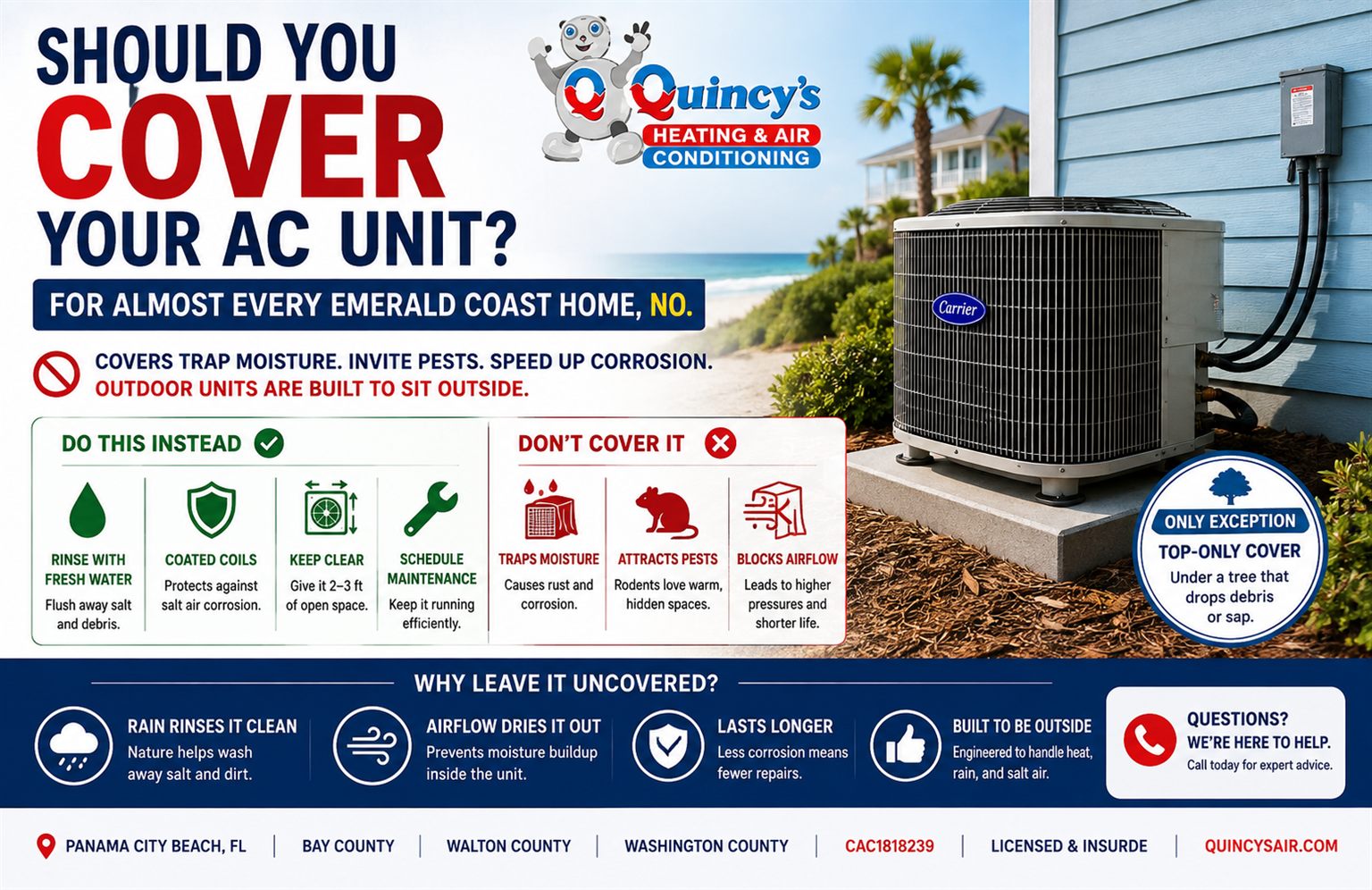
No, you should not cover your AC unit, and that goes for nearly every home on the Emerald Coast. A full wrap traps moisture against the coil and cabinet, which speeds up the exact salt corrosion you are trying to stop. It also builds a dry, sheltered nest for rodents. Outdoor units are built to sit outside.
We get asked this every fall, usually by somebody who moved down from Ohio and has covered the unit every October of their life. Reasonable habit up there. Down here it is actively harmful, and here is why.
- Do not wrap the unit. A sealed cover holds humidity and salt against bare metal for months.
- Covers are a rodent and insect invitation: warm, dry, hidden, and full of wiring to chew.
- A heat pump must never be covered, because it runs all winter and defrosts itself.
- The only defensible cover is breathable and top-only, under a tree that drops debris or sap.
- What works instead: fresh water rinsing, coated coils, clearance and maintenance.
- Should you cover your AC unit in winter?
- What covering an outdoor AC unit does
- Myths about AC covers, and the reality
- The exceptions: when a cover is fine
- Can you cover a heat pump in winter?
- Should you cover it before a hurricane?
- How to protect an AC unit from salt air
- What to do instead, step by step
Should you cover your AC unit in winter?
On the Emerald Coast, no. Winter here is not the winter that AC covers were invented for. Panama City Beach gets a handful of nights near freezing and no sustained snow or ice load. There is nothing for a cover to protect against.
The advice comes from northern climates, where a condenser can sit under two feet of snow for months. Even there, manufacturers do not require a cover. It is a habit, not an engineering requirement.
What we have instead is nine months of humidity, salt-laden air off the Gulf, and hard afternoon rain. In that climate an ac unit cover in winter keeps moisture in and airflow out for an entire season. Rain is not the enemy. Standing moisture is.
What covering an outdoor AC unit actually does
Three things go wrong, and they compound.
It traps moisture. Humid Gulf air still works in around the edges of any cover, but it cannot circulate enough to dry the coil. Every temperature swing lays fresh condensation on the fins, and that water carries chloride.
It concentrates salt. Salt arrives as fine airborne moisture and settles on anything within a mile or two of the water. Rain normally washes a good share of it off. Under a cover, rain is blocked but humidity is not, so salt builds up and stays wet. That is the worst case for aluminium fins and copper tubing, as our guide to how salt air destroys AC units explains.
It houses animals. A covered condenser is a warm, dry, roofed shelter in your yard. Mice, palmetto bugs and fire ants all agree it is good real estate, and a chewed low-voltage wire in April is a service call you did not need.
| Cover type | What it actually does | Verdict |
|---|---|---|
| Full vinyl or plastic wrap | Seals humidity and salt against the coil, blocks airflow, invites nesting | Do not use |
| Full "breathable" fabric cover | Dries slower than open air, still shelters rodents, hides corrosion from view | Not recommended |
| Top-only mesh or slatted screen | Sheds leaves, needles and sap while all four sides stay open | OK under a messy tree |
| Weighted plywood board on top | Blocks falling debris, sides fully open, easy to remove | OK short term |
| Full cover during construction | Keeps drywall dust, sawdust and overspray out of the fins | OK, remove before running |
| No cover at all | Rain rinses the cabinet, air dries the coil, animals stay out | Right for most homes |
Every acceptable option leaves the sides open. The moment a cover wraps the cabinet, it stops being protection and becomes a greenhouse.
Not sure what shape your outdoor unit is in?
Drop your number. We'll call back within minutes during business hours.
Myths about AC covers, and the reality
Most of these sound sensible, which is why they stick. Each one falls apart once you think about what humidity does inside an enclosed space.
| The myth | The reality | Do this instead |
|---|---|---|
| "A cover keeps salt off the coil" | Salt arrives as airborne moisture, gets under any cover, then cannot dry | Rinse the coil with fresh water |
| "A cover stops rust" | Trapped condensation on painted steel is the fastest way to rust a cabinet | Leave it open and draining |
| "A cover keeps leaves out" | True, and the one genuine benefit on this list | Use a top-only screen, not a wrap |
| "It will freeze without one" | Condensers are rated to sit through far worse than a Florida cold snap | Nothing |
| "It saves energy in winter" | No effect on a cooling-only AC. On a heat pump it is dangerous | Nothing |
| "It protects it in a hurricane" | Gusts strip covers off, and straps and fabric become airborne debris | Clear the yard, check the tie-downs |
The exceptions: when a cover is actually fine
Two situations make a cover defensible, and both are narrow.
1. Heavy debris or sap from directly overhead. Under a longleaf pine, live oak or sweetgum, a unit collects needles, acorns and sticky sap that will not rinse off. A breathable, top-only mesh screen or slatted lid is reasonable there. It shields the fan opening and nothing else, so all four sides stay open. Trimming the tree is the better fix.
2. Construction or renovation nearby. Drywall dust, concrete dust and paint overspray pack a coil solid, which is one of the few things worse than salt. Wrap the unit fully for the duration of the work, then take it off.
That last part is not optional. A condenser running with a cover on it starves for airflow, head pressure climbs, and the compressor pays.
- Never cover a unit that might run. One warm February afternoon is enough.
- Never cover the sides outside of a construction shutdown. Top-only, always.
- Never use a tarp or trash bags. No breathability, and they hold water in the folds.
Can you cover a heat pump in winter?
No. Never. This is the one people get wrong most often, and it is the one that costs real money.
A heat pump is not a summer appliance, it is your heating system. On a cold January night that outdoor unit is what warms the house, pulling heat out of the outside air, and it needs unrestricted airflow across the coil to do it.
It also runs a defrost cycle. In cool, damp weather frost forms on the outdoor coil and the system reverses to melt it off. That meltwater has to drain and the coil has to dry. Cover it and the ice gets worse each cycle, until the system trips on high pressure or slugs the compressor with liquid refrigerant.
From the driveway, a heat pump and a straight AC condenser look identical. Our comparison of a heat pump versus an air conditioner covers how to tell. Most newer systems around Panama City Beach are heat pumps.
| System type | Runs in winter? | Can it be covered? |
|---|---|---|
| Heat pump (most newer coastal homes) | Yes, it is the heat source | Never |
| Cooling-only AC with a furnace | No, outdoor unit idles | Top-only screen if under a tree |
| Ductless mini split outdoor unit | Usually yes, most do heating | Never |
Should you cover your AC unit before a hurricane?
No, and this one surprises people every June. The threat in a named storm is wind and flying debris, not rain, and a cover does nothing about either.
Covers strip off in the first gusts, leaving bungee cords and a sheet of vinyl loose in a 90 mph wind. If the cover does hold, the unit is a sail bolted to a concrete pad. Real storm prep looks like this:
- Clear the yard. Patio furniture, planters and umbrellas do the damage, not rain.
- Trim branches over the unit. A falling limb is the storm damage we see most.
- Check the pad and tie-down straps. Confirm yours are intact and not corroded through.
- Kill power at the breaker if flooding is possible. A submerged unit that was energized is a total loss far more often.
- Photograph the unit and the data plate. Model and serial numbers make a claim easier.
- Do not restart a flooded unit yourself. Have it inspected first.
If a storm does catch your system, have it looked at before you run it. We cover Panama City Beach and most of Bay County, and we reach about 95% of calls the same day. Details are on our AC repair service page.
How do you protect an AC unit from salt air?
This is the real question underneath the cover question. Nobody is attached to covers, people are worried about corrosion, and near the Gulf that worry is justified. You fight salt with water and metallurgy, not fabric.
Rinse the outdoor coil with fresh water, where it is accessible. A garden hose on gentle pressure, top to bottom, washes chloride off the fins before it pits the aluminium. Monthly if you are close to the water, quarterly further inland. Never a pressure washer, which folds the fins flat. Our guide to rinsing outdoor AC coils covers doing it safely.
Get the corrosion protection at the factory. Coated coils and coastal rated cabinets put a barrier between salt and metal from day one, which beats anything sprayed on later. Coastal coils are standard options within the selections we offer, and our piece on blue fin coil coating explains what it does.
Give it room to breathe. Two feet of clear space on all sides, five feet overhead. Shrubs crowding a condenser cause the same trapped-moisture problem as a cover.
| What to do | Why it works | How often | Cost |
|---|---|---|---|
| Rinse the coil with fresh water | Washes chloride off the fins before it pits the aluminium | Monthly within a mile of the Gulf | Free |
| Keep 2 feet of clearance | Airflow dries the cabinet and keeps head pressure down | Check each season | Free |
| Trim shrubs, clear debris | Stops leaves and needles packing into the fins | Twice a year | Free |
| Keep the pad level and draining | Standing water at the base is where rust-through starts | Check each season | Free |
| Coated coil or coastal cabinet | Barrier between salt and metal from day one | Chosen at install | Option at replacement |
| Professional maintenance | Catches pitted contactors and weak capacitors before August | Spring and fall | $292/yr single system |
| Leave it uncovered | Trapped moisture undoes every item above | Always | Free |
Maintenance matters more here than inland, because salt shortens the life of electrical contacts. Our maintenance plan is $292 a year for a single-system home and includes 10% off repairs. Each visit runs about 25 to 45 minutes per system.
What to do instead, step by step
If you were going to buy a cover this season, do this instead.
- Take off any cover that is on there now. Rust streaks, a nest or white powdery deposits mean it has been doing harm.
- Shut power off at the disconnect before you touch anything with water.
- Clear the debris out of the base and off the fins by hand.
- Rinse the coil with a garden hose, gentle pressure, top to bottom, all the way around.
- Cut back anything within two feet of the cabinet or hanging over it.
- Book the seasonal service in spring and fall, before the schedule fills.
That is the whole coastal playbook: unglamorous and nearly free. If you are in Panama City Beach, Bay County, South Walton or Washington County and want a unit looked at, call us. No hard sales.
Worried your outdoor unit is corroding?
We will look at the coil, the cabinet and the contacts, and tell you where it really stands. No hard sales.
📞 Call (850) 235-8834Frequently asked questions
Should you cover your AC unit in the winter?
For homes on the Emerald Coast, no. Panama City Beach gets a few near freezing nights and no sustained snow or ice load, so there is nothing for a cover to protect against. Outdoor condensers are built to sit outside year round, and a full cover traps humidity against the coil.
Can you cover a heat pump in winter?
No, never. A heat pump is your heating system, so it runs through the coldest weeks of the year and needs full airflow across the outdoor coil to pull heat from the air. It also runs defrost cycles. Covering it blocks airflow, traps meltwater and can damage the compressor.
Does covering an outdoor AC unit prevent salt air corrosion?
It makes corrosion worse. Salt on the coast travels as airborne moisture, so it gets under any cover and then has no way to dry out. Metal corrodes fastest when chloride sits on a wet surface for long stretches, which is exactly what a cover creates. Rinse with fresh water instead.
What kind of AC unit cover is actually safe to use?
Only a breathable, top-only cover: a mesh screen or slatted lid that shields the fan opening while leaving all four sides open. That is worth using if the unit sits under a pine, oak or sweetgum that drops debris or sap. Avoid anything vinyl or waterproof.
Should I cover my AC unit before a hurricane?
No. Wind, not water, is what damages an outdoor unit in a storm, and a cover strips off in gusts long before landfall. The straps and fabric then become flying debris. Better storm prep is clearing the yard, trimming branches above the unit and checking the tie-down straps.
How do I protect my outdoor AC unit from salt air without a cover?
Rinse the outdoor coil with fresh water where it is accessible, monthly if you are within about a mile of the Gulf. Keep roughly two feet of clear space on all sides so the cabinet dries. Choose factory coated coils when you replace, and keep up twice yearly maintenance.