
Why Beachfront AC Units Fail Faster in Panama City Beach
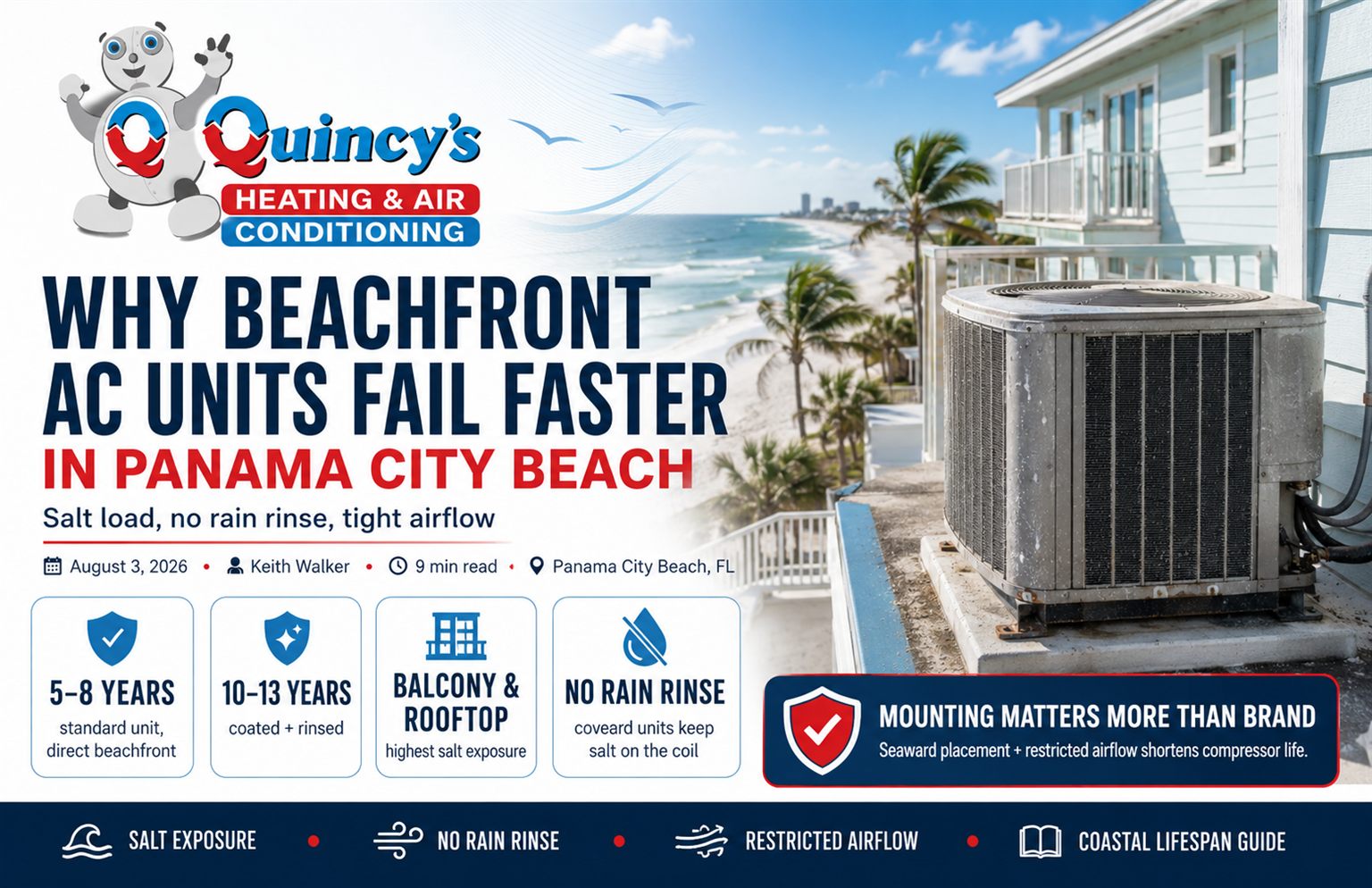
Beachfront AC units fail faster because they take a heavier, more constant salt load than inland equipment and almost never get rinsed clean by rain. Balcony, rooftop and seaward mounting puts the coil directly in the onshore wind, and tight enclosures choke airflow. Expect 5 to 8 years from a standard unit within a quarter mile of the Gulf.
This is not general salt air corrosion. It is about property type. Panama City Beach and 30A are full of condos and high rises where the equipment lives on a balcony, a roof, or the seaward wall.
- Mounting matters more than brand. A Gulf side balcony unit ages faster than the same model on the landward side.
- Rain never rinses a covered unit. Overhangs and balcony ceilings block the only free cleaning a coil gets.
- Direct beachfront equipment often lasts 5 to 8 years uncoated, and 10 to 13 years coated and rinsed.
- Tight rails and closets restrict airflow, which raises head pressure and shortens compressor life.
- In a condo, the building may control what you can install. Get the rules before you shop.
Why does a beachfront AC unit take more salt than an inland one?
Salt comes off the surf as spray, rides the wind, and drops out as it travels inland. The first few hundred feet take the heaviest dose by a wide margin.
A unit behind an inland house is shielded twice over: distance has stripped most of the salt out of the air, and the house blocks the wind. A beachfront unit gets neither favor. It sits in the same air that films your sliding glass door white every week.
Then there is direction. Onshore wind blows off the water for much of the year, so anything on the seaward face of a building stands in that stream all day. Anything on the landward side gets a real break, which is why two units in one building can be years apart in condition at the same age.
The chemistry is covered in our guide to how Gulf Coast salt air destroys AC units. What matters here is dose: same reaction, several times the exposure.
Why doesn't rain rinse the salt off a beachfront unit?
On an inland home, rain does real work. A unit out in the open gets flushed with fresh water dozens of times a year. That is free maintenance.
Beachfront equipment loses that entirely. A balcony unit sits under the balcony above it. Rooftop equipment sits behind a parapet. Side wall units live under a deep overhang. Rain blows past without touching the coil, while salt keeps arriving on the wind.
That is the most underrated cause of oceanfront HVAC corrosion. Salt accumulates layer on layer until the coil holds a chloride film that keeps working on the metal every humid night. Our walkthrough on rinsing outdoor AC coils safely covers the method, and on a covered unit that rinse is the only cleaning the coil ever gets.
What is a realistic coastal AC lifespan by distance from the Gulf?
Condo AC unit lifespan tracks distance from the water more tightly than it tracks brand or price.
| Distance from the Gulf | Exposure level | Standard outdoor unit | Coastal rated and rinsed | Recommended rinse |
|---|---|---|---|---|
| Direct beachfront, 0 to 500 ft | Severe | 5 to 8 years | 10 to 13 years | Every 2 to 4 weeks |
| 500 ft to a quarter mile | Heavy | 6 to 10 years | 12 to 15 years | Monthly |
| Quarter mile to 1 mile | Moderate to heavy | 8 to 12 years | 13 to 16 years | Every 4 to 8 weeks |
| 1 to 3 miles | Moderate | 10 to 14 years | 14 to 17 years | Quarterly |
| 3 to 5 miles, bay side or sheltered | Light | 12 to 15 years | 15 years or more | Twice a year |
| Over 5 miles inland | Minimal | 14 to 18 years | Little added benefit | At maintenance visits |
Representative ranges for Bay County and South Walton properties receiving regular maintenance. Results vary with mounting and rinse consistency.
Read those rows against your own address. In Panama City Beach on the Gulf side of Front Beach Road, you are in the top two rows. In Santa Rosa Beach north of 98, the bottom two.
Not sure how much life your coastal unit has left?
Drop your number. We'll call back within minutes during business hours.
Does it matter if the AC unit is on a balcony, a rooftop or the ground?
It matters a lot. Two units of the same model and year in one building can be five years apart in condition purely because of where they were bolted down.
An AC unit on a balcony is the harshest common placement here: high up where the wind carries more salt, on the open face of the building, under a ceiling that blocks rain, and crammed against a rail so it cannot breathe either.
Rooftop equipment is a close second: full wind, full sun, radiant heat off the deck, plus standing water where the pad has settled.
| Where the unit sits | Salt exposure | Main risk | Overall risk |
|---|---|---|---|
| Balcony, seaward side of a high rise | Severe | Direct spray, zero rain rinsing, tight clearance | Highest |
| Rooftop, unshielded | Severe | Wind driven salt, heat load, hard to service | Very high |
| Ground level, seaward side of the home | Heavy | Salt laden wind straight off the water | High |
| Balcony, landward side of the building | Moderate to heavy | Still no rain rinsing, better wind shelter | Medium high |
| Equipment closet or screened enclosure | Moderate | Recirculated hot air, restricted airflow | Medium |
| Ground level, sheltered inland lot | Light | Normal wear | Lowest |
If you have any say in placement on a new install, use it. Moving equipment from the Gulf face to the landward side buys years, not months.
Why does a balcony or equipment closet choke airflow?
An outdoor unit dumps heat into the air moving across its coil. Starve it of air and high side pressure climbs. That means a hotter compressor, higher amp draw, worse efficiency and a shorter life.
This compounds with corrosion. Salt fouled fins already restrict airflow. Put that coil inside a balcony enclosure with 6 inches of clearance and a solid rail in front of it, and the unit fights two restrictions at once.
Manufacturers publish minimum clearances for a reason. As a working rule, give the unit at least 12 to 24 inches on every side and 4 to 5 feet of open space above the fan discharge. Storage stacked around an equipment closet does what an overgrown hedge does inland. Long run times, a scorching hot outdoor unit and a breaker tripping on hot afternoons are the warning signs.
Why is high rise AC maintenance harder to get done?
The physics is the same. The logistics are not. Servicing rooftop and high rise equipment involves elevators, freight schedules, roof hatches, fall protection and an association that wants notice first.
So the equipment that needs service most gets it least. Nobody puts off a job on a unit in a driveway. People absolutely put off one needing a building engineer and a two week booking window.
A few things make it smoother:
- Water access. A hose bib within reach decides whether the coil ever gets rinsed. Many balconies have no spigot.
- Drain routing. Blocked drains on high rise air handlers flood ceilings two floors down.
- Access agreements. Know who holds the key and what hours the freight elevator runs.
- Clearance for a change out. If the unit came in before a wall was built, plan how the next one gets in.
Our technicians spend 25 to 45 minutes on site per system, and the outdoor coil is washed with water if it is accessible. On beachfront property, "if it is accessible" is the whole ballgame. Our coastal AC maintenance guide for Panama City Beach covers what a real visit checks.
What makes AC replacement complicated in a condo?
In a single family home, replacement is a conversation between you and your contractor. In a tower it can involve the association, the building engineer and sometimes a shared system you do not control.
Three situations come up constantly here:
- Your own split system, your own balcony. You still need approval for access, work hours and hoisting, but the specification is yours.
- Shared infrastructure. A common water loop, shared riser or central chiller limits what you can install, because your equipment has to match the building. The association usually names the model.
- Roof mounted equipment. Even when the unit serves only your condo, the roof is common property. Expect rules on penetrations, curbs, crane use and the membrane warranty.
Ask for the rules in writing before you get attached to a piece of equipment: who owns the outdoor unit, what models are approved, and what hours work is permitted in season.
One more thing catches owners out. Rental heavy buildings often restrict work during peak weeks, so a July failure can mean waiting. That is the best argument for replacing coastal equipment on your schedule.
What actually helps a beachfront unit, and what does not
| Action | Does it help? | Why |
|---|---|---|
| Fresh water rinse on a schedule | Yes, biggest lever | Removes chloride before it can sit and work on the metal |
| Factory applied coastal coil coating | Yes | Covers the full fin surface and tube joints before assembly |
| Keeping full manufacturer clearance | Yes | Lower head pressure, cooler compressor, longer life |
| Landward or sheltered placement | Yes, when possible | Cuts the salt dose more than any product does |
| Twice yearly professional maintenance | Yes | Catches pitted contactors and weak capacitors early |
| Aftermarket spray coating on a corroded coil | Marginal | Seals existing contamination in rather than keeping salt out |
| Vinyl cover left on during the season | No, harmful | Traps moisture against the coil and blocks airflow |
Read our breakdown of blue fin and E-coated coastal coils before you spend money on a spray job. Coastal coils are standard options within the selections we offer, so on a beachfront replacement it is a specification conversation, not a special order hunt.
A rinse routine that actually gets done
- Kill the power at the disconnect or the breaker before anything gets wet.
- Clear the debris and check clearance on all sides.
- Rinse with a garden hose at normal household pressure. Never a pressure washer. Work inside out where the coil is reachable, top down where it is not.
- Flush the base so salty runoff drains away instead of pooling under the unit.
- Restore power and confirm the fan runs clean and quiet.
Set a repeating reminder using the schedule in the first table. Every 2 to 4 weeks sounds like a lot until you price replacing a condenser three years early.
Is the extra maintenance worth it on a coastal condo?
Run the arithmetic rather than the feelings. A replacement outdoor unit is a four figure job on this coast. If rinsing and twice yearly service move a beachfront unit from 7 years to 11, that is thousands of dollars deferred on a system you already own.
Our maintenance plan starts at $292 a year for a single system home and includes 10% off repairs. On beachfront property that is not an upsell, it is arithmetic.
When the unit is done, spec the replacement for where it actually lives: a coastal rated coil, proper clearance, and placement chosen for shelter rather than convenience. Our new AC installation page covers what a correct install includes, including a safety switch on every install and a Manual J load calculation performed when necessary.
Beachfront or high rise system you are unsure about?
We will tell you what condition it is in and how much life is left. No hard sales.
📞 Call (850) 235-8834Frequently asked questions
Why do beachfront AC units fail faster than inland ones?
A beachfront unit sits in salt laden onshore wind most of the year, so it collects chloride far faster than a unit tucked behind an inland house. Building overhangs, balcony ceilings and rooftop parapets then block the rain that would rinse it off. Constant deposition plus no rinsing corrodes fins, cabinets and electrical contacts years early.
What is a realistic condo AC unit lifespan in Panama City Beach?
On direct beachfront property, a standard uncoated outdoor unit often lasts 5 to 8 years, and a coated coastal unit that gets rinsed usually reaches 10 to 13 years. A quarter mile back, standard equipment runs 8 to 12 years. Bay side and sheltered condos reach 12 to 15 years. Mounting matters more than brand.
Is it bad to have an AC unit on a balcony?
It is workable, but it is the harshest common mounting on the coast. A balcony puts the coil in undiluted onshore wind, under a ceiling that blocks rain, and usually inside a rail that restricts airflow. Restricted airflow raises head pressure and shortens compressor life. Keep full clearance and rinse often.
How often should an oceanfront AC unit be rinsed?
Direct beachfront equipment benefits from a plain fresh water rinse every 2 to 4 weeks in the warm months. A quarter mile to a mile back, monthly to every other month is reasonable. Past 3 miles, quarterly is usually enough. Use a garden hose at normal household pressure, never a pressure washer.
Can I replace just my condo AC unit, or does the building have to approve it?
It depends on what the association controls. If your equipment sits on your own balcony and connects to nothing shared, you usually need approval only for access, hoisting and work hours. If the building runs a shared water loop, a common riser or roof mounted equipment, the association controls the specification.
Does a coastal coil coating actually extend the life of a high rise unit?
Yes, when it is applied at the factory before assembly. A factory coating covers the full fin surface and the tube joints, which is where corrosion starts. On the coast it commonly buys several extra years over a bare coil. Aftermarket spray on a coil that is already pitted does much less.